
The fish house
The carcass of the Nantucket Restaurant lies at water’s edge on the northwest corner of Crockett.
The Nantucket was a local seafood joint, one of those simple, honest, unpretentious places that offered an easy atmosphere, neighborly service and a good meal at a fair price. The best thing on the menu was the battered, deep fried captains platter with French fries and the common veggie medley of broccoli, cauliflower and carrots.
The platter included prawns, scallops, calamari, clam strips and cod, and plenty of it. The fries were pedestrian but the chef managed to get the veggie medley just right, firm and full of color.
Back in the day, a veggie medley was ladled out of an icky smelling vat. The vegetables had lost their color, unless you consider gray a vegetable color, and the texture was somewhere between mealy and mush. At some point in culinary time cooks learned that vegetables were best cooked to a sort of al dente, that broccoli should be bright green and, like other things in life, cauliflower can be more satisfying when it’s stiff rather than limp.
If deep fried wasn’t your deal there was always grilled fish or steak, or one of a variety of seafood pasta dishes. And don’t forget the chowder with a little packet of oyster crackers on the side.
The Nantucket was unpretentious, the everybody knows the waitresses and bartender place, appointed with the maritime kitsch that’s mandatory for a fish house. The dining room was decorated with paintings of ships and ocean scenes and depictions of old salt, seafarers; wizened ancients wearing watch caps or slickers and invariably sucking on a pipe.
We’d sit on the outdoor deck, at picnic tables painted a bright white, and covered with blue and white checked tablecloths. From here we’d watch the ship traffic, oil tankers mostly. The inbound ships headed east to the refineries on Suisun Bay were empty and rode high in the water. Once laden, the ships would lowride back through the Carquinez Strait, through the San Pablo and San Francisco Bays and finally out to sea.
The bright, fresh air of the outside dining deck was interrupted by the smell of frying fish and filled with the sounds of squawking gulls and the slooshing of fishing boats bobbing at the adjacent pier. The restaurant was located yards from the railroad tracks and the occasional freight would shake the restaurant and disturb the peace. But that was okay, it was part of the ambience.
It’s been years since I’ve been at that waterfront. I guess the last time was when I stopped on the way back home from somewhere east of home, to have a martini and a plate of fried calamari.
“We are sad to inform our loyal customers but the Nantucket Restaurant will be closing permanently Sunday, February 17, 2019,” read the restaurant’s farewell message. “Thank you for your continued patronage.”
The lease was up, the owner was 81 and I guess he’d had enough of the restaurant biz.
The site had been home to a restaurant since 1928, the first one named Dowrelio’s. Ninety-one years later there were no takers. The location was a mixture of good and bad; the good being a spot right on the water’s edge, decorated with piers and fishing boats. The bad was that the place wasn’t easy to find; down a dark winding road, past a graveyard of old shipping containers and into a cratered, dirt and graveled parking lot. For the newcomer it could look downright sketchy.
There’s not much left of that section of waterfront that’s worth anything. Even the bright view has vacated the place. In August of 2020 a fire took out the restaurant and most of the piers. What was left of the restaurant has been covered over with a sarcophagus of blue stucco and plywood, graffiti scarred and forlorn.
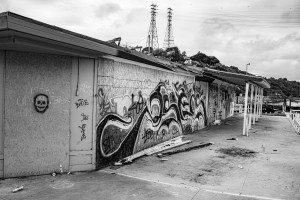
The remains of The Nantucket Restaurant. The skull marks the place where the hostess greeted diners.









 The Life in My Years