“Oh wow, that’s so surreal man.”
How often did I utter that in another time, in another life, in another reality. Times when I dabbled in herbal, uhh, curatives. Times when I was probably listening to The Jefferson Airplane. “ When the men on the chessboard Get up and tell you where to go..”
Hey man, the chessboard. so surreal?
Now that I’m a bit too old and wise for that sort of activity I like to find my surrealism through other avenues.
And so last Saturday I was browsing the photography sites and found Tracy’s, Reflections of an Untidy Mind (Great title. Wish I’d thought of it).
Tracy is the host this week of the Lens Artists Photo Challenge and she chose the topic surreal. My first reaction was, “I don’t think I’ve got anything to fit that topic.”
After a little browsing through the archives and some noodling around with Photoshop I stumbled onto a few possibilities.
Can anyone guess what the banner photo is an image of? (Answer at the end of this post).
Photoshop has an editing feature called HDR (High Dynamic Range) toning. I’m not going to go into the nuts and bolts of it because, well, I’m only slightly versed in a few of the nuts and none of the bolts.
Conveniently enough though, the HDR menu contains a selection called surreal, which I used to edit a photo of a daisy.
“Flyover country.” It’s the pejorative heaped on anyplace that isn’t within a day’s drive of America’s two coastlines.
As someone who lives in the San Francisco Bay Area, I suppose that I’ve used the term with disdain when talking about the Midwest, as have my grandiose kinsmen from the shores of the east and west. I couldn’t say for sure but my guess is that residents of “flyover” states respond to “flyover country” with a middle finger and a ‘just keep flying over.’
How does the story go?
Midwesterners are proud, patriotic and pious. Hardy folk, mostly white and mainly conservative, born of hardy European stock who emigrated from hardy European countries. They’re described as being anything between friendly and suspicious and they have a particular dislike and distrust of so-called “elites” from the New York’s and San Francisco’s.
Indeed, in 2008, then presidential candidate Barack Obama was caught delivering the standard fare at a fundraiser, “And it’s not surprising then they get bitter, they cling to guns or religion or antipathy toward people who aren’t like them or anti-immigrant sentiment or anti-trade sentiment as a way to explain their frustrations.”
Obama was talking specifically about ” these small towns in Pennsylvania,” but his faux pas raised the ire and suspicions of much of Middle America. To add an enhancement to the crime, Obama was caught making the remark in San Francisco – yeah, elite central. It seemed like a self-fulfilling prophesy for both the “elites” and the “flyover” folk.
And so here I am, with a pandemic still in full flower, just landed in Omaha, smack in the middle of “flyover country,” on day one of over thirty more, driving through landlocked America. I’ve arrived to either validate or debunk, at least in my own mind, all of the notions about “flyover country.”
August 1st, 1804; A clear and fair dawn has greeted the Lewis and Clark Expedition. The party is camped on the western shore of the Missouri River, after having arrived the day before. The forty-four members of the expedition are unaware that their little camp will one day be a city of 843,000 – Omaha, Nebraska.
But for a smattering of earlier arrivals, mostly French and British fur traders, the expedition represents the first white men to arrive at this eastern edge of America’s Great Plains, an expanse of rich, verdant grassland encompassing over one million square miles.
Lewis and Clark have been exploring a pristine paradise, a veritable garden of Eden, where a bounty of food is available for the taking and one need only kneel by the river’s edge to taste pure clean water.
On this first day of the month, in celebration of his thirty-fourth birthday, William Clark dines on venison, elk and beaver tail, followed by a dessert of cherries, plums, raspberries, currants and grapes.
In his diary Clark notes, “What a field for a Botents [botanist] and a natirless [naturalist].”
In two days, Lewis and Clark intend to hold a council with representatives of two indigenous tribes, the Oto and the Missouri and so the captains have christened this camp, Council Bluffs.
Dawn breaks foggy on August 3rd but by 9 AM the fog has burned off and an hour later the emissaries from the two tribes arrive for the meeting.
In the condescending manner that would come to characterize White America’s negotiations with America’s original residents, Lewis begins by addressing the native representatives as “children,” and referring to President Thomas Jefferson as “the great father.”
“Children,” begins Clark, “your only father; he is the only friend to whom you can now look for protection, or from whom you can ask favors, or receive good councils, and he will take care to serve you and not deceive you.”
When done dangling the carrot, Lewis unveils the stick, warning that “one false step would bring upon your nation the displeasure of your great father, who could consume you as the fire consumes the great plains.”
The carrot would turn out to be a deceit, and the stick would be a promise fulfilled.
Were the Native Americans at that council realizing the beginning of the end of paradise, while Lewis and Clark were envisioning “progress?”
Twenty-one years later, Jean Pierre Cabane established a trading post on the site of the future Nebraska city.
During the bitter winters of 1846-47 and 1847-48, more than 600 Mormon pioneers headed for Utah, perished near this site, from exposure, disease, starvation and scurvy.
Less than ten years later, the city of Omaha was established.
Paradise was losing. Certainly the rape of Eden was made inevitable when the Mayflower dropped anchor, 184 years before Lewis and Clark made camp at Council Bluffs.
I wonder if we would call those Midwest states “flyover country” if American Manifest Destiny had, by some miracle, spared the great grasslands and plains, left untouched the oceans of grass and the palettes of wildflowers and allowed the vast herds to roam unmolested.
“We stood by and allowed what happened to the Great Plains a century ago, the destruction of one of the ecological wonders of the world. In modern America, we need to see this with clear eyes, and soberly, so that we understand well that the flyover country of our own time derives much of its forgettability from being a slate wiped almost clean of its original figures.”
~ Dan Flores, American Serengeti: The Last Big Animals of the Great Plains
Two hundred and seventeen years after Lewis and Clark: It’s 5:43 in the afternoon of September 10th 2021, and Omaha’s Eppley Airfield is as far from being paradise as anything could be.
To step outside of the air conditioned coolness of the terminal is to take a punch from the heat; steamy, sticky and stifling.
The gate agent announces the boarding sequence; special needs passengers, military, first class, and economy.
Walking past the proletariat towards the jetway and my first class seat I could almost feel their mixture of envy and hatred. Settled in my seat I feel the pain of the passengers filing past and back to damnation.
In truth, this will only be my second time flying first class, so I’m well acquainted with economy, the search for overhead space and squeezing into a seat. I know what it’s like having someone’s seat back in my lap and feeling my own seat back yanked from behind as a fellow passenger steadies himself while he shoe horns his way into his own seat in back of mine.
The previous time I flew first class Cora and I were returning from Richmond, Virginia and I had to be at work the next day. No day of decompression. From two weeks away from work, straight back to the office to face 500 emails, whatever work my office back up decided she didn’t feel like doing, and an ass chewing from my boss for having the audacity to take time away.
I decided to liquidate damn nearly every American Airlines mile I had and upgrade to first class.
I’m flying first class this time because COVID isn’t done yet and I’d like to have as much space between me and the rest of the public as possible.
That and the fact that the first class price wasn’t much more than economy.
A chapter in an occasional series of posts documenting an autumn 2021 road trip through the Midwest.
September 10, 2021
I’m relaxing, if relaxation is actually possible, in the Delta Airlines boarding area at Oakland International Airport, known in airport-speak as simply, OAK.
At the airport, relaxation is an earned and short lived luxury. There’s a gauntlet to get through before you can put your feet up and read, or take the edge off with an overpriced, undersized cocktail in which the main ingredient, the one that takes the edge off, is often metered by an infernal invention called the precision pour. Bartenders at the airport lounge are not usually given any license to be generous, a constraint cursed by thirsty travelers, cherished by harried flight attendants, and let’s be honest, born of reasonable common sense.
Given COVID’s flighty, on again, off again nature and the dearth of pilots, attendants and every other body charged with getting an airliner in the air and safely back on the ground, a short lived airport stopover can, in the click on an airline app notification, become a protracted, patience sucking ordeal. Update. Flight 3456 scheduled out of OAK at 0800 has been canceled. You have been automatically rebooked on flight 6789 which is scheduled to depart OAK at 18:10. We’re sorry for the inconvenience. Thank you for choosing our airline.
Banner photo. The Downtown skyline taken from The Embarcadero.
If you ever have the opportunity to ramble the city sidewalks (assuming you have a city that’s handy ), look around you. No, not for muggers. Okay, yeah always keep an eye out for sketchy fellow citizens, but also keep your eyes open for the varied patterns.
The city is alive with geometry; a plethora of squares, rectangles, triangles, circles and cylinders. And if precise angles don’t move you there’s plenty of the shapeless, and the precilelessly planned amorphous.
And by all means look up.
I visited the Financial District one Sunday morning, specifically on Sunday, because on a Sunday the Financial is essentially closed and as devoid of people as downtown small town America. That might be the only thing that tiny Pocahontas, Iowa and San Francisco’s Financial have in common. On a Sunday morning you can fire a cannon down the middle of the street and not hit a thing.
Forsaken streets make it all the easier to photograph the architecture without the intrusion of photo bombing humans.
Standing on a plaza between Market and Mission Streets I noticed four highrise buildings separated by three city blocks. With a little imagination you can almost see it as one building composed of four designs. (Okay, maybe a lot of imagination).
From the plaza I walked up a flight of stairs and when I looked down, the pavement looked as if it had been laid unevenly, complete with uniform folds.
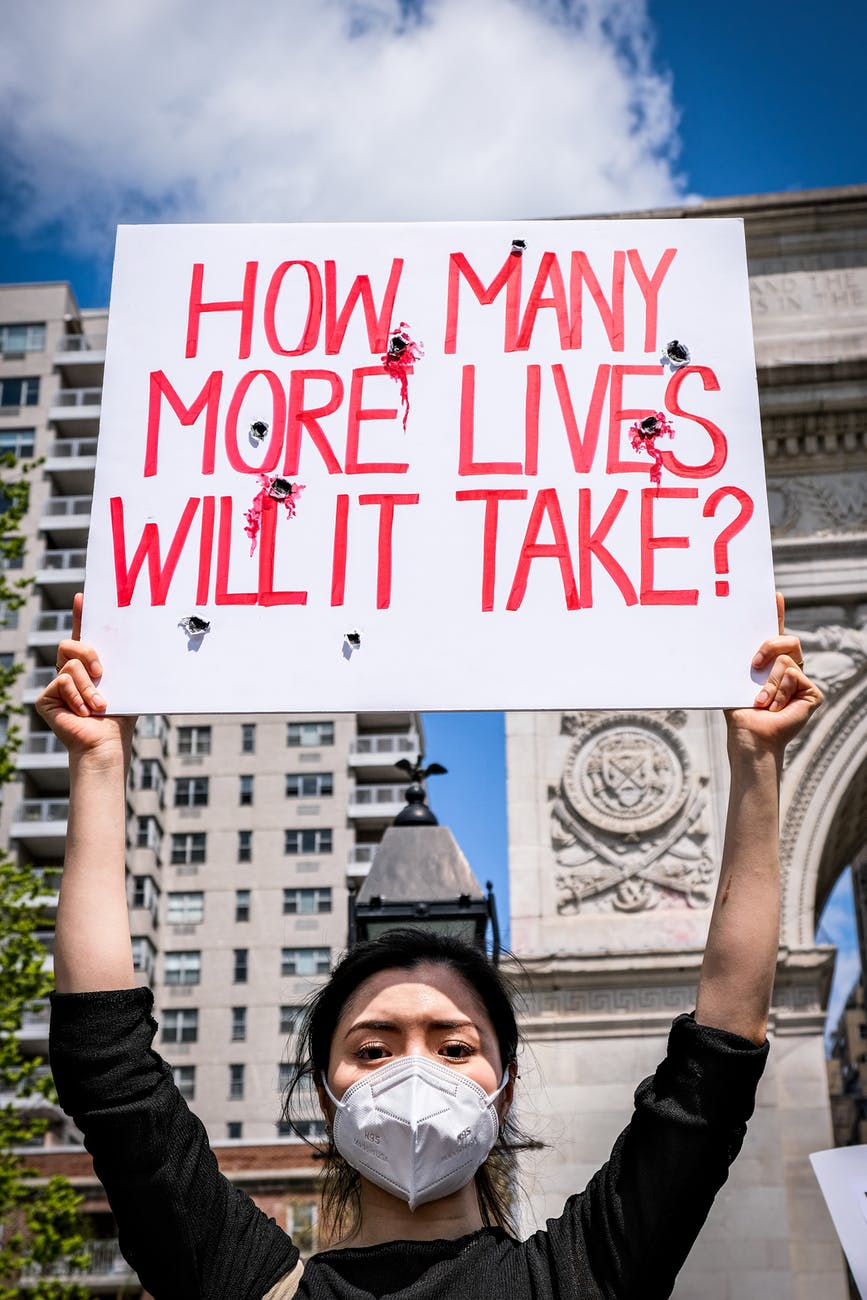
How many more lives will it take? Well that’s a damn good question. Answers? Anybody? Helloooo!
To the surprise of absolutely no one, another American town has adopted the slogan “_______(fill in the town name) strong.”
This time it’s Highland Park, Illinois, where, to the surprise of absolutely no one, a mass shooting occurred. In America, mass shootings occur to the surprise of absolutely no one. The only surprise is the actual location.
Hey a mass shooting! Coming soon to a town near you!
Are you, the reader, surprised to hear the news of another mass shooting?
Are you, the reader, surprised to see that I’m writing another post on another mass shooting?
You know, I sort of promised that I wouldn’t do this gun shit anymore.
But the gun shit in America keeps happening.
And so, here I am writing about the gun shit in America – again.
Damn, I’m just incorrigible. That’s what my wife tells me.
Why? Why keep writing shit about gun shit?
That’s a good question. These gun posts really must be off putting to the readers who prefer family stories, travel pieces and photo essays. Those folks are abandoning my ship.
And still I persist.
I persist because I’m pissed.
And I’m lost.
Lost in questions.
Questions, questions, questions.
And very few answers.
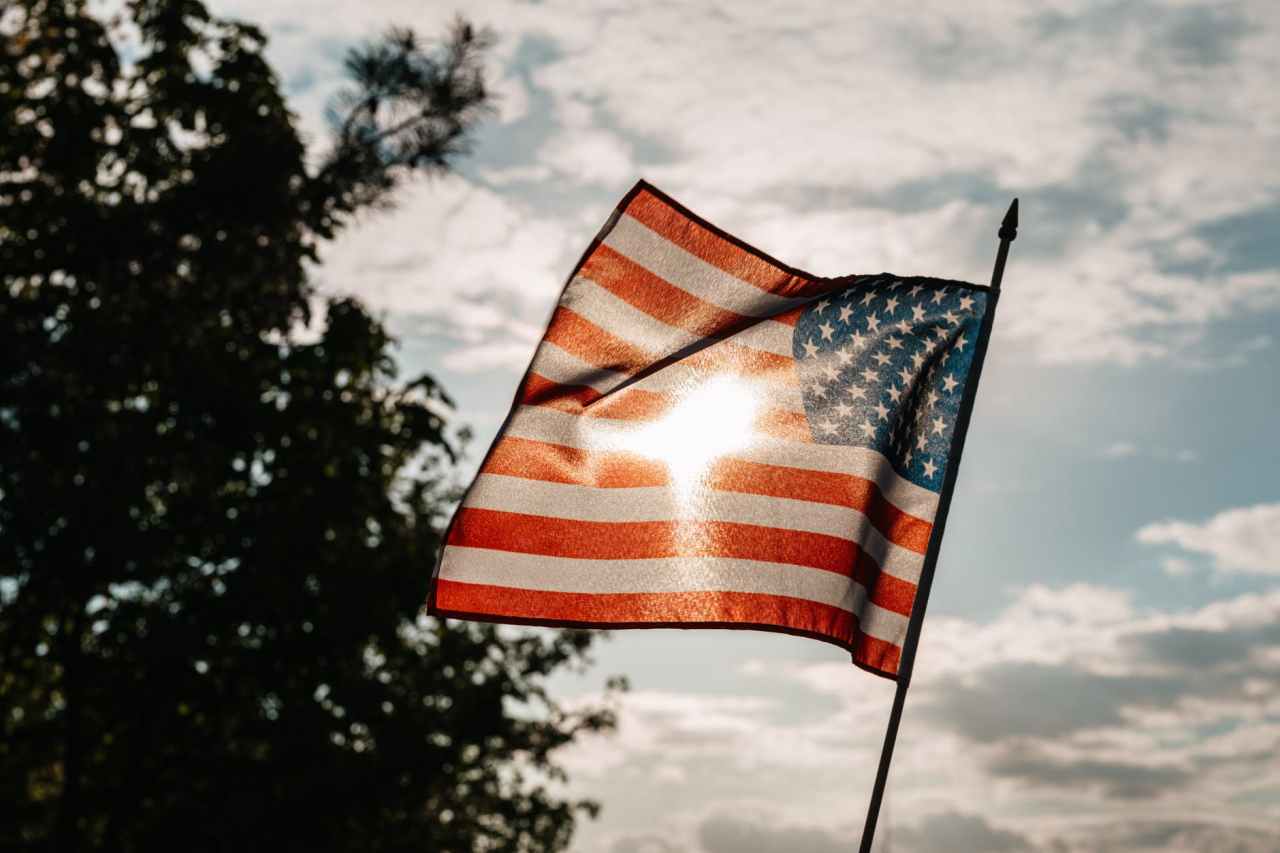
A few days ago my friend and fellow blogger Martin C. Fredricks IV, wrote a piece titled Declaring “Loss of Independence Day,” (click the link), in which he explains why he won’t be flying the American flag this July 4th – Independence Day.
Martin writes, “We can no longer, honestly or in good conscience, celebrate an “Independence Day” when all meaning of those words has been stripped from the lives of millions of our fellow citizens. It’s false. Empty. A sham. A lie that must taste like oil-soaked dirt in the mouths of women.”
I’ve been having the same internal argument with myself. Do I put out the flag on the Fourth?
Recent events, including outrageous decisions coming down from The Supreme Court, stunning revelations from the January 6th Committee hearings, a general nod and wink to white supremacists, and new laws in various states that come straight from an authoritarian playbook, are evidence of a democracy adrift and heading dangerously close to autocratic shoals.
I’ve had to ask myself, what exactly are we celebrating this year? What have we had to celebrate during the past five Independence Days? Abrogating rights? Perverting democracy? General baseness? Is this what we fly the flag to commemorate on Independence Day?
I almost never visit a cemetery, but I can’t pass up a forsaken, decaying old graveyard or boneyard.
What’s the difference you ask? Three different words that all seemingly mean the same thing.
Merriam-Webster defines them all succinctly as “a burial ground.” That’s far too simple. A graveyard can be a cemetery, but a cemetery cannot, unless through the work of time and vandals, be a graveyard.
West of here in Richmond, just up the interstate, there’s a cemetery called Rolling Hills, and it’s just as the name describes; rolling, grassy hills, so green and well manicured that it could be a golf course (that is if you flatten it out, take away all the gravestones and add a fancy bar). The gravestones and burial sites are neat and well maintained and it’s run under a boilerplate of do’s and don’ts that read like some sort of eternal homeowner’s association. Unless you’re there to pay a former someone a visit it’s a rather bland, depressing place – charnel white bread.
Off to the east, in Benicia, is a graveyard, the Benicia City Cemetery (because no community actually names its final resting place a graveyard). Like many final resting places whether it’s a cemetery, or a boneyard or “boot hill,” the Benicia City Cemetery sits on high ground, with a pleasant view of the Carquinez Straits, the waterway which connects the San Francisco Bay and the Sacramento River.
Except for a small new section that has groomed lawns, the Benicia Cemetery is rolling hills of dirt, littered with weeds and debris from trees. Old gravestones, some cracked, some toppled, some half buried and others just crumbled piles of stone. That’s a graveyard.
A boneyard? You probably have to resort to a Stephen King novel to find a boneyard.
I usually stumble on graveyards during a road trip.
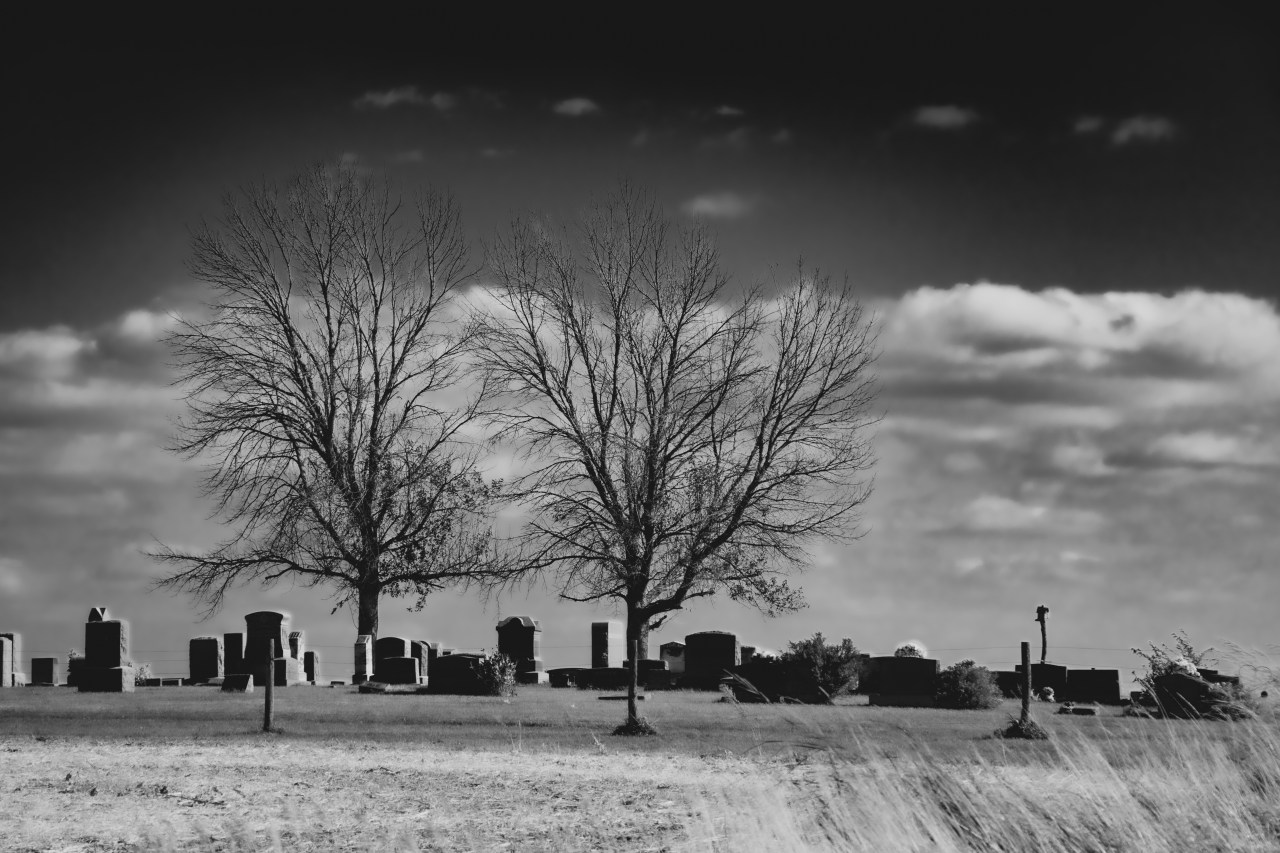
I was in Madison County, Iowa when I spotted a sign for Young Cemetery. The sign pointed up a short single lane side road. I took the road and parked. It was more cemetery than graveyard so I didn’t stay long. On my way back towards the main road I looked in the rear view mirror and saw a haunting scene; wispy, wind blown grasses, two bare, stark trees and the silhouettes of headstones. I suppose that from a distance and under the right conditions, Young Cemetery can pass as a graveyard.
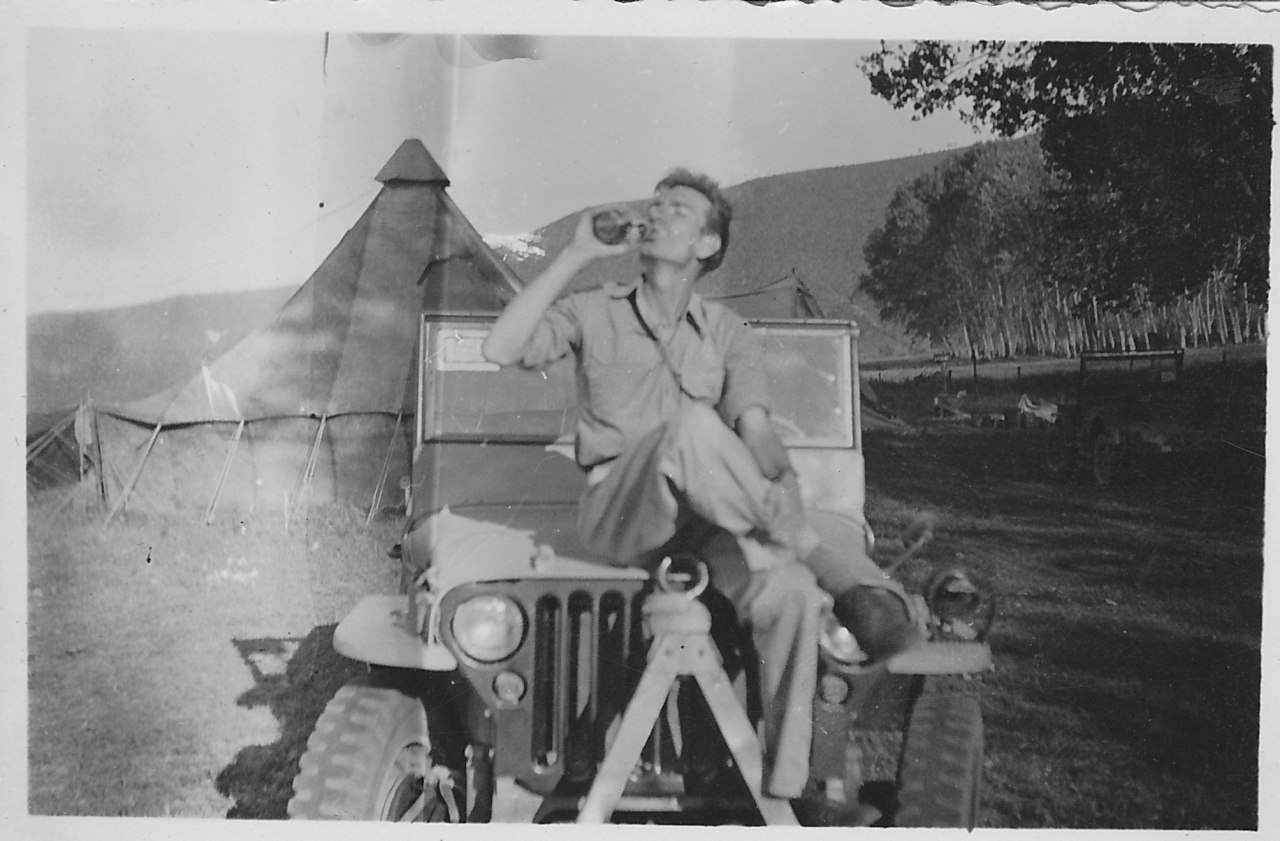
Banner photo. Dad having a cold one. North Africa? Italy?
Hey dad. When you were a youth, did you ever wonder what kind of father you might be? You were at loose ends during most of your twenties. Did you even entertain the prospect of fatherhood?
You had a lot of time to run those thoughts around in your head. You were 36 when I was born. Mom was 30.
You couldn’t have realized it at the time, but when I was born you’d already lived nearly half your life, the final few years tormented by dementia. Knowing you, hell knowing anybody with a thimbleful of reason, if you’d been aware of what was coming down your street you’d have likely figured out a way to check out early, before the demon came a knockin’. I know I would’ve.
You came from Toole, Utah, a mining town that would’ve rested in the shadow of Salt Lake City, except that when you were born, in 1917, there wasn’t enough of Salt Lake City to cast a shadow.
By your late twenties, Salt Lake City was the biggest thing you’d ever seen and the furthest you’d been from Toole was Coeur d’alene, Idaho, where you did a stint with the Civilian Conservation Corps.
That all changed in 1944, when you joined the millions of men who shipped out, either west to the Pacific, or east to Europe to fight the last of the “good wars.”
Your wartime journey took you through Chicago, New York, London, North Africa, and the boot of Italy. The war was winding down in Rome when you arrived and met your future bride. I can only imagine your wide eyed culture shock.
It seems implausible, a young man, green as grass, from a desert mining town hooking up with a Roman girl.
There were times, many times, when the two of you seemed mismatched. It strikes me that maybe you met at a time in your lives when you saw yourselves without prospects and just settled. Continue reading
Anne Sandler hosts this week’s Lens Artists Challenge and has chosen the topic, Local Vistas.
I live in Hercules, California, between a range of hills (and the rest of America) to the east and San Francisco to the west.
Hercules is what you might call bland suburbia. Strip malls, tract housing and a city council’s yearning to be something other than a bedroom community.
That said, there’s much to be found by taking just a short drive.
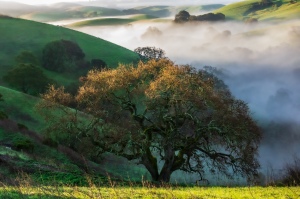
At sunrise, the East Bay Hills might be adorned with eddies of morning fog.
San Francisco is about thirty minutes away on a good day – okay, a REALLY good day.
On the way you pass by Emeryville and its little marina. I’m a long time distance runner and my favorite boat is berthed here – Endurance.
The drive into The City goes past the busy Port of Oakland which handles 99% of the containers that move through Northern California. On average, 2.5 million containers pass through the port every year.
Parks and trails in the area afford interesting views of the bay and the port operations.
A stack of containers at the Port of Oakland
Cranes at the port resemble something out of War of the Worlds













 The Life in My Years