
An eight day trip to New York City in four posts.
Note: I hadn’t originally meant for this to be the first in the series of four, but the timing of the anniversary compelled me to change my original idea.
The 9/11 Memorial and Museum
Why are we drawn to the places that break our hearts, the sites that remind us of man’s capacity for inhumanity?
I’ve personally seen plenty, and each time I’ve felt the same sorrow and I’ve always asked the same rhetorical why. I’ve stood on Cemetery Ridge at Gettysburg, looked down on the Sunken Road at Antietam, and wondered at the brutality at the Bloody Angle at Spotsylvania. I’ve walked the battlegrounds and war torn villages of Normandy. I’ve seen the homes of the enslaved on the grounds of southern plantations. I’ve stood inside of the Schindler Factory, walked the grounds of Auschwitz in Poland, and seen the mountain of abandoned shoes in the Holocaust Museum in Washington D.C. I’ve touched the ebony wall of the Vietnam Memorial in the nation’s capitol. And then there’s the countless square miles of cemeteries; Gettysburg, Fredericksburg, Appomattox Courthouse, Arlington, the San Francisco Presidio, and Omaha Beach.
We’ve just arrived in New York City, settled into the hotel and unpacked the immediate necessities – the phone chargers. We’d flown economy so naturally that groaning, creaking sound filling the room is our stomachs, reminding us that they would like some attention – stat.
Before we left for the trip we had already decided to check off one of our must do boxes and get dinner from one of the many halal carts that populate Manhattan. A highly rated one is about a 10 minute walk from the hotel.
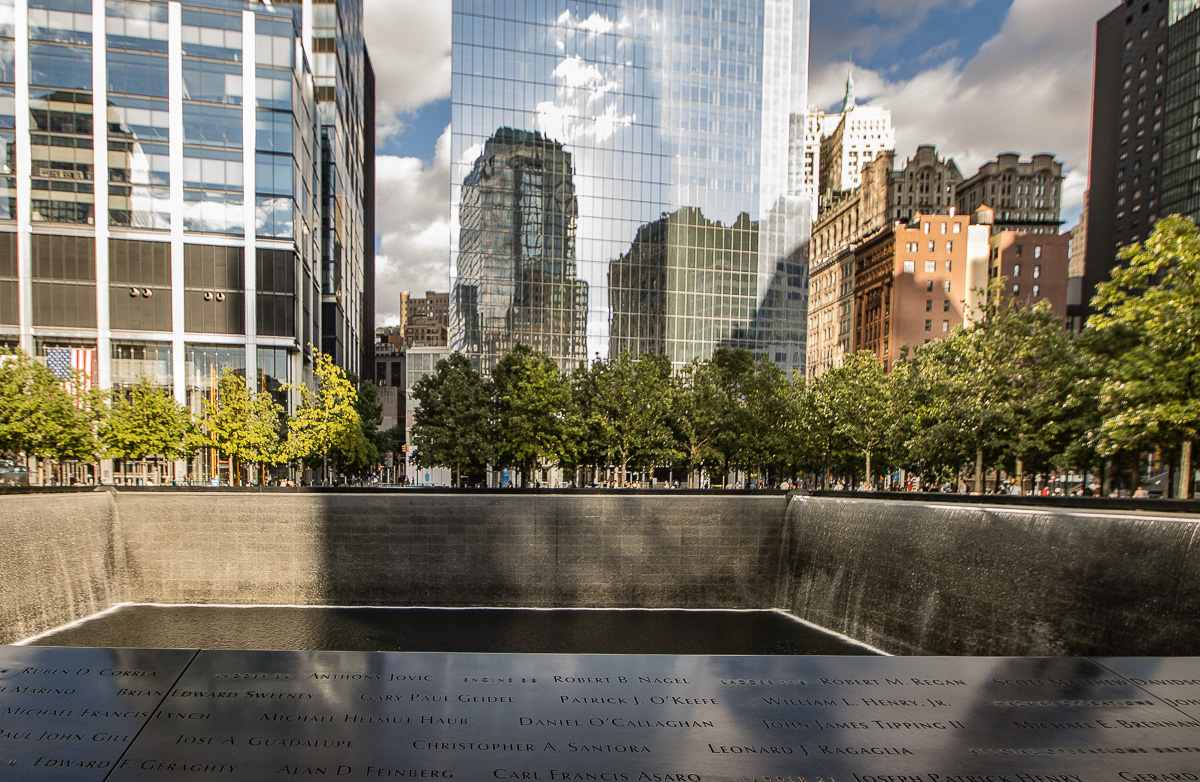
Google guides us along some sidewalks and then send us across a wide park. We don’t realize where we are until we’re looking into a yawning square hole into which a perpetual waterfall is pouring on all sides.
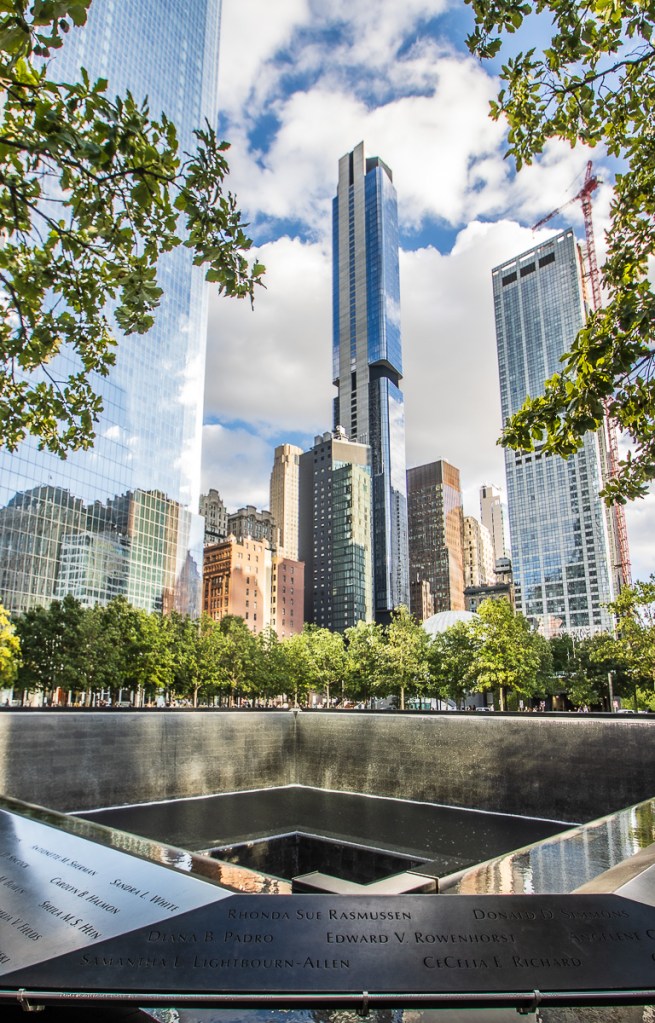
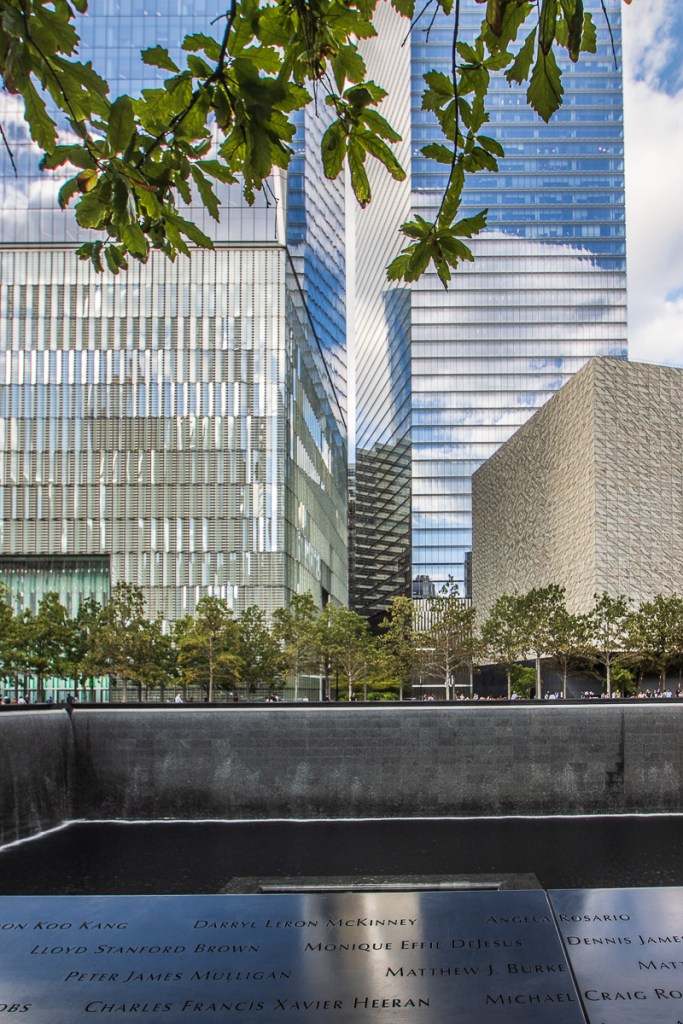
We’re peering into the footprint of what once was a 1,362 foot tall skyscraper – the South Tower of the World Trade Center. Along all four sides of the pool there is a parapet with panels that bear the inscriptions of those who perished in the South Tower, and on Flights 175, 77, 93, and at the Pentagon.
It would seem reasonable that the names would be arranged alphabetically. But this isn’t a place to be guided by strict cold logic. The designers had a different, more meaningful approach in mind. The names on the plaques are arranged by “meaningful adjacencies,” described in the website as “where they were at the time of their death and what personal relationships they shared with other victims.”
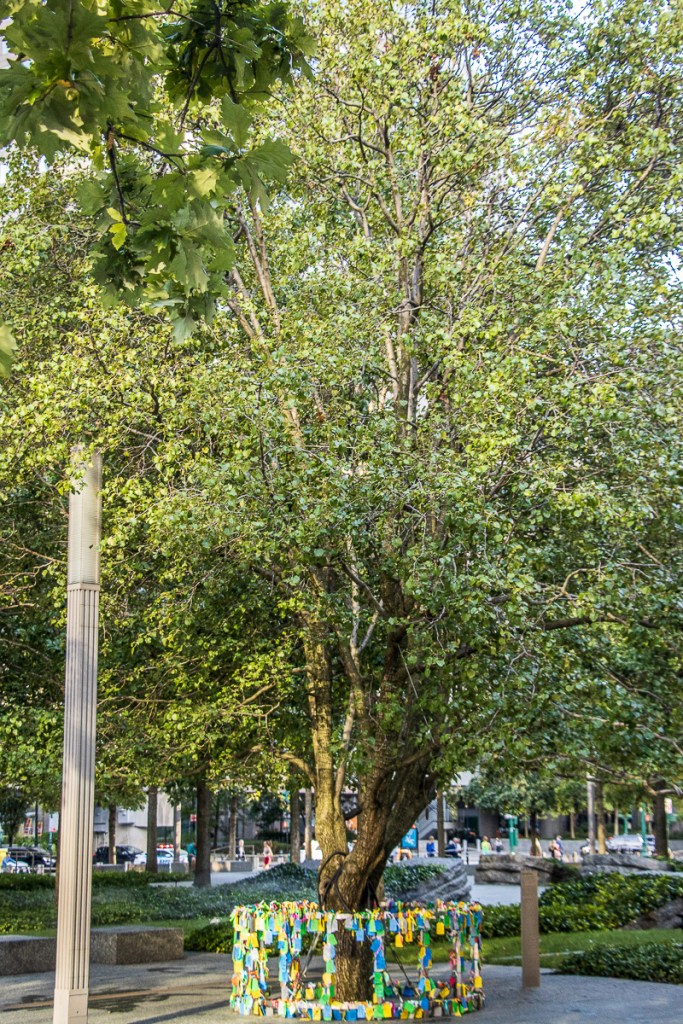
Near the South Tower Pool stands a tree surrounded by a simple iron barrier that’s festooned with multicolored tags. It’s a Callery Pear tree and it stands on these grounds as a symbol of hope and resurgence. The 9/11 Memorial & Museum website describes the touching story of what is known as the Survivor Tree. “In October 2001, a severely damaged tree was discovered at Ground Zero, with snapped roots and burned and broken branches. The tree was removed from the rubble and placed in the care of the New York City Department of Parks & Recreation. After its recovery and rehabilitation, the tree was returned to the Memorial in 2010.”
Each of the colored tags carries a visitor’s personal message. After reading the inscription on a plaque that describes the tree and it’s meaning Cora finds a place to sit and cry.
Our walk to the food cart takes us through the park to the North Tower Memorial. It’s a similar pool, this one in the footprint of once was a 1,730 foot skyscraper. On 9/11, on the 106th and 107th floors of the North Tower, diners at the Windows on the World restaurants in the North Tower were enjoying a beautiful blue sky.
The parapets here bear the names of the victims of the North Tower and of Flight 11.
It’s a picturebook day. The sun is beginning to set. Puffy clouds and a still powder blue sky are reflected in the surrounding steel and glass skyscrapers of Manhattan. Maybe this is the best time to be here, under a calm, comforting canopy.
The park is nearly silent. People converse in hushed tones. There’s no running, no frolicking. The only punctuating sounds come from outside the park in perpetually busy Manhattan.
We only pause briefly here. All of the emotions, from Gettysburg, Auschwitz, the Vietnam Wall, Omaha Beach, and all of those other places where sorrow washes over all else, have come back to visit. What else is there to do but look down into the void, look up at the sky and the surrounding buildings and trees and wonder why?
And recall where you were on that morning 25 years ago.
It was 5:45 in the morning, and Cora and I were getting dressed for work. As usual, the morning news was on the small TV in our bedroom, mostly just to get the latest weather and traffic. When we saw news of the first plane hitting the North Tower, I figured, like most people, that it was a private pilot who had made a tragic mistake. And so we mostly ignored it.
When the South Tower was hit seventeen minutes later, we realized that America was under attack.
So what do you do? You worry. And you ask the, who, what and why questions. And then you go to work.
As events began to unfold Cora was sent home from work. Me? I worked for a small private company. The owner, an old skinflint named Richard Cotter, decided to keep everyone at work for the day. You never know. There was always the chance that he might lose out on a dime or two if he sent us home.
And so we spent the day, not really working but listening to snippets of news and unfounded stories (the Golden Gate was on the hit list), and hearing military jets in the skies above. And worrying.
A week later, the anthrax letters showed up, envelopes containing powdered anthrax spores mailed to news outlets and U.S. Senators Patrick Leahy and Tom Daschle. In the end, five people died and seventeen others were sickened. The anthrax letters caused my first ever panic attack when, unable to sleep one night, I moved to a couch in one of our unoccupied bedrooms. I woke up in the dark, drenched in sweat, with a racing heart, difficulty breathing and a feeling that the walls were closing in.
Those anthrax letters left a permanent reminder of September 2001. In the immediate wake of the attacks people were urged to refrain from sending out holiday cards that year. We complied with the request and for some reason we never resumed sending Christmas cards.
We’ve booked a tour of the 9/11 museum. It’s the best way to really know what it is you’re seeing as you go through the galleries.
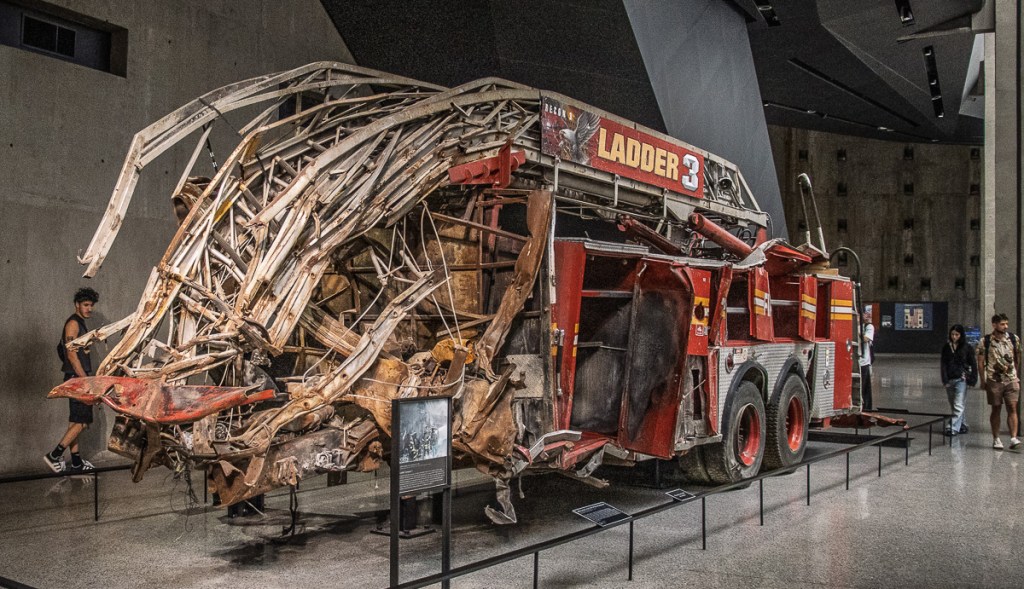
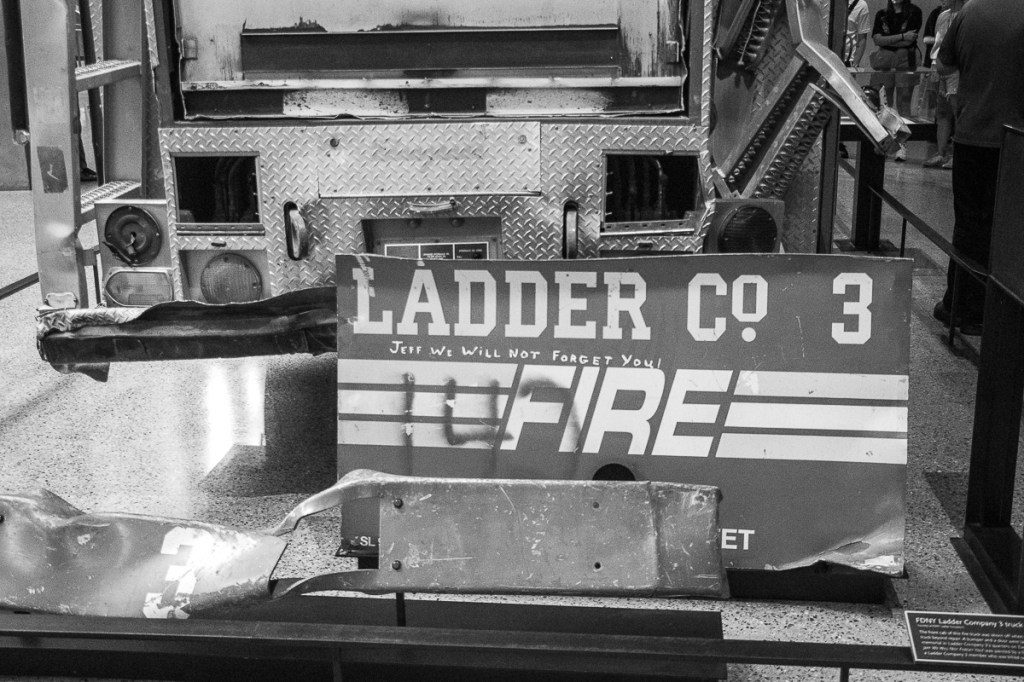
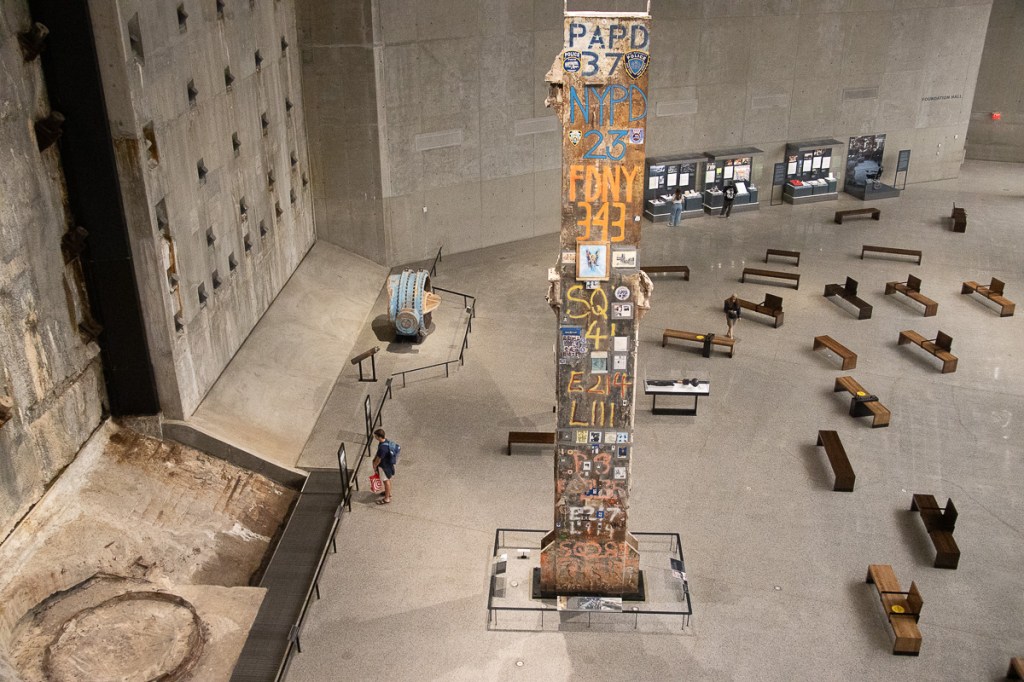
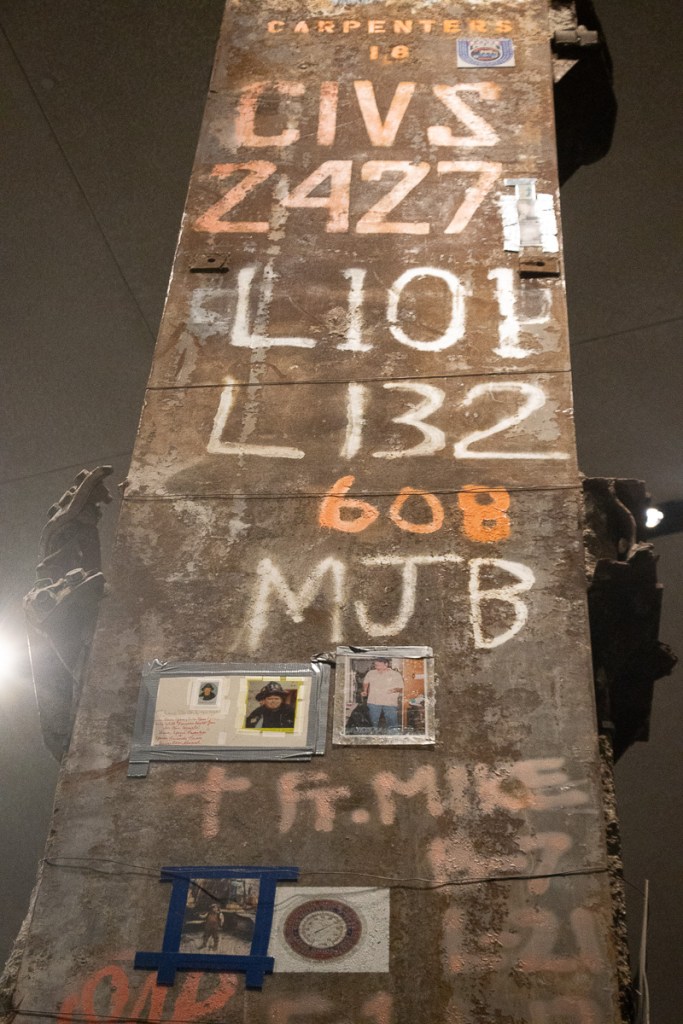
The tour takes us down, down, down. Down to below the pool that marks the footprint of the South Tower. We pass twisted remains of the towers, damaged and charred vehicles, personal items found in the rubble, and gallery after gallery of photos and videos. We gather at the very bottom, in a large gallery called Foundation Hall where the last remaining original beam of the South Tower rests. The beam, covered with messages left by responders and recovery crews, towers over visitors who gather in silence below.
While the experience as a whole delivers a crushing sadness, for me it’s the constant audio feed that is most affecting. Throughout the journey we’re haunted by the sounds of the day. The sirens, the screams and shouts, the frantic voices of overwhelmed dispatchers, and the replays of reporters and eye witnesses recounting the events bring it all back. Most chilling are the the voices and the words from the grave. At one point we hear the radio communications of fire fighters entering one of the towers. History tells us that those are their last words.
Madeline Amy Sweeney was a flight attendant on Flight 11. As the plane approached the North Tower she was on a phone call with an airline manager on the ground. “I see water. I see buildings. I see buildings! We are flying low. We are flying very, very low. We are flying way too low. Oh my God we are flying way too low. Oh my God!” The water she saw was the Hudson River.
While our guide is amazingly knowledgeable his dramatic pauses followed by deep, drawn out sighs seem affected. (Over the course of eight days we will often walk by the 9/11 site and pass through tours where the guides inevitably are speaking in dramatic tones that seem inauthentic).
We’re wrung out when we leave the museum. That’s how it works. You expend no physical energy but the emotion leaves you physically and emotionally spent.
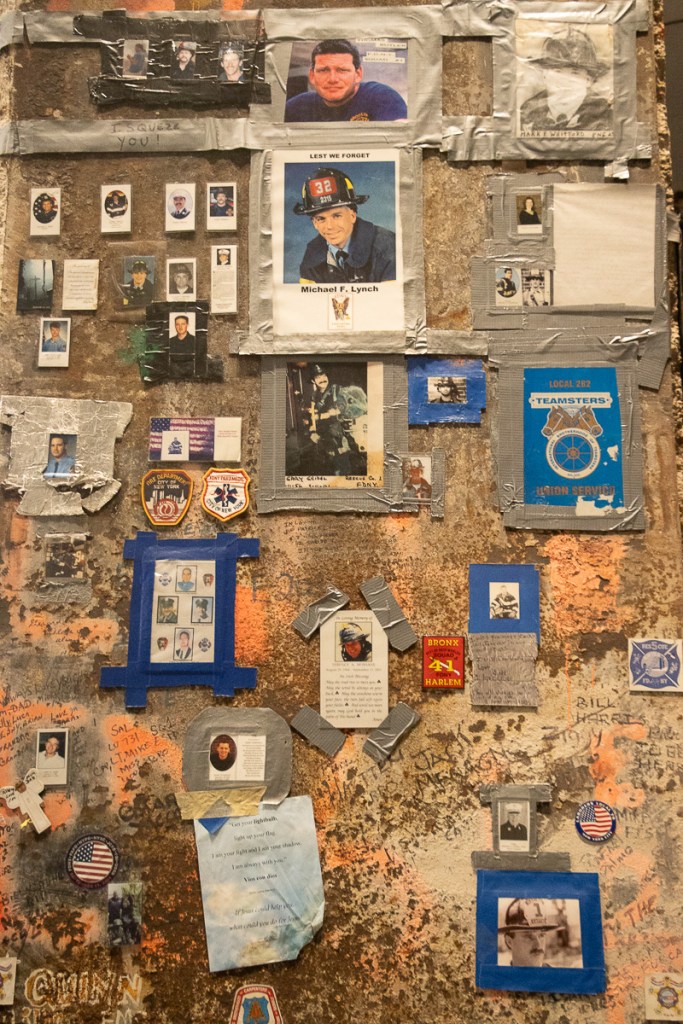
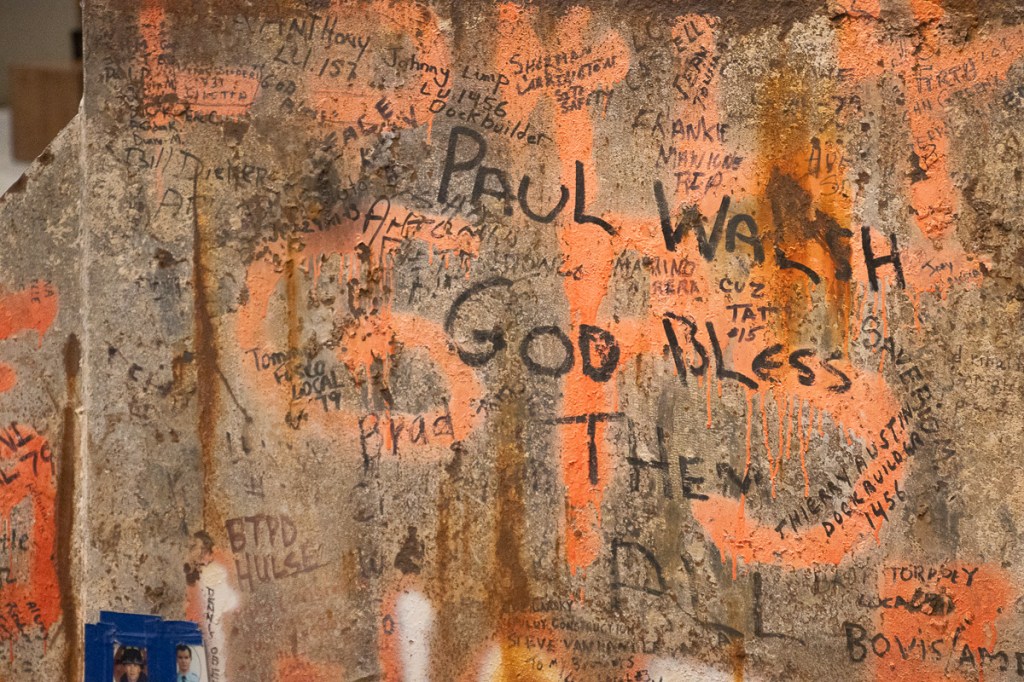
September 9, 2026. We’ve been back home for eight days and the 25th anniversary of the 9/11 attacks is bringing it all back again.
The painful recollection will be fed by news reports and documentaries. And that’s not a bad thing. As we’ve been saying for a quarter of a century, “never forget. “ Maybe what we should most remember is the unity of the nation and the world in the aftermath.
The ceremonies will be mostly solemn and respectful. Flags will be lowered, the names of the fallen will be read, and bells will be tolled. There’s a rule at the New York City memorial ceremonies that politicians are not allowed to speak. It isn’t a rule that’s aimed at any particular politician; all are subject to that rule, from president to senator to alderman to the dog catcher. It’s a long standing non-partisan tradition that discourages any politician who might be tempted to wade into partisan waters.
Four living presidents will attend – Joe Biden, Barack Obama, Bill Clinton, and George W. Bush – and all four will remain respectfully silent.
Donald John Trump, a man who doesn’t abide rules and scoffs at tradition, has chosen to skip the New York ceremony precisely because he will not be allowed to speak. Whenever he makes an appearance it has to be about himself, and he lacks the self-restraint to avoid adding remarks about himself and his grievances. Instead, Donald John Trump will speak at the Pentagon, as is his privilege as Commander in Chief.
In the end, Donald John Trump’s absence is altogether approriate. If there is any politician who loves to bathe in the waters of partisanship it’s the 47th President. But rules and tradition aside Trump has, since that very day twenty-five years ago, perverted the history of the event and soiled its remembrance.
In the immdiate aftermath of the attack, Trump claimed that “thousands and thousands” of Arab-Americans in Jersey City “were cheering” the attack. That claim has been proven false and he has never retracted it.
In 2019, Trump falsely claimed that a video posted on social media showed Democratic congresswoman Ilhan Omar, a Muslim, dancing during the anniversary of the attacks. What the video actually showed was the congresswoman dancing at party put on by the Congressional Black Caucus on September 13th. He has never retracted that claim.
In 2016 Trump claimed that he sent 225 of his construction workers to help in the recovery effort. That claim was refuted by former Battalion Chief Richard Alles, during a July, 2019 interview. On September 11, 2001 Alles was at the scene shortly after the collapse of the second building. “I was in a supervisory role with the fire department at the time,” said Alles. “I was there for several months — I have no knowledge of his being down there.”
While on the 2016 campaign trail, Trump placed himself among the rescue and recovery workers, saying, “Everyone who helped clear the rubble—and I was there, and I watched, and I helped a little bit.”
Mr. Alles refuted that myth as well. “He was a private citizen at the time. I don’t know what kind of role he could have possibly played, said Alles. He added, “There would be a record of it. Everybody worked under direct supervision of the police and fire department and the joint commander for emergency services. Is there a chance he was ever down there by himself and I didn’t know it? It’s possible, but I know of no one who ever witnessed him there.”
Most recently, Trump placed himself in the nearby U.S. Steel Building – now known as One Liberty Plaza. At the time, it was feared that the building was in danger of collapsing. Trump claimed that the building was “really creaking.” He continued with his myth, “I’ll never forget: two firemen. We thought it was coming down on top of us and two firemen—big, strong guys. And I’m not the smallest guy in the world. They grabbed me under the arms, said, ‘Gotta get outta here.’ And they literally lifted me up—this is not easy to do; I’m big. They lifted me up, and they started running with me. I said, ‘Fellas, I can run myself.’ But they were amazing, but they thought it was coming down. It didn’t come down: U.S. Steel.” There are no witnesses to corroborate that story.
During his time in office, Donald John Trump has consistently maligned America’s NATO allies claiming that the NATO nations would never come to America’s aid. The fact is that Article V of the NATO agreement stating that an armed attack against one member is considered an attack against all members has been invoked only once – after 9/11 – when NATO came to the aid of the United States.
That infamous day brought out the best in Americans.
The best were the brave men and women who ran towards the danger, knowing that they might not return. The best were people like U.S. Air Force Lieutenant Heather Penney who was ordered to scramble her plane and intercept Flight 93 that was on it’s way to Washington D.C. Since her F-16 was unarmed Lieutenant Penney would have had to sacrifice herself and ram her fighter into the hijacked jetliner. That became unnecessary because some of the best were on that jetliner and they overcame the hijackers and crashed the plane.
The best worked tirelessly in the immediate clean-up, and in caring for the physically and emotionally injured. The best worked to rebuild the area. The best wrote the history of the day, and continue to work at the memorial and in the museum. The best served in the longest war in American history (and that includes members of the militries of NATO nations).
The events of 9/11 also revealed the worst.
The lesser of America reacted by taking out its rage on anyone who appeared to be Muslim or of Middle Eastern descent. The wrath of co-workers, of segments of the news and social media, of politicians, and classmates, rained slander, threats, and physical harm on innocent Muslims. Women wearing hijabs were publicly harassed. Muslims feared for their very lives. At least three murders were committed during the immediate aftermath of the 9/11 attacks.
The man who would one day be President of the United States helped to spread the Islamophobia and continues to do so to this day.
Twenty-five years after 9/11, Islamophobia is rampant and not just as a fear of a non-Christian religion. Islamophobia has become a political weapon. Outgoing South Carolina representative Nancy Mace, wrote, “Every single Muslim holding public office in America is a trojan horse, and a threat to both national security and our republic.” Another outgoing Republican, Randy Fine said, “We need more Islamophobia, not less.”
It’s been a torturous twenty-five year journey since September 11, 2001. And it hasn’t been a fruitful one. On September 12th, 2001, America was a nation united. In September of 2026, it’s a nation sundered. Victimization is a major driver in politics and governance.
If there is anything positive that can be taken from that horrible day, it’s the knowledge that it’s possible for Americans to share a common resolve, and that nations can come together. It’s the awareness that the better of us have stood up for the victims of irrational hate.
Those ideals seem distant today. One wonders if they can ever be reborn. Can Americans ever be unified as we were when smoke and dust clouded the Manhattan skies? Or will we continue to descend into the darkness of disunion?
Why do we keep returning to these places?
Maybe it’s the learning experience, and the eternal hope that through that learning the same tragedies will be avoided in the future. That hope has, sadly, been a vain one. And if that hope has so far been futile, then maybe these places can still serve as reminders of the resilience of the human spirit, that solidarity and benevolence are possible, and that good can triumph over evil.
The second bite will be a tastier, more pleasant one; Eating the Apple.


And just a reminder that Canadians stepped up to help people whose flights were diverted. Especially the folks in Gander, Newfoundland. I think we would do the same if this terrible thing happened today, despite our current differences with trump and his cronies.
LikeLiked by 1 person
Hello Audrey, I think that most American remember the aid that Canada rendered when the flights were diverted. And I think most Americans are aware that Canada sent soldiers to fight in the war that followed. It’s a belicose administration that is rewriting history (which is what fascists do) and a misinformed and ignorant MAGA base that ignores the aid that Canada and NATO provided.
I have no doubt that Canada would again come to America’s aid if the same thing happened again. Sadly I don’t believe that America would come to Canada’s aid unless Trump thought that there was something in it for him. America has squandered friendships and lost the world’s trust.
Thank you for reading and commenting
Paul
LikeLiked by 1 person
Last time I was in New York, Ground Zero was a building site. The time before that, we went up one of the towers of the World Trade Center and enjoyed the views. Next time I (hopefully) visit I will return to Ground Zero and pay my respects. I didn’t know there was a museum – it looks harrowing but a must to visit I feel.
I recognise what you say about the rise of Islamophobia in the immediate aftermath as we saw the same in London after the Tube bombings of 2005. Anyone who looked even vaguely Muslim could be targeted. And I fear that was the root of the appalling racism that’s currently tainting our politics.
LikeLiked by 1 person
Hello Sarah, The entire area is still a construction site. Across a narrow, little used street from our hotel, about a 5 minute walk from Ground Zero they’re getting ready to break ground on what will be a Trade Center building. The Occulus, across from Ground Zero is considered part of the new Trade Center.
The Memorial Park, with the two pools, the Survivor Tree and a vast green dotted with trees is quite peaceful. The Museum is historically important but it brings the memories back in, as you correctly put it, a “harrowing” way.
Here in America, the post-9/11 Islamophobia has been continuous, largely I suspect because we went through the two decades long war and aided by the racism and xenophobia of Trump and the MAGA movement.
In the days leading up to the 9/11 ceremonies, Zohran Mamdani was treated horribly by the right wing media and right wing politicians. I’m rooting for his success.
LikeLiked by 1 person
A powerful story Paul. Like the Holocaust, we must never forget 9/11. Hate and the need for power cannot take lives any more!
LikeLike
Hello Anne, Thank you for reading and commenting.
Part of never forgetting is not allowing the rewriting of history. We’ve seen it for decades with the Holocaust. We’ve seen it regarding slavery. And we’ve also seen crackpots try to rewrite the history of 9/11.
Thank you again,
Paul
LikeLiked by 1 person
My father-in-law rang us around 6 am our time, telling us; I thought he had lost the plot. Then, years later, Les and I stood at the memorial, thinking about how brave those people were and those who tried to save them.
LikeLike