
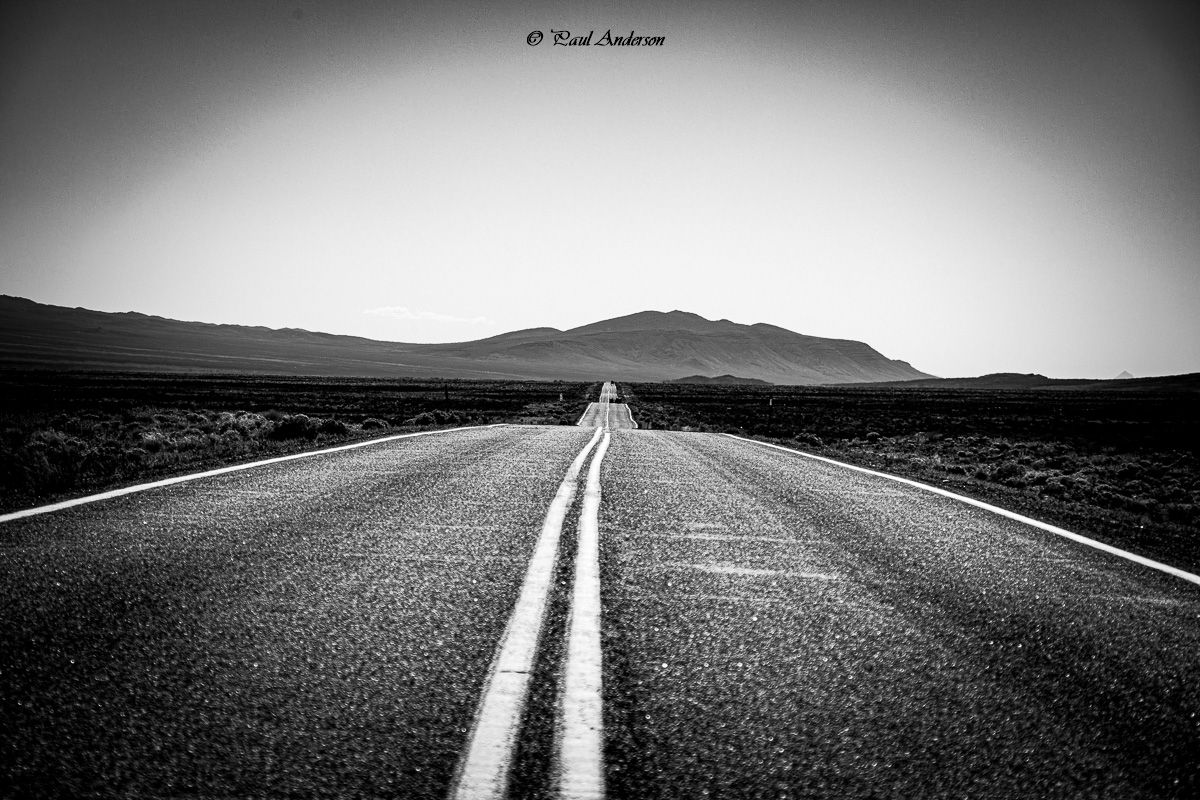
Headlight glowin’
The cars hurry past
Just like the years
Are flowin’ so fast
If I can get there I know I’ll be warm
The ackin’ in my bones will soon be gone
lAnd I journey back to Tonopah
I’ve got a caffeine buzz from a giant coffee, a sugar high from the biggest apple fritter in the coffee joint’s display case, and country music on the radio. With the probable exception of Las Vegas, the Sunday morning radio fare in Nevada is either a fire and brimstone Christian preacher, or pedal steels and lyrics about whiskey, pickup trucks and broken hearts.
I left Reno at eight and should arrive in Tonopah around noon.
Clark, Nevada at the junction of Highway 80 and State Route 439, aka, the USA Parkway.
Named after James Clark, a potato farmer who settled in the area in 1862, Clark could probably get by just as well if it were nameless. No history to speak of (except for old James), no real community, and no life – just a place. If you’ve arrived at Clark looking for the romanticized America of manicured green lawns, tire swings hanging from oaks, white picket fences, Friday Night lights, Little League Saturdays, and Sunday church socials, well pilgrim, you took a wrong turn somewhere in
Iowa.
Clark is a charmless collection of concrete and steel distribution centers, an industrial center, a Food Bank, and an Indian restaurant; all incongruous intruders into the high desert. This isn’t the place where you settle down, raise the kids, and have barbeques with the neighbors. In Clark, there’s an extended stay motel that one would assume caters to corporate suits who visit just long enough to make sure that the local fulfillment center managers aren’t robbing the warehouses, and then, once satisfied, they get the fuck out and back to corporate in some big city.
The high desert is a place of rugged beauty, an allure that is, without doubt, in the eye of the beholder. It bakes in the summer and chills to the bone in the winter, and sometimes you have to look deep into the soul of the brown flatlands and rolling mountains to see the hard grace.
The money men and state and local government boys appreciate a different beauty – a green one. The land in the area used to be valuable for what was under it – silver. Now its valuable just for the open space to plant industry on. Frank Sinatra and Sammy Davis died and with their deaths went the Reno entertainment industry (that’s the ultra simple version of a number of events).
What to do?
Provide business friendly tax laws and miles upon miles of land to build on and a non-community that’s not put off by transient labor.
It took until my adulthood for me to appreciate this land. I hated it when I was a kid and my family drove east to visit the extended family in Salt Lake City. A mid-August, oven baked drone of a ride in a station wagon with no air conditioning. We stopped in Reno where I devoured a plate of manhole cover sized pancakes drowing in syrup, and dad fed the slots and had a bloody Mary. Between Reno and Elko, where a motel with a pool awaited, I mastered the annoying art of ‘are we there yet.’ Sixty years later I can appreciate the graduer.
If I turn to look westward I can still see the dark bulwark of the Sierra Nevada. It’s a magnificent sight. Not so much when parched pioneers headed west in covered wagons, caught a glimpse of the snow capped granite visage and realized they were in a race against nature. In 1846, members of the Donner Party looked at those peaks and saw death.
Every time that we made this drive dad would tell me about the pioneers who braved the long journey to California. Before I was ten I’d read Ordeal by Hunger, George Stewart’s classic book about the Donner Party. My dad’s spiels along with the book helped point me towards my degree in history.
At the junction of 439 and Highway 50 is Silver Springs where I turn left and head a short distance southwest. Silver Springs, population around 5000, looks like a pleasant little community but it’s not for those of us who feel comfortable in metropolitan suburbia.
There was a time, after the kids had left the nest, when I proposed to Cora the idea of moving to a small community like Silver Springs. “I’ll visit you,” she’d say. I tried to entice her with promises of riches. Of course she would be doing the work. “You can cook Filipino food that the locals have never tried. We could get rich selling lumpia.” All that is probably true. Lumpia is like a drug. After the first hit, you’re hooked. “Hey man, can you spare a couple bucks. I’m jonesing for a lumpia Shanghai.”
Looking back, I don’t know what I was thinking. I cherish my little day trips to San Francisco, taking in a Giants game, or going out for Himalayan food or sushi in Berkeley. I suppose I could’ve been entertained with small town high school football but I doubt that there’s much in the way of Himalayan food out here and I’m not one to risk mini-mart sushi. And Cora? She’d have been lost. The only Filipina within a hundred miles.
From 50, in Silver Springs there’s a dog leg junction onto route 95 and a winding drive towards Tonopah. From Silver Springs it’s a half hour drive through desolation until I get to Yerington.
Yerington, population 3000, is Sunday morning quiet when I drive through. It has all the small town prerequisites; a McDonalds, a family diner, and a little independent motel. Of course there’s that little, got everything, store that no self respecting small town would be without. It’s the store that’s packed with all manner of things from groceries to clothing to hardware to fishing tackle to shit you’ll never need.
There’s usually no real method to the merchandising. You might just find grade A medium eggs side by side with salmon eggs, sitting on a shelf just below motor oil. It’s the store with a blinding yellow sign that you can see for blocks – Dollar General. Though much maligned, there’s a special place in my heart for Dollar General. When I was being eaten alive by mosquitos in New Harmony, Indiana, Dollar General was the only place open and it just happened to have cortisone cream and mosquito repellant. I can’t recall where they were in the store but I wouldn’t be surprised if they were sitting between Snickers bars and tube socks. God bless Dollar General.
Yerington’s beginnings go back to 1854, when a cattle drive led by N.H.A. “Hock” Mason passed through the valley where present day Yerington is located. Five years later he returned to the valley that would later bear his name.
In the early 1870s the Mason Valley was the site of a growing community that alternately went by the names “The Switch,” or Greenfield. Area folklore tells the story of a saloon in that community that dispensed particularly foul hootch that the locals labeled “poison”. The accented pronunciation of “poison” came off sounding like “pizen” spawning a third name that gained some traction – “Pizen Switch.”
By 1973, the little community consisting of a livery stable, store, blacksmith shop, a hotel, and saloons (note the plural), was officially christened Greenfield.
In the late 19th century, the name Henry Marvin (H.M.) Yerington carried a fair amount of weight in Nevada mining, railroading, and politics. It was about that time that Greenfield officialdom was lobbying for a railroad line to pass through town. In 1894, the town was renamed Yerington in order to flatter old H.M. into extending the Carson and Colorado Railway into Yerington (it seems there’s a lot of that sort of flattery still going on these days in Washington). H.M. must’ve been pleased seeing his name attached to a growing town in his home state but it didn’t move him to grant the town its wishes. It would take fifty years for a railway line to run through the area. By then H.M. had long been dispatched to the wrong side of the dirt.
As is often the case in America, this land was inhabited for thousands of years before white men showed up. The Paiute occupied this land until, as was always the case for the Native inhabitants, they were relegated to a reservation. In this instance it’s the Walker River Paiute Reservation, just east of Yerington where my route will take me.
At Yerington, Route 95 makes a sharp left and shortly after, enters the reservation. Smack in the middle of the reservation is the town of Schurz. The stretch between Yerington and Schurz is about the loneliest I’ve ever travelled. I count zero cars, and even though the drive takes only thirty minutes, it’s still a bit unnerving.
Schurz was named after Carl Christian Schurz, a German immigrant who had a varied career as a lawyer, abolitionist, foreign minister, Union general in the Civil War, newspaperman, United States Senator, and Secretary of the Interior.
Like any politician, Schurz was never coy when it came to giving his opinion. Two of his quotes still carry a fair amount of weight. In 1859, Schurz declared, “If you want to be free, there is but one way; it is to guarantee an equally full measure of liberty to all your neighbors. There is no other.”
It was Schurz, who put the correct context on Commodore Stephen Decatur’s 1816 quote, “Our country! In her intercourse with foreign nations may she always be in the right; but our country, right or wrong!” Speaking before the Senate in 1872, Schurz fixed it; “My country, right or wrong; if right, to be kept right; and if wrong, to be set right.”
Schurz is a pleasant little green oasis in the brown Nevada range. With a population of 650, the town’s main existence seems to be to serve the Paiute Reservation. The road slices through a tiny community of a few businesses, small simple homes on ill defined plots, and a scattering of double wides.
I pass a community center, a community park, a sheet metal building that houses Bad Jack’s Fireworks, a few long abandoned buildings of weather beaten wood, a small post office, a little coffee house, and Gorilla Fireworks. And then – Schurz is gone.
As I leave the reservation, I see Walker Lake off to my left. Looking at the shoreline of the bright shimmering body it’s evident that at one time the lake was significantly larger.
“America’s Patriotic Home” is what Hawthorne, Nevada calls itself. Even though the town has a population of over 3000, like most of small town America on a Sunday, it appears to be deserted. Where is everyone? It’s October and I’m guessing that most are in one of two Sunday morning houses of worship; church, or in the living room watching NFL football.
Hawthorne’s fervid nickname originates from the fact that it’s the home of the Hawthorne Army Depot, the world’s largest munitions storage facility. That the area bulges with munitions is evidenced by the 2500 little bunker entrances that dot the side of the rolling hills.
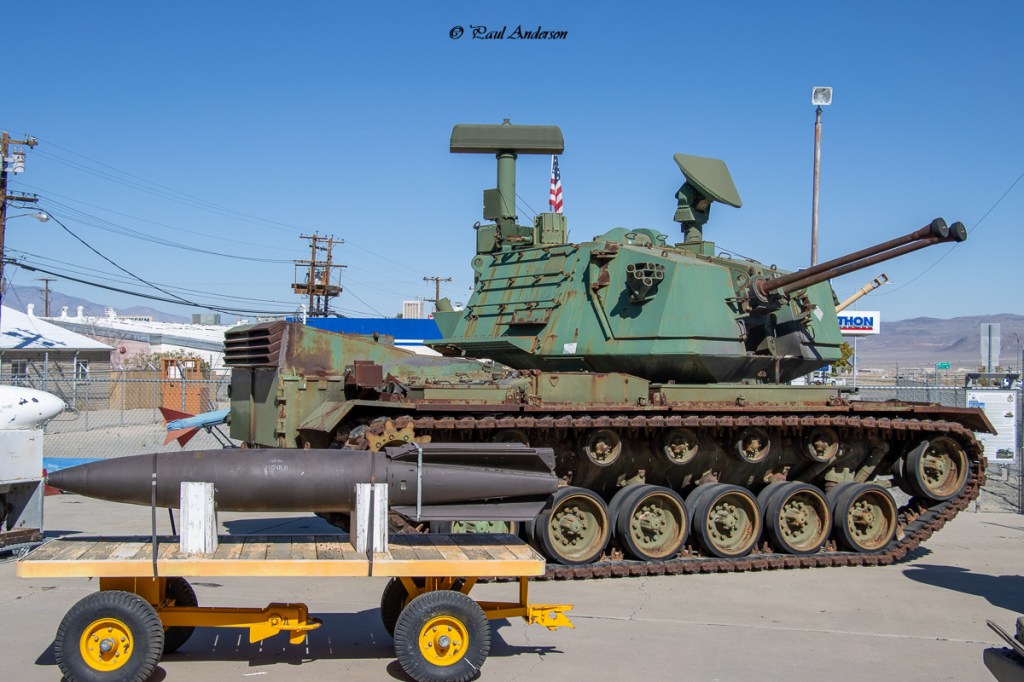
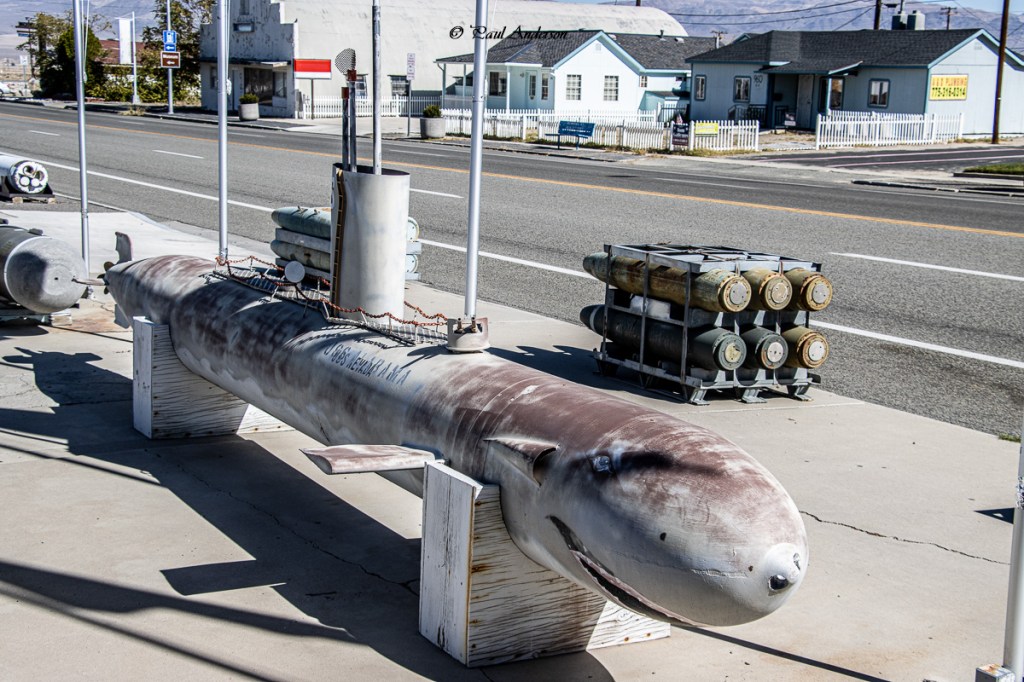
At the corner of E Street and 9th is a bright white building, trimmed in red and blue (remember – America’s Patriotic Home). The building resembles an old auto showroom. What’s out in front does not, though there is a vehicle parked there – a tank. Scattered about the remainder of the lot is a collection of bombs, torpedoes, artillery pieces, and missiles.
It’s not something you see every day so I pull over. I’ve found the Hawthorne Ordnance Museum (though I wasn’t looking for it), and it’s closed. Of course it is. Damn Sunday mornings. If it were open I’d go in and look around. I’ve been to the Spam Museum in Minnesota, the Camp Algona POW Museum in Iowa, and a museum in Northfield Minnesota dedicated to the James Gang’s bank robbery in that town that didn’t end well for the outlaws. So why not an ordnance museum in the middle of the Nevada desert?
I decide to just walk around and look at the various projectiles of destruction in the outdoor display. I’m assuming that everything here is disarmed, and that the keys to the tank (if it uses such a thing) are locked safely away.
Oo oo, oh the night is fallin’
Oo oo, oh hear Nevada callin’
Hot dry and wind blown country callin’ me
Out where those shadows run so tall
Hot dry and wind blown country I can hear you callin’ me
Callin’ me back to Tonopah
It’s a little over a hundred miles to Tonopah. I’m headed eastbound for a bit and where Route 95 makes an arc towards the south I come upon Luning. Before it became a town, Luning was a stagecoach station named Deep Wells.
In 1881 it was named after Nicholas B. Luning, a big shot with the Carson and Colorado Railroad,when the rails came through town. For a short while Luning served the silver mines to the east. When the silver mines played out a brief lull occurred followed by a resurgence with the discovery of copper in 1900. The World War I years were boom years for Luning when $ 2 million dollars worth of silver, lead, and gold shipped through town. During the forties and fifties, magnesium ore was trucked through Luning.
Luning’s fate was similar to other western towns that depended on mining and the railroad. The mines dry out and the railroad turns fickle. By 1990, the rails were ripped up.
Luning, what’s left of it, is on life support. Twenty-one die hards make up the population and they’re all over 65. A lot of mobile homes, maybe three or four livable houses and many more that are ramshackle.
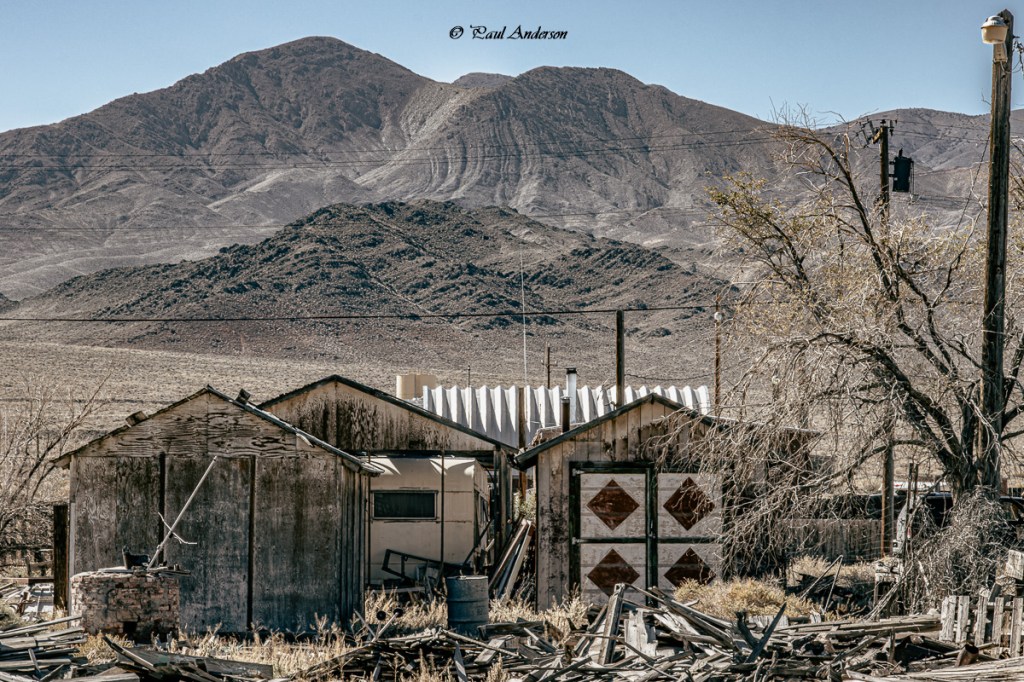
The fact that there’s a still (barely) functioning post office means that Luning still has a pulse. A post office closure usually means that the patient has expired.
During my road trips I’ve passed through a few of these towns that sit at death’s door. Towns with a population the size of a big family. Only once or twice have I ever seen a single soul. Everyone seems to be in hiding. Certainly not at work as there’s nothing to support a job. I never fail to ask myself why they remain. Holdovers from when the town was viable? Newcomers wanting to get off the grid?
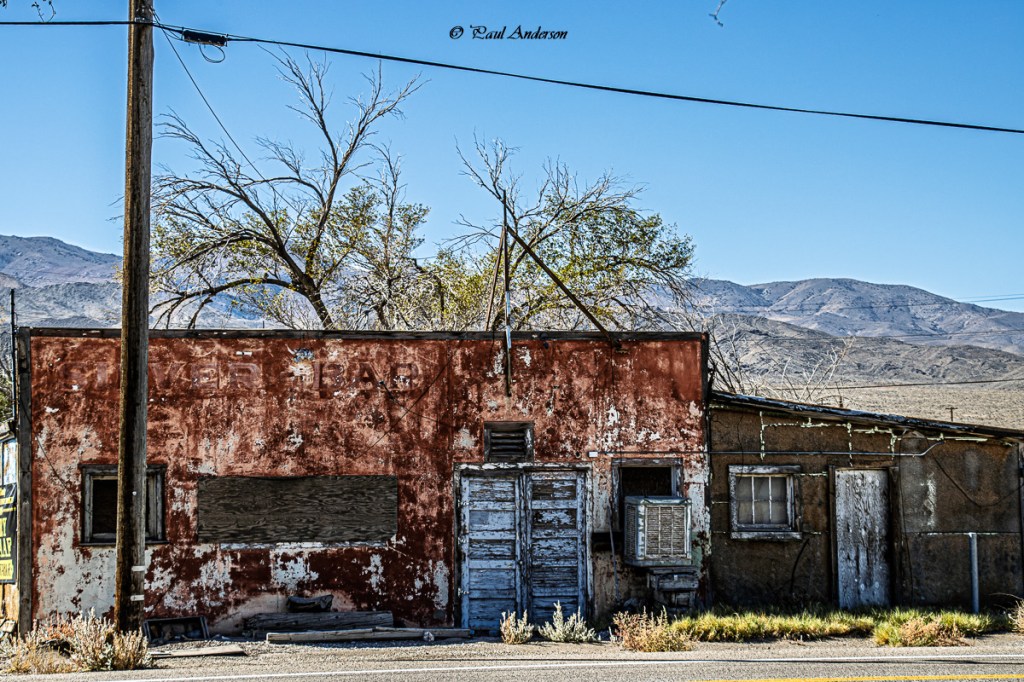
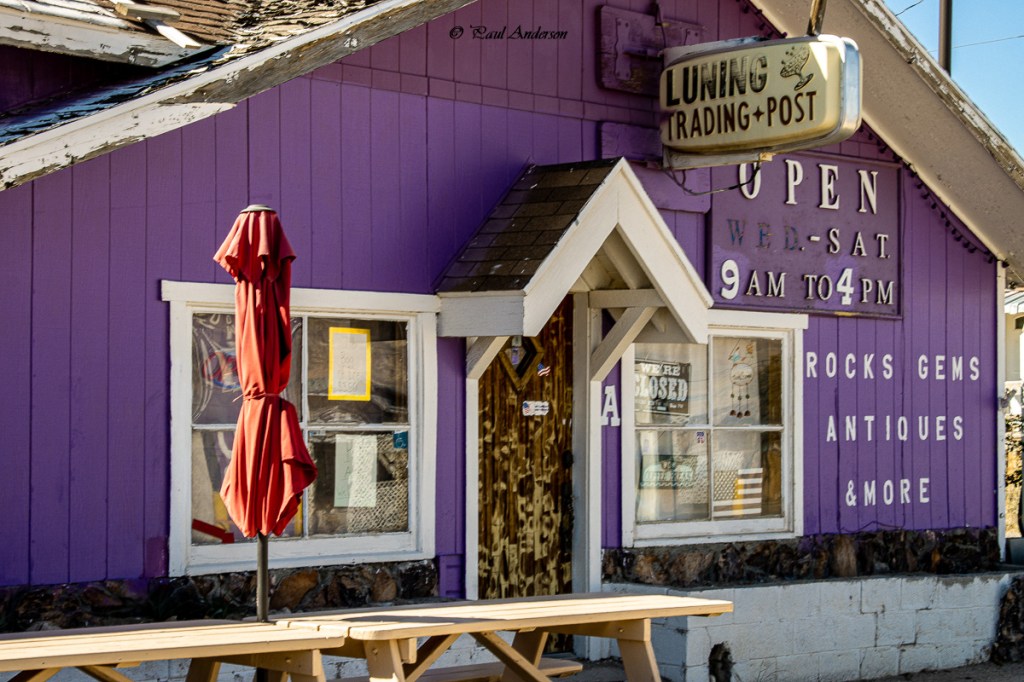
Just up from the post office sits the remains of the Silver Bar Saloon. One block farther up I see a vital sign; the Luning Rock Shop Trading Post and Cafe – open Saturdays. But today is Sunday. Damn Sundays.
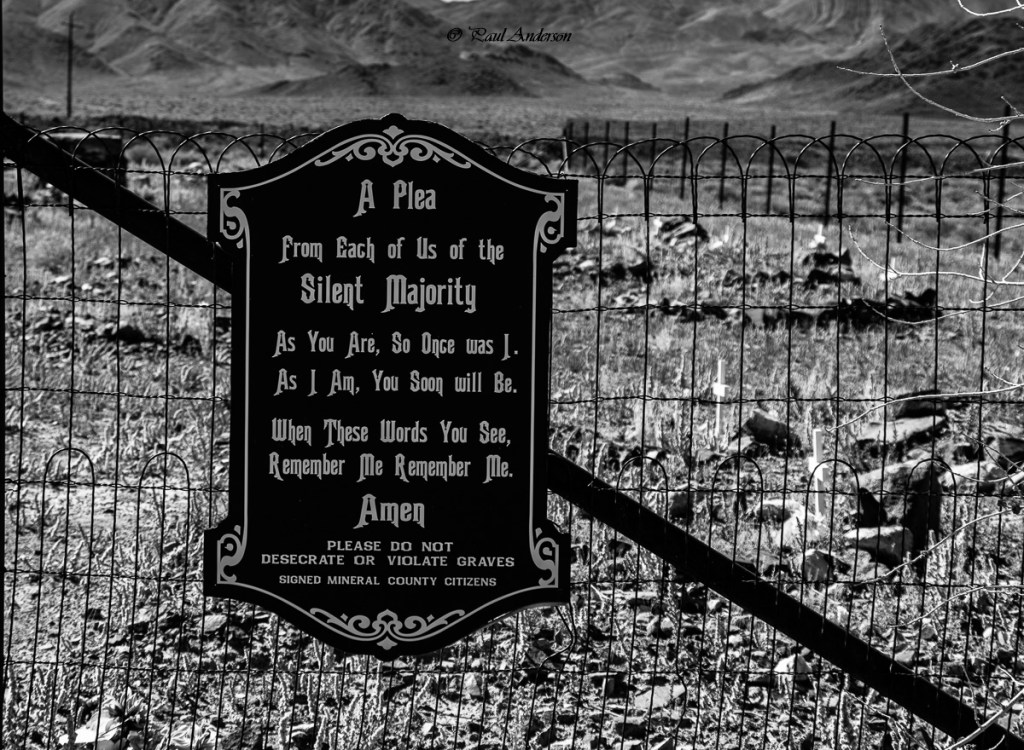
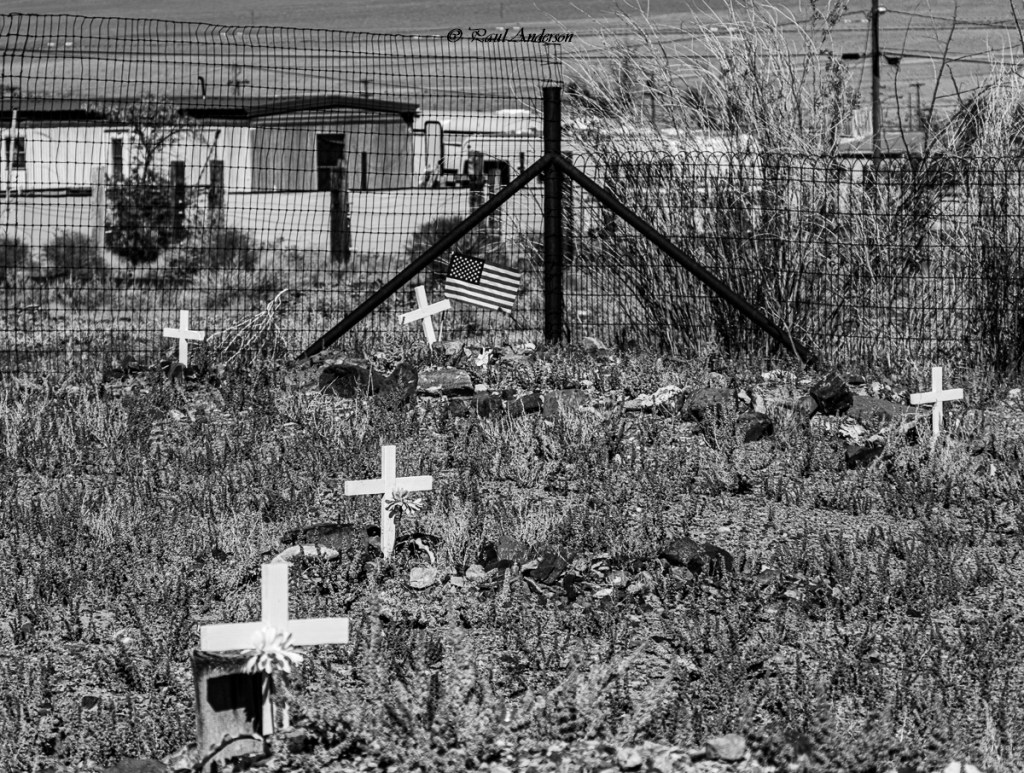
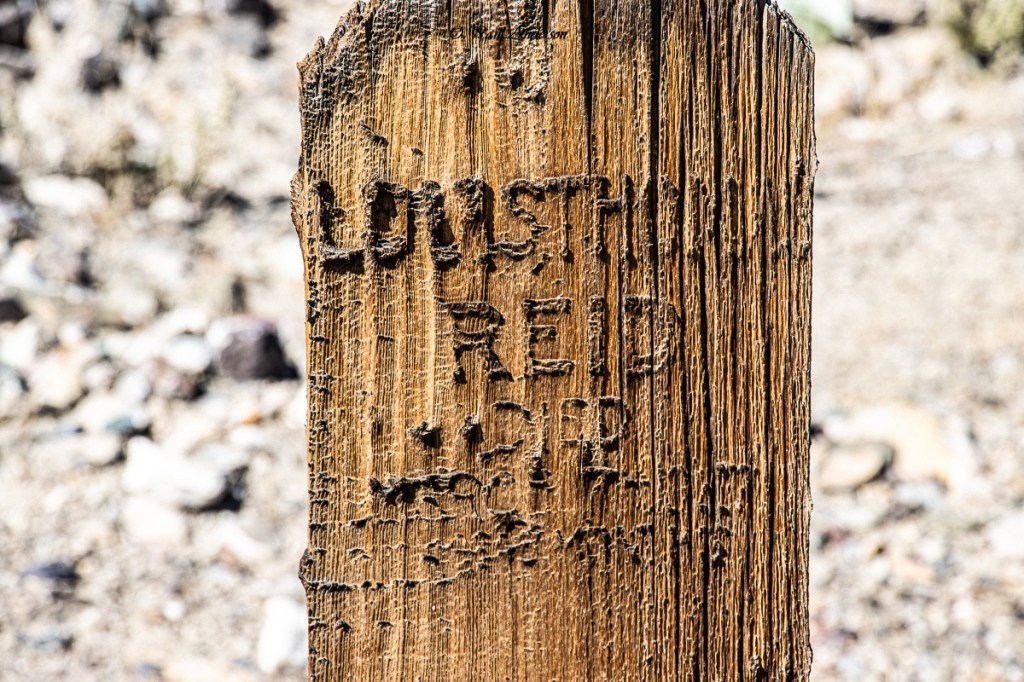
No sign of life in town, might as well pay a visit to the signs of death – Luning Cemetery. The old boneyard isn’t unlike many I’ve seen in the mining towns; brown, stony, overgrown with brush, not a single little patch of green, and almost completely forgotten.
If I can reach the desert I know I’ll be young again
I’ll touch my woman’s face
And things will be as they were then
Bad horses work and whiskey
Have left me tired and sore
And I got no use for wanderin’ any more
I don’t bother to stop at Mina, which, with a population of 122 is a veritable metropolis compared to where I just came from ten minutes up the highway. There’s life here; a small market, the Mina Club which advertises cold beer, and La Casita Mexican Grill. The bright red little building is the most hospitable looking place I’ve seen since Reno – given that Hawthorne was shut tight for Sunday morning. I feel like I should stop at La Casita. I’ll bet the food is superb. Something I’ve found to be true is that these out of the way, I mean really out of the way, can serve really good food.
Or turn your stomach.
Fuck it. Tonopah or bust. Traffic coming my direction has picked up. Mostly big rigs on the main route between Vegas and Reno. The rigs whoosh by like big diesel cyclones, shaking the car as they pass.
At another bend in the highway I come upon a small collection of derelict buildings, some burned to the ground, the remainder adorned with graffiti. There’s also the remains of a gas station and a motel. This is the corpse of Coaldale, population; coyotes, rattlesnakes, foxes, and assorted other critters. Coaldale was a failed mining town, and then a tourist’s way station until 1993 when the EPA found that the gas station’s tanks were hemorrhaging high octane into the landscape. Lacking the resources to stop the bleeding, the owners of the station gave up the business and left town. Seeing no prospects in a motorist’s stop with no filling station, the remainder of the residents soon followed.
At a little oasis called Miller’s Rest Stop, the highway makes a southeast bend and after a few minutes drive, there’s Tonopah, rising up out of the high desert floor.
I turn up my collar
Turn my face to the wind
Trucks run the line
Seems my chances are slim (of getting a ride)
East across the mountains here Nevada sings
Tellin’ me it’s time to hurry home
I pick up my saddle and head for all the things
I left waiting there in Tonopah
Tonopah
Words and music by Dave Stanley


Great travelogue Paul. We spent a night in Tonopah once, but in our trailer. I’m loving your trip!
LikeLiked by 1 person
Hi Anne, Interesting place huh? If you don’t count Las Vegas it’s sort of a microcosm of the state.
LikeLike
I always love following you on these road trips – you conjure the images of the desert and these tiny communities (and non-communities) so well that I can easily imagine being there on the road too 🙂
LikeLiked by 1 person
Hi Sarah, Thank you so much for the compliment. If you feel like you’re along I guess I must be doing something right. Trip is almost over.
LikeLiked by 1 person