
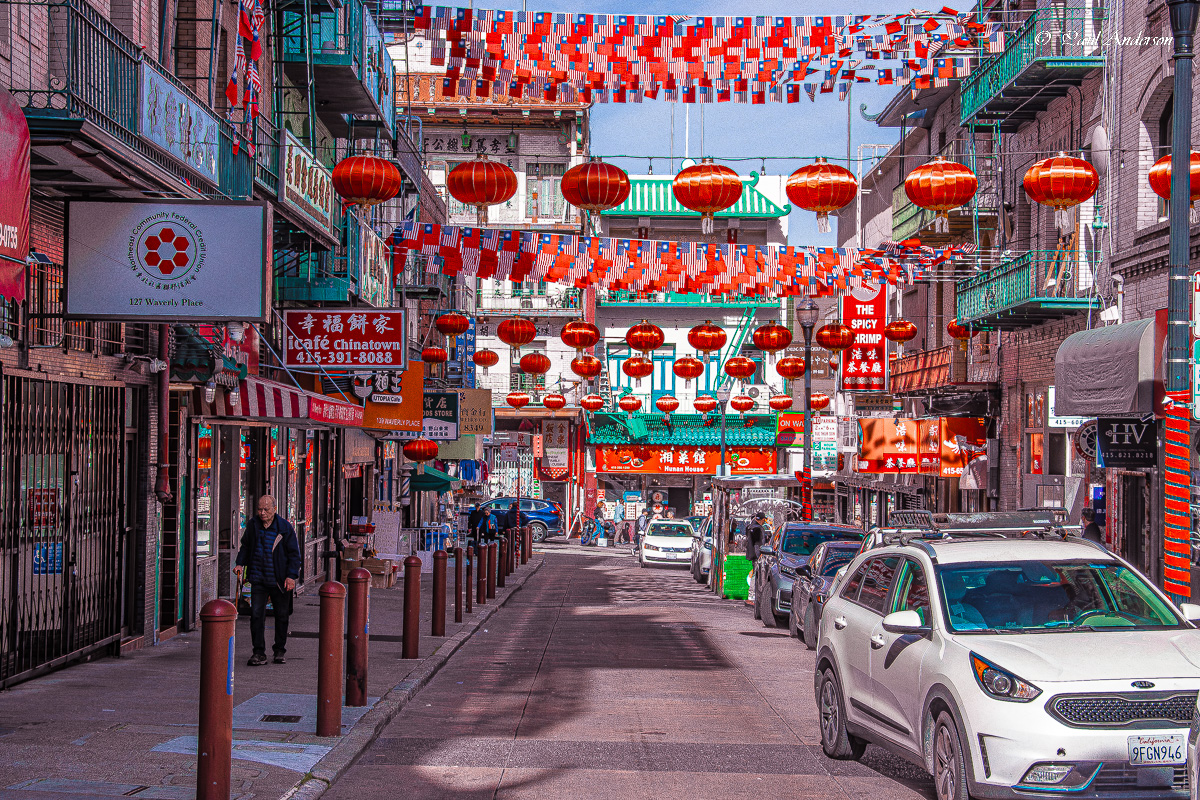
My San Francisco is a series of posts that describes my own personal relationship with The City. My San Francisco pieces might be photo essays, or life stories, or commentaries – or a combinations of all three. My impressions aren’t always paeans to San Francisco. It’s a beautiful city, but like any city, it’s dirty, noisy and has its fair share of urban warts. These pieces will always have one common theme; they are expressions of my personal San Francisco experience.
Intro: I first wrote this post in May of 2019, just two months after a pandemic shut down the world. Over the years it became one of the most read posts on this site. After rereading the original piece along with a review of my notes I decided to do a rewrite. Hopefully this doesn’t turn into a lesson in, ‘if it ain’t broke, don’t fix it.’
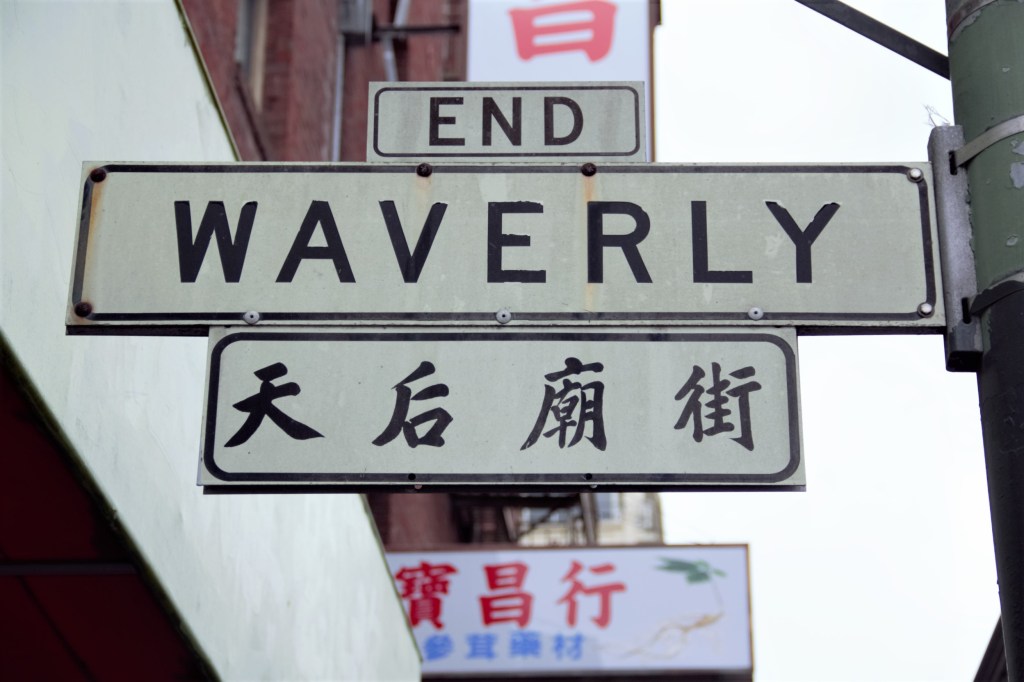
Waverly – Lunar New Year 2019
“My mother named me after the street that we lived on: Waverly Place Jong, my official name for important American documents.” ~ From The Joy Luck Club, by Amy Tan.
I’m standing at the end of the alley, gawking at a street sign, just before taking a photo of it. Even if you endorse the old saying about a picture and it’s worth in words, a dirty white sign against a typically gray San Francisco morning sky seems pretty damned mute. Tourists swirl about, bumping, dodging, gawking, some probably wondering why this random old fool thinks there’s something special about a street sign. Maybe they figure I’m an eccentric member of their itinerant species, trying to find his bearings in the ocean of activity that’s San Francisco’s Chinatown in February.
In any other off season month, there wouldn’t be such a crush of out of towners. Or locals for that matter.
Local tourists are a year round breed. They come from the suburbs, patiently – or not – waiting out the traffic on either the Golden Gate or the San Francisco-Oakland Bay Bridge (part of which was, on May 6, 2026, officially designated as the Willie Mays Highway). On a clear day the views from the raised vantage point of a historic bridge can be spectacular, unless you have to sit in the shit every day, in which case the classic elevated view of Alcatraz peering through feelers of morning fog has long ago lost its appeal.
The Peninsula dwellers wait out the jam on 101. The crush begins at about Cesar Chavez (likely to be renamed because of recent revelations about Chavez, the man). Traffic creeps past rolling Bernal Heights on the left, and to the right, the vintage sign on The Old Clam House (which started serving seafood the same year that the Confederates fired on Fort Sumter). It’s been four decades or more since I first passed that sign and promised myself that I’d try the place.
I still haven’t. Maybe this will be the year. Yeah – likely not.
These northbound suburbanites will likely as not be held up by a routine (dare I say, obligatory) fender bender where 101 makes a bend at Hospital Curve, named after San Francisco General, which sits just off to the left. I once knew a nurse who worked in the emergency room at S.F. Gen. She told me that if you ever feel the need to visit the E.R, San Francisco General is the place to go. That’s the way of a county general. They see it all; from heart attacks to broken bones, to gunshot wounds, to injured earthquake victims.
Now S.F. Gen is called Zuckerberg San Francisco General Hospital and Trauma Center, and if the nomenclators knew then what they know now they might have chosen a different name; Morally Bankrupt Child Addicting Douchie Billionaire General comes immediately to mind.
The locals often return to Chinatown for old times sake; dim sum at a place that might still be there as they remember it, but has more likely changed hands any number of times. The City, particularly after COVID, is transitory. Just ask anyone who’s tried to keep a business alive on Market Street.
Maybe they’re Bourdain fans, in Chinatown to walk upright into the darkly lit Li Po Lounge and then stagger out after having had one of that little dive’s lethal Mai Tais that got Bourdain magnificently shit faced on an episode of The Layover. The Mai Tai? According to the website, The Search for the Ultimate Mai Tai, the Li Po cocktail is, “a mix of dark, light, and 151 rums, pineapple, and Chinese Liqueur . . . very freely poured” (I assume that “very freely,” translates to a lot”. The article goes on, “The Chinese liqueur used is called Ng Ka Py, a Sorghum-based spirit that is bottled at 48% ABV.”
Or maybe they visit just to see how much the always colorful and vibrant (if you don’t count COVID times) neighborhood has changed.
But it’s early February now, smack in the middle of the two months long Lunar New Year season, and Chinatown is experiencing its annual winter spike.
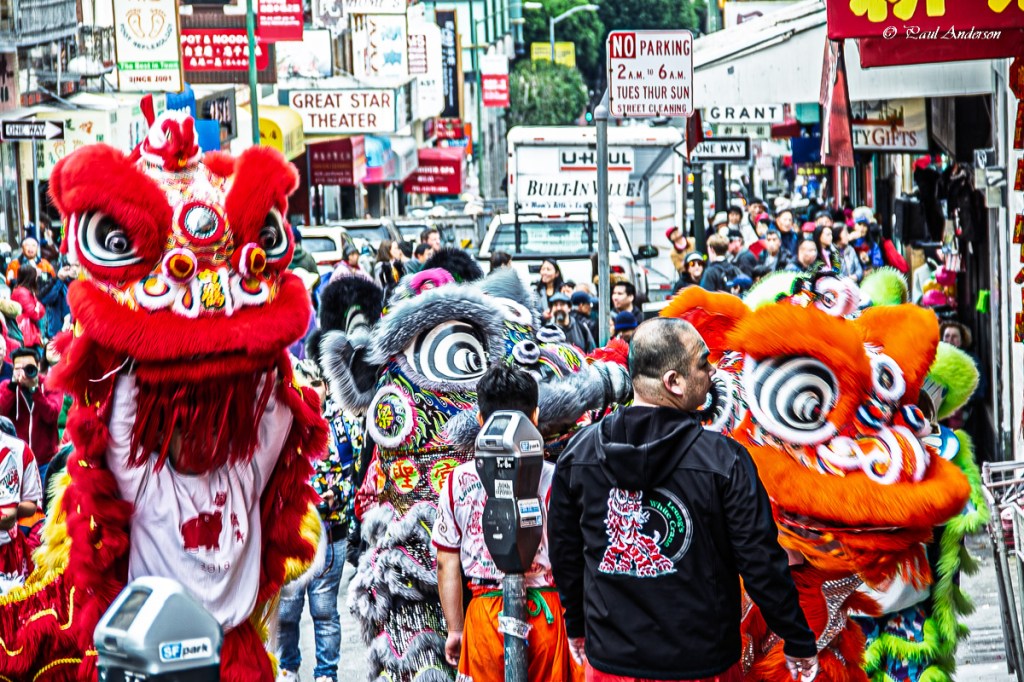
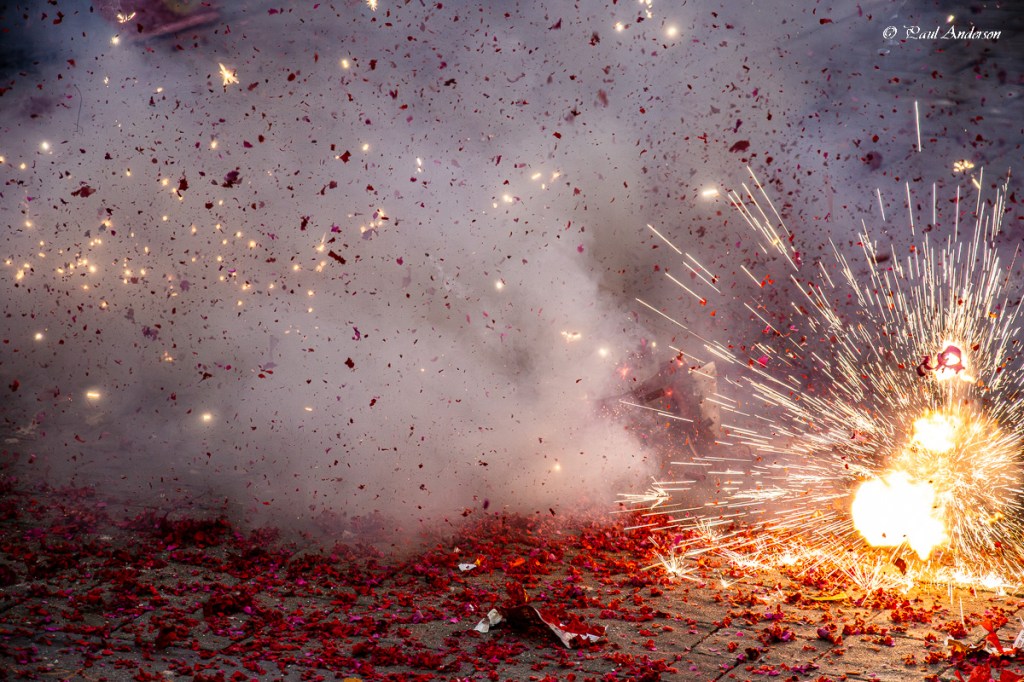
The souvenir shops, always brilliant with brightly colored gewgaws and imported junk, are now packed with the red and gold lucky money envelopes called hóngbāo, and all manner of little piggy dolls (it’s 2019 and this new year celebrates the Year of the Pig). Lion dancers enthrall knots of visitors, and the unexpected staccato of a bursting string of fire crackers frightens the blood out of even the most seasoned Lunar New Year visitor.
Now, back to that street sign. I’m not so much a lost tourist, as a local who’s surprised to learn that Waverly Place is, well, a genuine place. It’s one of those signs I’ve walked beneath countless times for decades and never made note of – just another street. But today, it rings a pleasant bell.
It was about thirty years ago when I was enchanted by The Joy Luck Club, Amy Tan’s classic collection of short stories that takes place in Chinatown. Read once, and then reread, and then reread again, the book still sits in a bookshelf, pages yellowing, maybe some wine, coffee or bourbon stains (or all three), the cover slightly torn and the tops of the pages gray with dust. It’s one of the books that always survives the cut whenever I make the occasional purge of books bound for a donation to the local library.
For readers of The Joy Luck Club, Waverly isn’t a place. Waverly is the child chess prodigy, and later successful tax attorney, who often tangles with Lindo, her traditional, headstrong mother, who has named the girl after the alley on which they live. For readers of The Joy Luck Club, Waverly Place is a pilgrimage (or in my case, a heartwarming surprise); the equivalent of the simple house in Iowa made famous in Grant Wood’s, American Gothic; or Ralphie’s, A Christmas Story home in Cleveland.
“At the end of our two block alley was a small sandlot playground with swings and slides well-shined down the middle with use. The play area was bordered by wood-slat benches where old-country people sat cracking roasted watermelon seeds with their golden teeth and scattering the husks to an impatient gathering of gurgling pigeons. The best playground, however, was the dark alley itself.” ~ From The Joy Luck Club.
Many of the little businesses described in the book simply aren’t here. Maybe they only existed in the author’s imagination, essentials to the author’s plot. Maybe, like many of the businesses in Chinatown they were ephemeral; here one day and gone the next. There is indeed a playground just around the corner from Waverly Place, the Willie “Woo Woo” Wong Playground, built as a WPA project and originally named the Chinese Playground.
Amy Tan’s description of the alley as “dark” belies the real Waverly Place that I’m walking through. It’s unlike many of Chinatown’s other alleys which can seem close, confined and dark; places that could easily figure in a noir story complete with a dead body getting devoured by time and rats in some black corner.
Waverly Place is wide, airy and colorful. Waverly doesn’t speak with the muffled echo of an alley, but rather the cheerful voices of the many who are here for a boba drink, or a bite to eat, or just to hang out, and grab a smoke and some gossip. The buildings, festooned with flags and lanterns are a vivid palette of colors, flapping and dancing in the bay breeze.
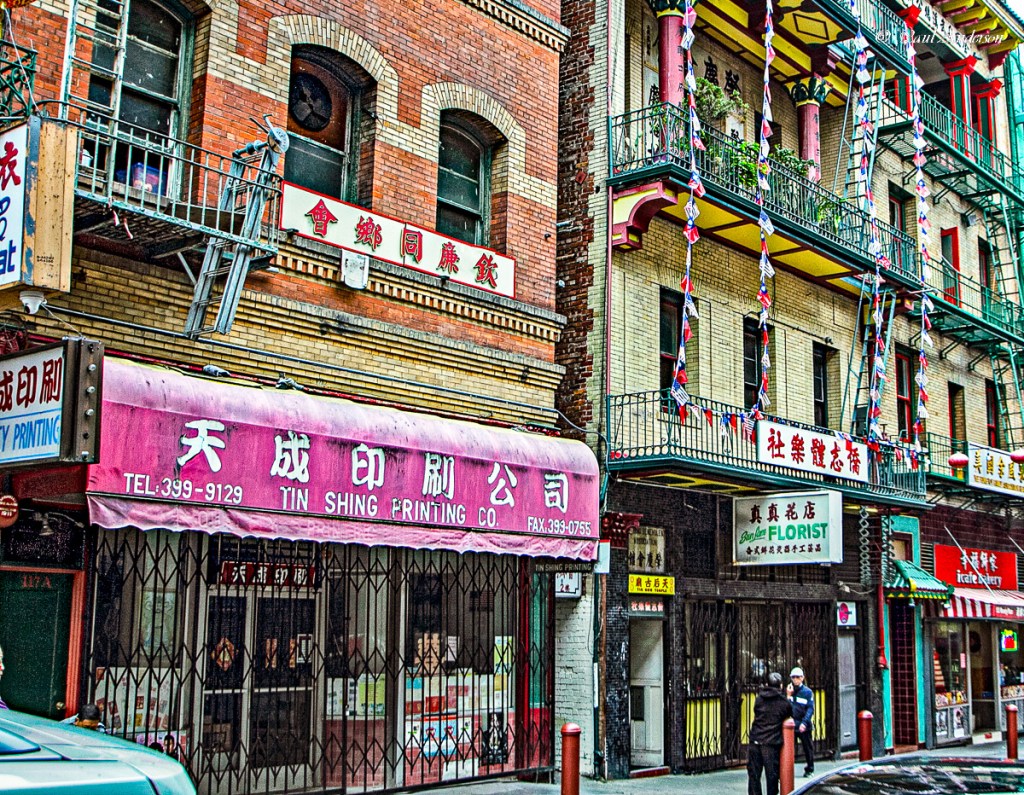
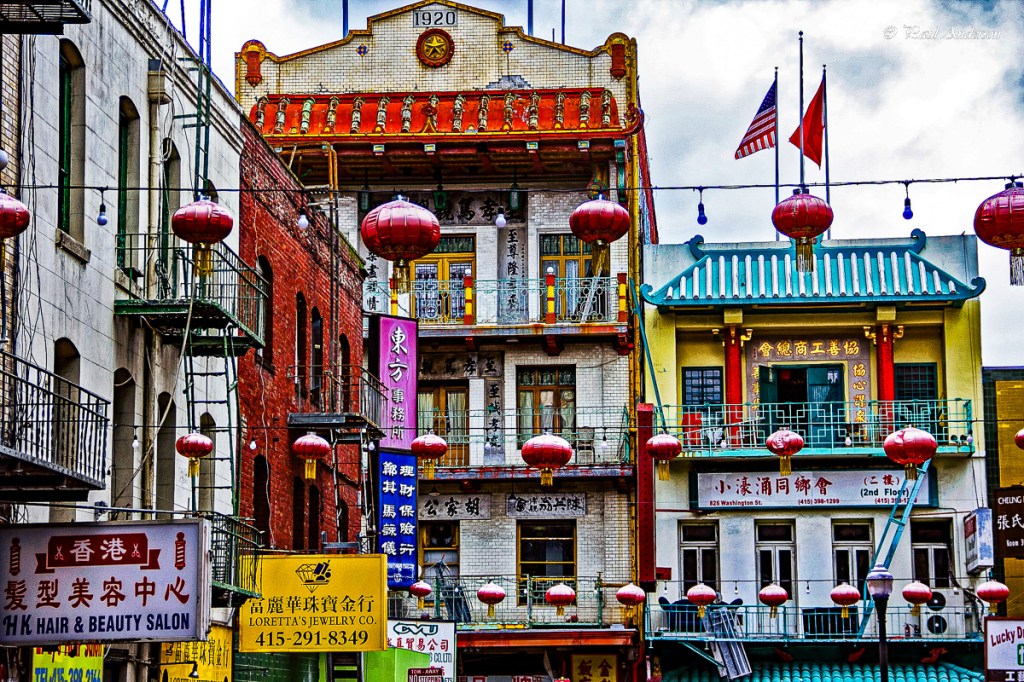
I grew up in the suburban hills above San Mateo, about a 30 minute southbound drive from San Francisco on 101. My little family of three made an occasional visit to Chinatown. Dad, like many current Bay Area residents, hated driving in The City. It’s not an uncommon fear among residents and non-residents alike. If it isn’t figuring out the maze of one way streets, it’s cresting the Leavenworth Street hill to get a plunging mountaintop view of the bay far below – ‘brakes don’t fail me now.’ If you’re driving a stick, the climb up one of those hills, with a Stop sign at every corner can be mentally exhausting. And then there’s the parking issue.
The day before a visit to The City, mom and dad would pore over a map like generals planning a campaign. During the drive up, I was the passenger, mom the navigator and dad the often cursing pilot.
Our family visits to Chinatown were usually centered around dinner at Yamato, at the corner of Grant and California, smack in the heart of Chinatown. Ironically enough, Yamato’s cuisine was . . .
Japanese.
We didn’t have to leave San Mateo for Chinese. The Cathay Kitchen’s steam table was just a fifteen minute drive from home? We didn’t know if it was authentic or not. We just got the usual- egg foo young, chop suey, and syrupy, gloppy sweet and sour pork. Didn’t bother with rice as mom would boil up some Minute Rice and then stir in half a stick of butter.
A postcard from Yamato described the restaurant as a place where “guests choose dining accommodations to their own preference; the intimate charm of exquisite cushion-seated tatami rooms or the spacious chair and table dining areas.”
During a time when, unless you were in a diner, servers were always dour men whose job it was to make the diner feel small and uncultivated, the servers at Yamato were all kimono clad young women. You know – that mysterious, geisha thing. Before entering the tatami room the waitress requested that guests remove their shoes. I guess you could call it tatami American style, as there was a pit beneath the dining table that allowed diners to dangle their feet and sit western style. In the 1960s, Japanese cuisine usually meant tempura, teriyaki and sukiyaki. The popularity of sushi was still a decade or more in the future.
Mom loved the place and insisted on being seated in a tatami room. Dad, on the other hand, wasn’t digging it. It wasn’t so much the whole business about the shoes, although he did occasionally worry that another diner might snatch his wing tips, causing him to pad back to the Union Square garage in his socks. Japanese just wasn’t his thing. Neither was Chinese, Mexican, Greek, Spanish, French,or North, South, East, or West African. The old man was strictly a meat and potatoes American from Salt Lake City.
Yeah, sure, there was meat at Yamato, but it wasn’t a gravy smothered slice of roast.
And potatoes?
Hell no.
Rice?
Hai (Yes).
But not Minute Rice.
Was it boiled?
No. It was steamed.
And not a pat of butter in the whole place.
Before dinner we would walk up and down Grant, and gawk at the tourist shops like visitors from Iowa City, never realizing that there was a bustling culture just a block west on Stockton. The alleys? Forget it. Those were the days when you didn’t walk down an alley.
Two Chinatowns
Grant Avenue. It’s where the tourists go. Chinatown begins where Grant intersects with Bush Street. Here the Dragon Gate ushers visitors into an eight block long corridor of gaudy kitsch. It’s all here in blinding color; tea sets, dinnerware, silk robes, jade jewelry, dayglo Buddhas, and Qin Dynasty themed chess sets made of faux ivory. Two t-shirts for five bucks, guaranteed to be threadbare by the time they arrive back home in Wyoming, and sweatshirts for tourists who left home mistakenly thinking that San Francisco is sun soaked, Beach Boys balmy.
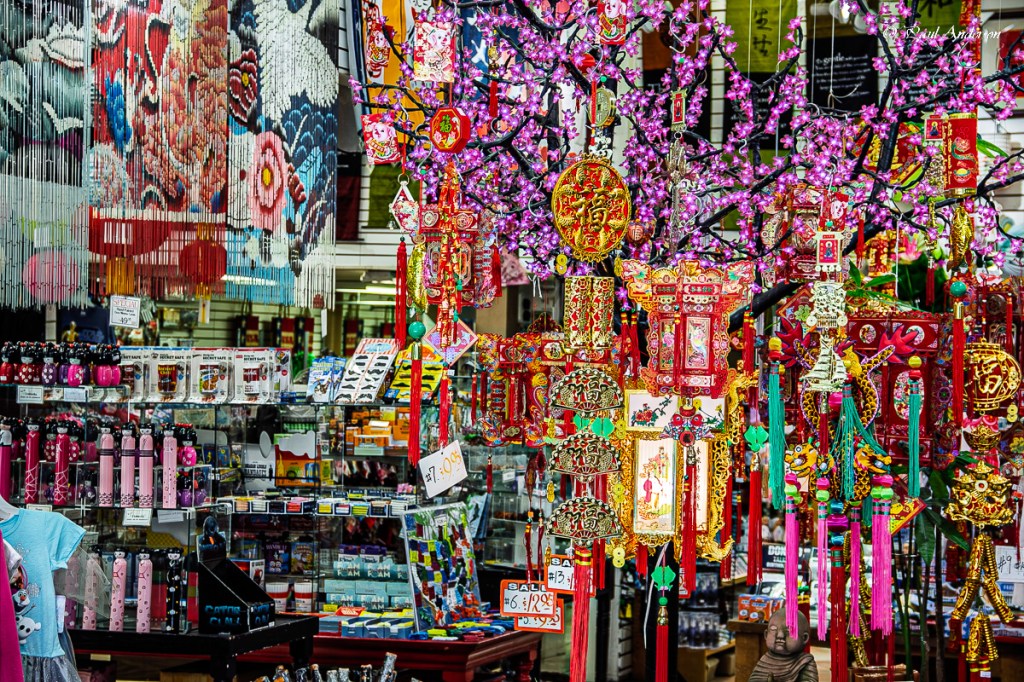
If you’re nostalgic for the good ol’ days of purges, forced labor, and the destruction of cultural heritage, you can get a copy of Mao’s Little Red Book. To complete the set you can find olive drab, red starred, Mao Zedong Cultural Revolution caps (probably not suitable to wear anyplace other than . . .
across the bay in Berkeley).
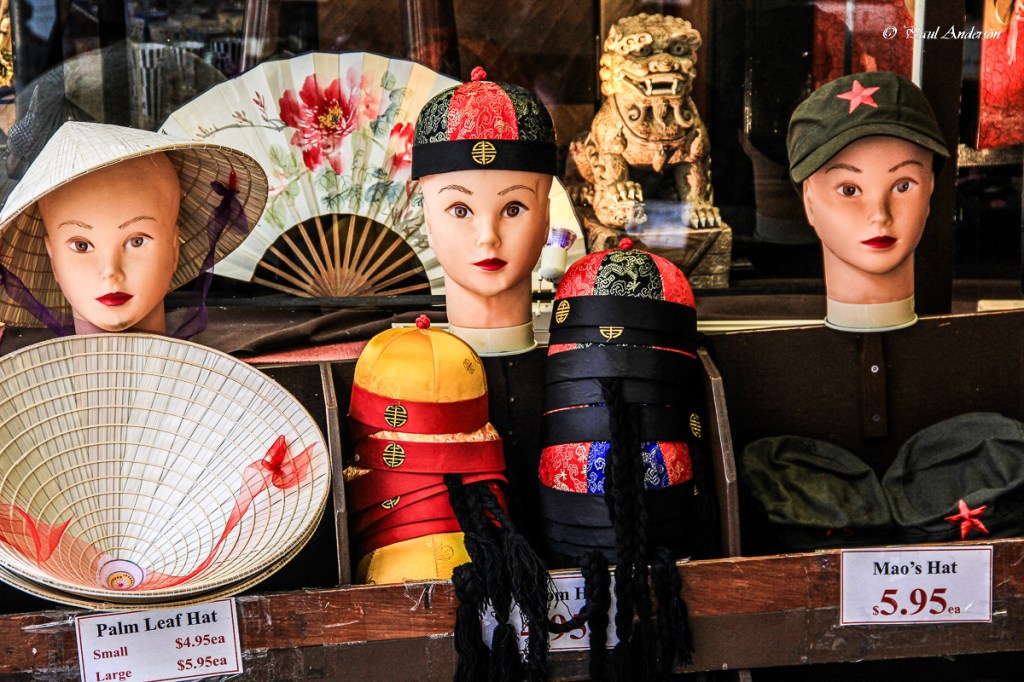
There are plenty of items that may seem like a good idea when they’re sitting on a shelf but lose their appeal once they arrive back in Tennessee. A Qing Dynasty hat comes to mind. Chopsticks? Iffy. Aunt Mabel is likely to give up on them and go back to a fork but they might be salvaged as handy tools to fish eons old rock hard stale candy and moldy chunks of cookies out from under the couch.
Every other window display has a herd of waving cats called Maneki-neko, all in a variety of sizes and colors. You can also find kimonos, sake sets, and geta sandals. All of these are Japanese – but –
I quibble.
Some shops even offer katana swords (also Japanese). Because what’s an American household without a 16th century Japanese weapon of war? The word safe comes to mind, but that’s just me being a kill joy.
For all the kitsch Grant is still a genuinely fun place.
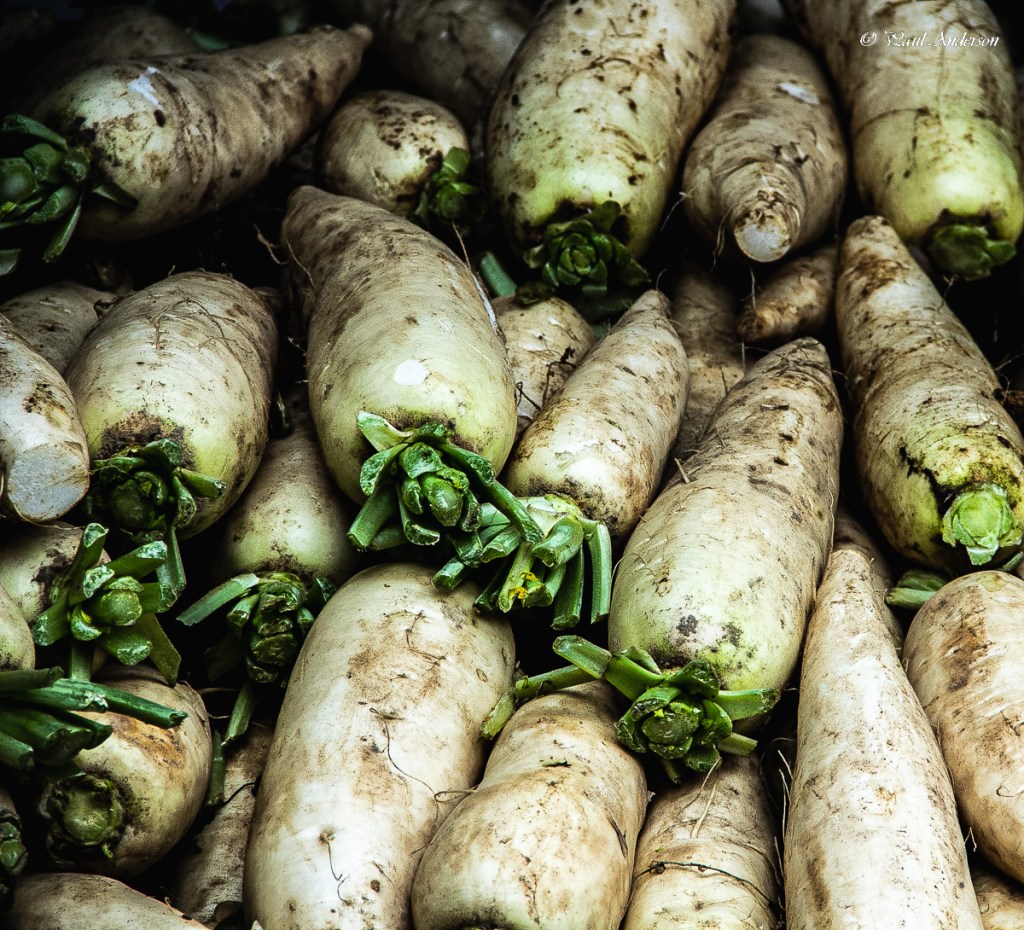
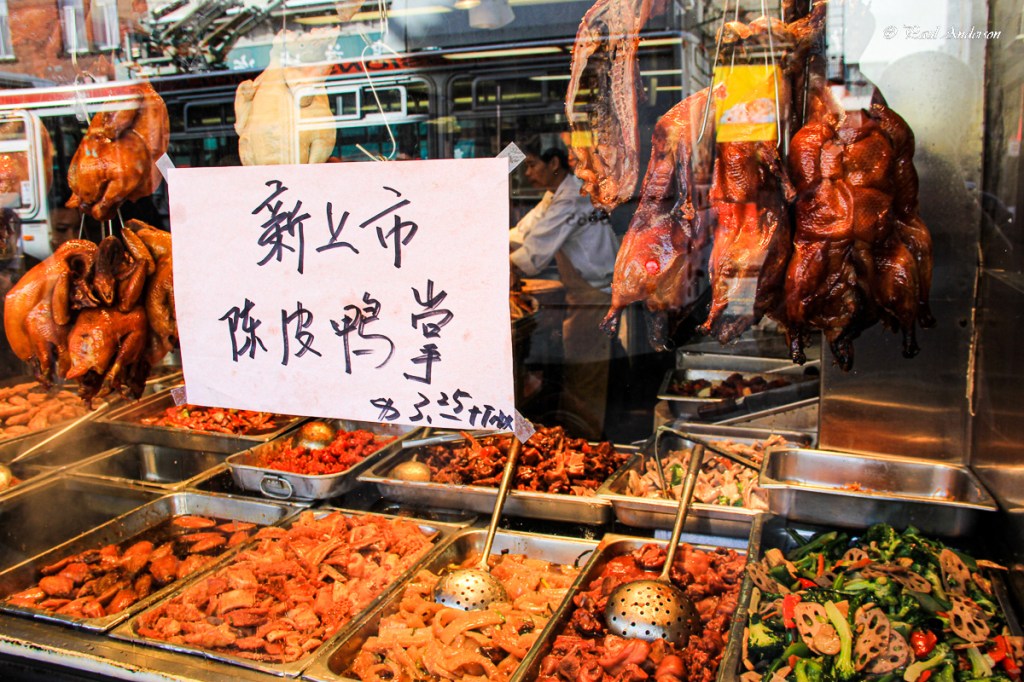
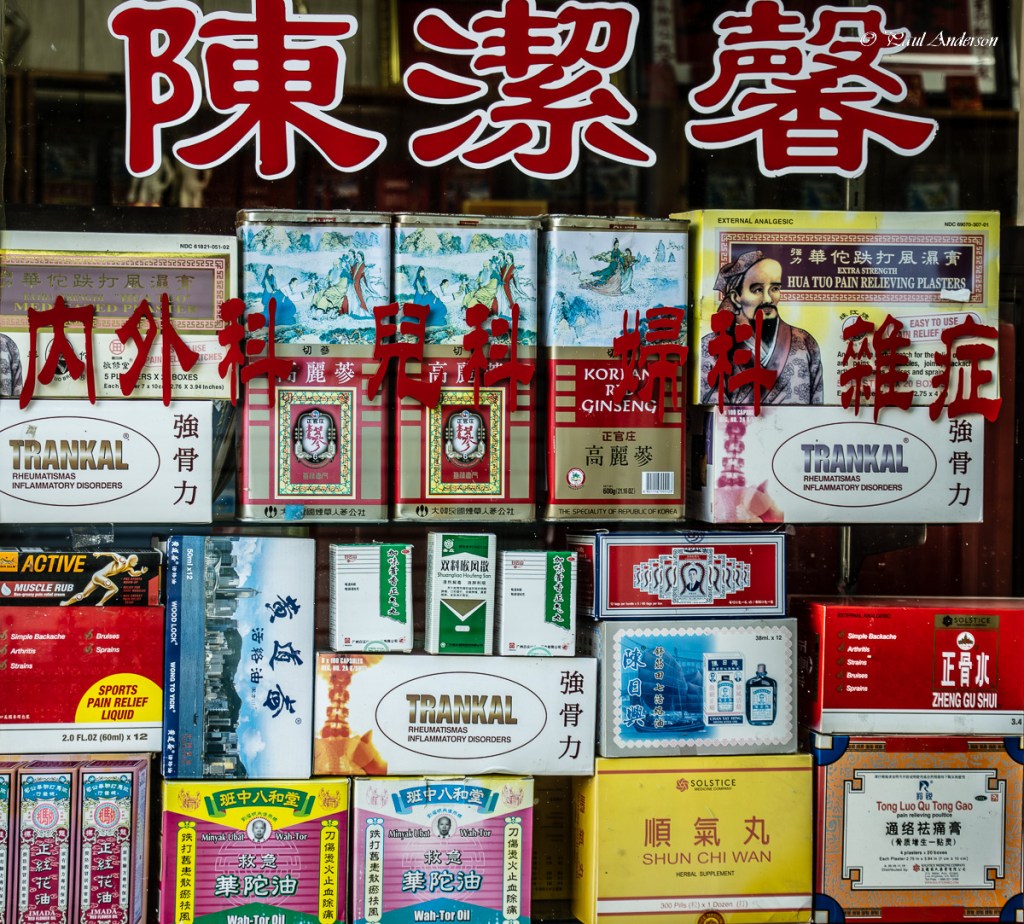
Okay, you’ve visited Alcatraz, the Golden Gate and Fisherman’s Wharf. Here’s what you need to do. Walk one block west from Grant to Stockton. You’ve just entered a different world; it’s the other Chinatown, the real Chinatown, the soul of Chinatown. It’s the fucking people’s Chinatown. Stockton is block upon block of produce markets, herbalists, variety stores, fish mongers, bakeries, meat markets, and grocers that offer an array of spices, dried stuff that most non-residents couldn’t recognize in a lifetime, meats, vegetables and things you might never have imagined.
On Grant you get your refrigerator magnet. On Stockton you get your cultural immersion. Once you’re on the sidewalk that lines Stockton, you get swept up in a rip current of humanity. It’s unceasing bustle. It’s a swirling multi-directional river of people moving from market to market. Queues of shoppers spill out of meat markets and bakeries. Workers clad in t-shirts and sweat stained 49ers caps, shouting to each other in Cantonese or Mandarin as they toil, unload crates of produce from double parked trucks, stacking them on sidewalks and even on the street. Fish mongers scoop tonight’s dinner from a pool teaming with live squirming fish. Buses on the 30 Stockton Line (long ago dubbed the Orient Express) disgorge multitudes and take on an equal multitude. It’s noisy and it’s crowded and chances are you’re going to end up stuck between a wall of pedestrians on each side of you and behind a bent old woman with a cart in tow. Oh and some guy supervising workers unloading a truck just blew a cloud of smoke in your direction. If you need to get through quickly you can either learn to take flight or step into the street and walk between the traffic and the wonderful madness on the sidewalk. And yes, it smells different, but so does McDonalds but given the choice I’d rather smell Chinatown.
English? It’s the second language here. If you count all of the other Asian languages and the myriad tourist tongues on any given day then English might just be the third, fourth or fifth. And that’s what makes it all so fucking great. And if it’s not great for you then maybe you’re better off just sticking to Alcatraz or the Golden Gate.
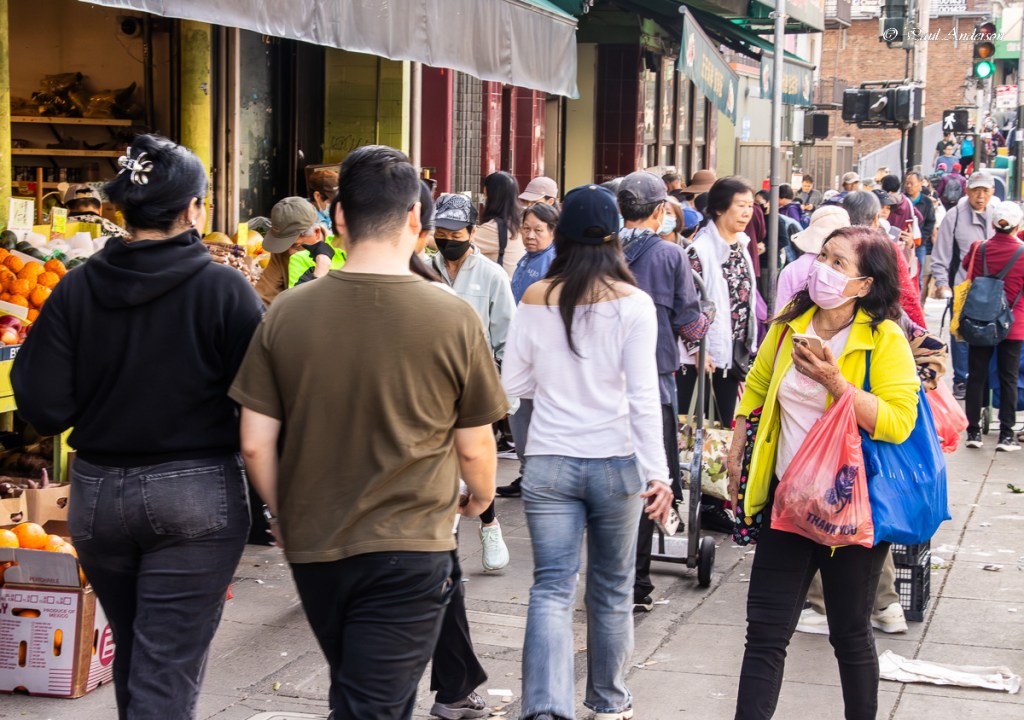
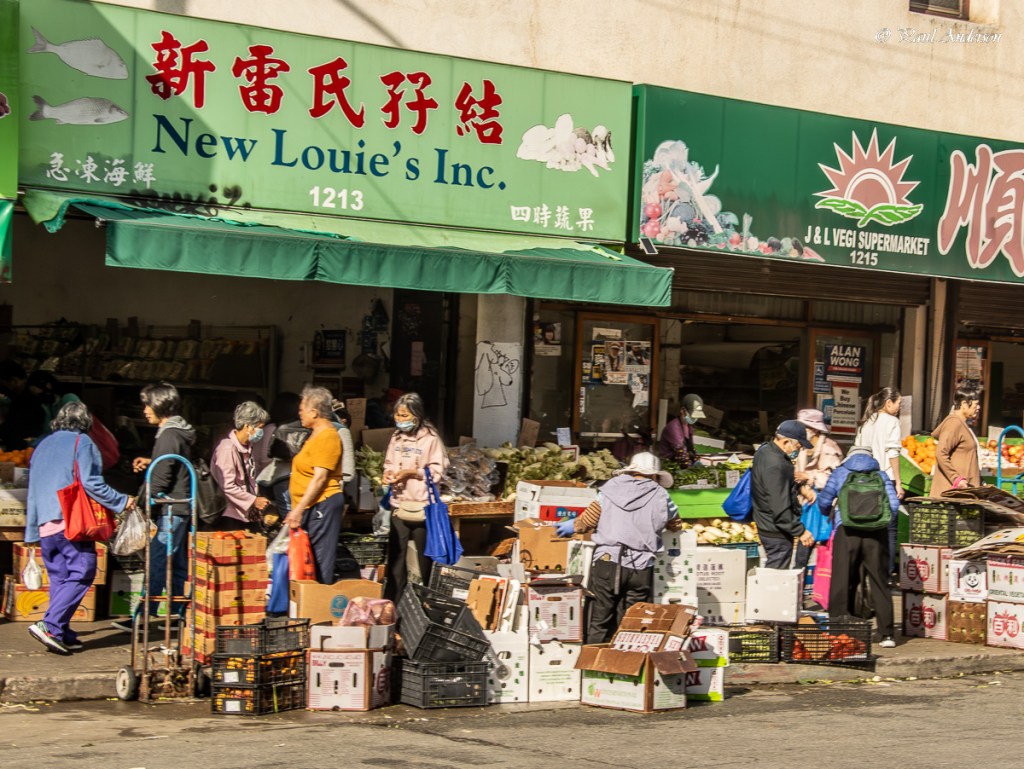
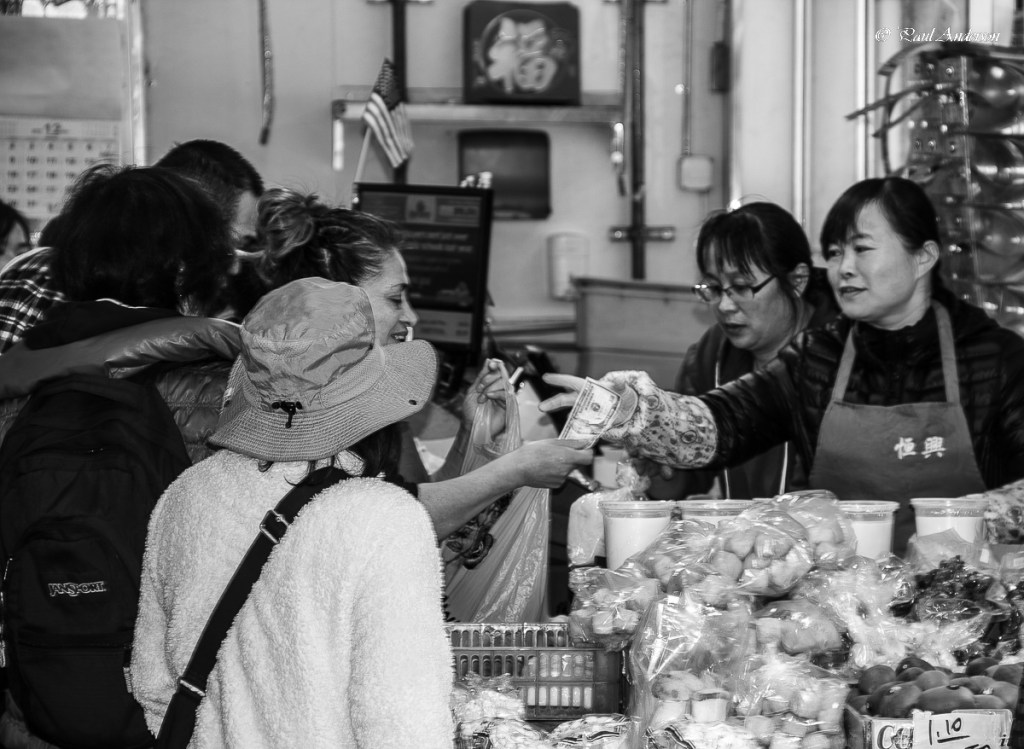
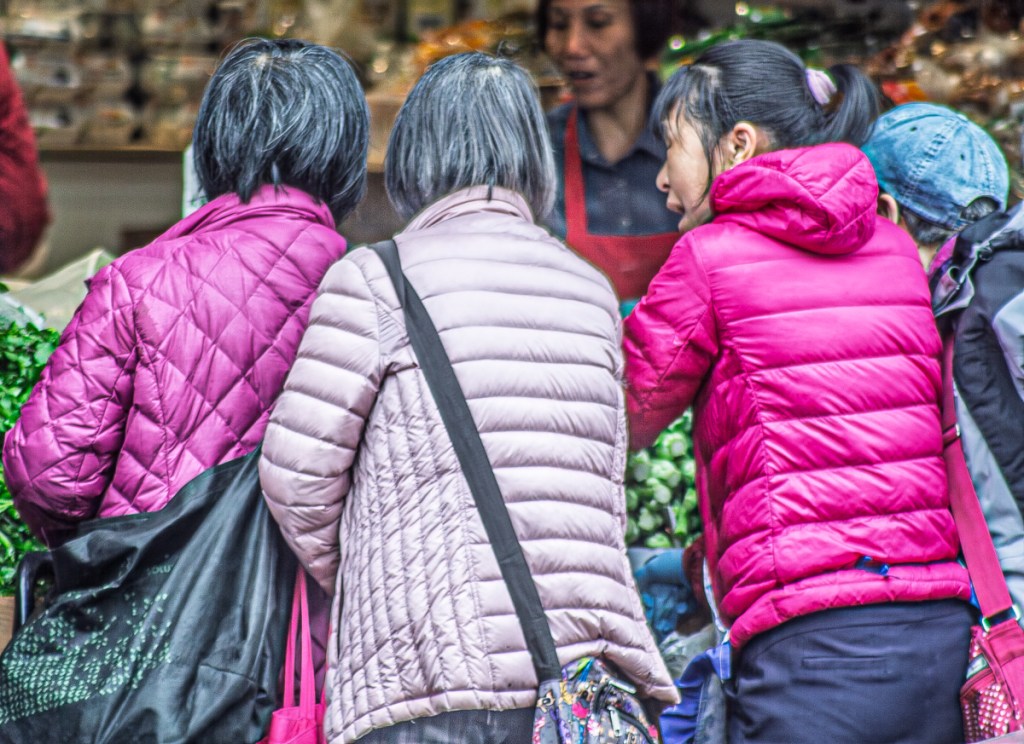
I discovered Stockton Street when I was in junior college and started dating Denise. We met sitting in the far back corner of Senor Castillo’s Spanish class. She claimed that she noticed me because I was staring at her boobs, an accusation that, while quite possibly true, I maintained was a vile slander. I claimed to be admiring her hair which flowed like a silken chestnut river down to the middle of her bottom – which, whenever she stood up, I probably also admired.
Either way we grew to know each other because I spoke Spanish a hell of a lot better than she did and I tried to coach her in whispers while in class, often getting caught and rebuked (in Spanish of course) by Senor Castillo. Whispers in class turned into a date, and then a lot of dates and then we were a couple. Something Senor Castillo noticed, and often teased us about. That said, he still didn’t tolerate the coaching.
That Denise’s Spanish was worse than mine was likely due to the fact that, while my California schooling had been prepping me since elementary school for Spanish, Denise received much of her schooling in Hong Kong – where in the 1960s, Spanish was probably as prevalent as Pig Latin. It didn’t hurt that I was fluent in Italian which was similar enough to Spanish to give me a bit of a leg up (when stuck on a Spanish word during a verbal drill I sometimes tried to sneak in the Italian equivalent but Senor Castillo would have none of that, admonishing me – in Italian – “Qui non parliamo Italiano. We don’t speak Italian here).
Denise’s family was as white, and as American, as Minute Rice. They had lived in Hong Kong because her father worked for the once venerable and now defunct, Pan American Airways. He claimed to be third on the seniority list and because of his tenure, the company awarded him his choice of station. The old man was a racist from Kentucky who wore his hair in a crew cut, drank bad Scotch and smoked cigarettes from a cigarette holder. Much to the embarrasment of his lovely daughter, the old cracker tossed the “n” word around with aplomb. Why he chose Hong Kong is something of a mystery. Maybe he had a bit of the colonialist in him to compliment the racism.
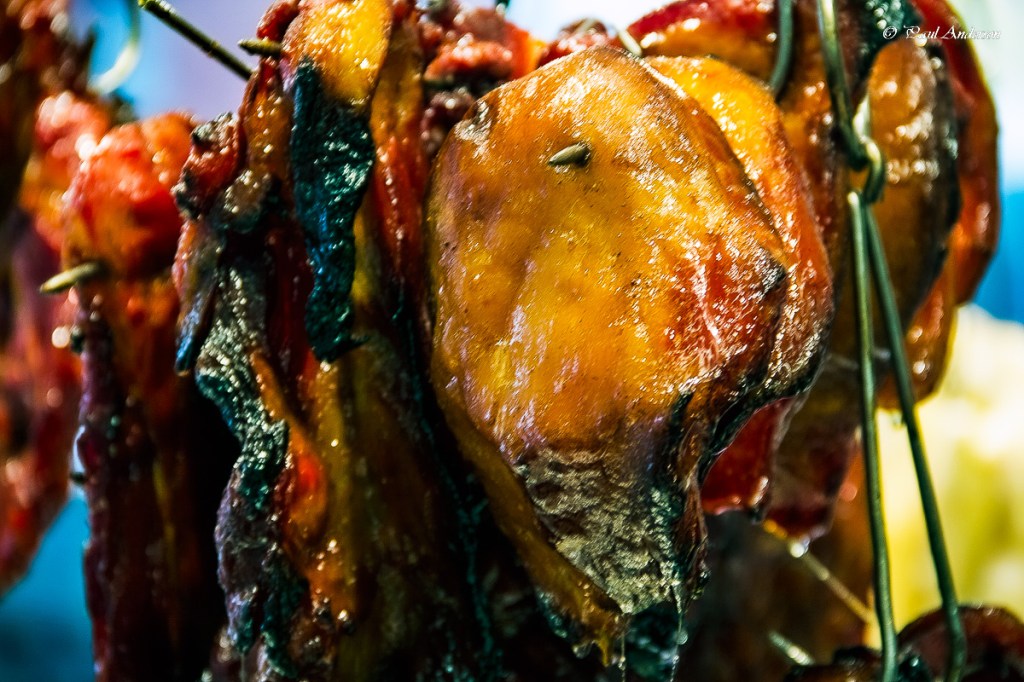
Maybe it was nostalgia for Hong Kong that drew Denise to Stockton Street. When we had the money, which was not easy to come by for two college students, I’d put a couple bucks worth of regular in the tank (when a couple bucks got you a fair amount of gas) and we’d go to Chinatown.We would buy a pound of char siu, that sweet and savory glistening pork, seasoned with five spice, and then munch on the chopped pieces as we weaved through the throngs of shoppers. After wrapping up the leftovers for the drive back home we’d go to a bakery for egg tarts or sesame balls. In autumn Denise introduced me to moon cakes. When we were really flush we’d go to a dim sum joint, where ladies pushed carts laden with all sorts of delights on little plates. Being from Hong Kong, Denise was my food guide, plucking a plate (maybe two if it was really special) of one item off the cart and waving my hand away from others.
Like the man said, all good things must come to an end, and when Denise declared that she was gay, we came to an amicable end. But I was hooked on Chinatown.
A year later I moved to San Francisco, where I shared a flat in a converted Victorian in The City’s Richmond District with Ben, a former coworker. Ben was a transplanted New Yorker, who dabbled in both photography and cocaine. He tried, unsuccessfully, to come off as a Bronx wiseguy; a sort of counterfeit Al Pacino.
My bedroom was the home’s spacious former sitting room, with a bay window that looked out onto 17th Avenue. My room got the morning sun and would’ve been perfect but for the fact that the couple upstairs fucked like rabbits – only louder. And if it wasn’t the upstairs couple it was Ben and girlfriend Gail in the next room. Copulation in surround sound.
It was an affordable time in San Francisco. A time before the city fathers sold out to greed; before the techies barged in, and raised the price of everything, particularly housing, and in doing so, erased the City’s charm, and the cultural and ethnic identities of entire neighborhoods. It was a good time to be an immigrant from suburbia; a time before liberal San Francisco’s end times.
For someone who had grown up in a white middle class community it wasn’t culture shock, it was cultural awakening. I often took the bus where it wasn’t unusual to hear a variety of languages. Depending on the line I was riding it might be Chinese, Japanese, Tagalog, Russian or Spanish. I tasted my first bulgogi; my first pancit; my first lengua, my first piroshki, and my first fat, football sized mission style burrito.
In the 1970s and early 1980s, I moved about in San Francisco, and home was always in either the Outer Richmond or Outer Sunset districts, where the sun is often hidden by The City’s famous and seemingly omnipresent fog. Still, Chinatown became a regular destination and decades later, even though I live in the East Bay separated from The City by a bridge and daunting traffic I still visit often.
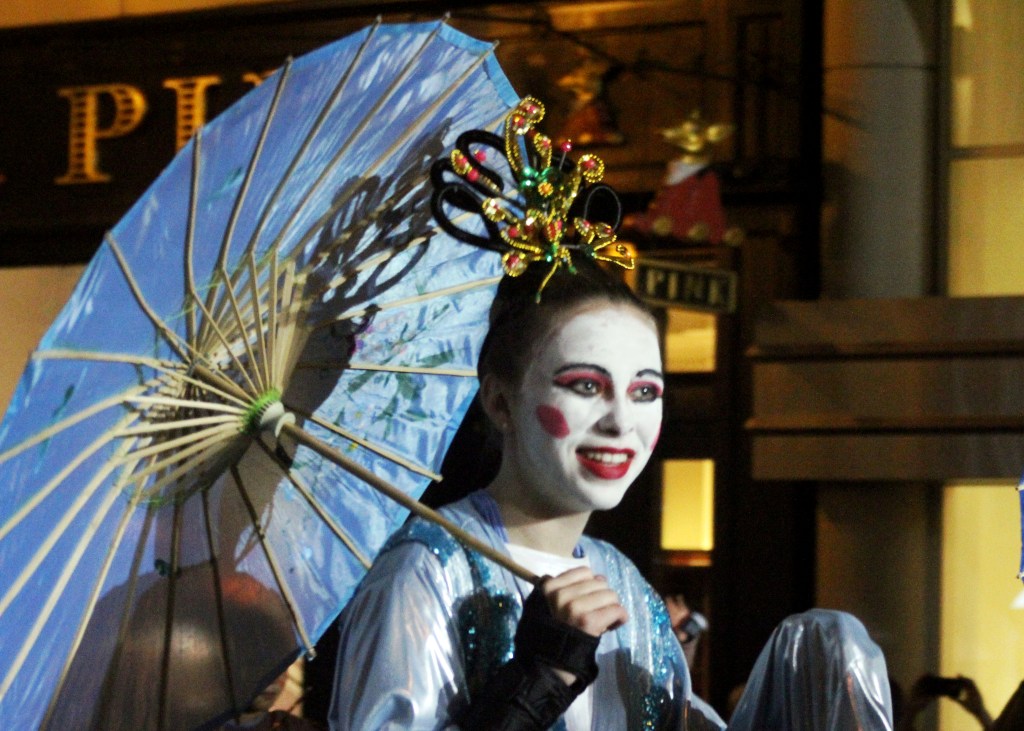
I’m drawn to Chinatown by its color and its vibrancy. On any given day you might happen upon a celebration. Nearly ever block is made brilliant with a mural, each one celebrating the culture of the neighborhood. I love the sounds, the different dialects, and the delicious smells radiating from the restaurants.
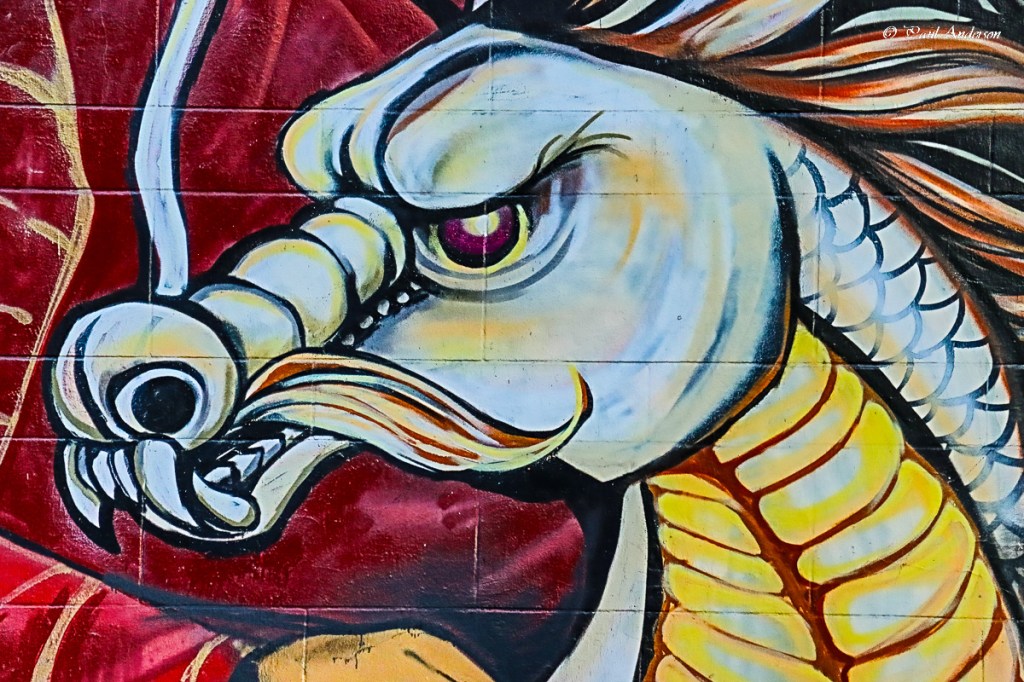
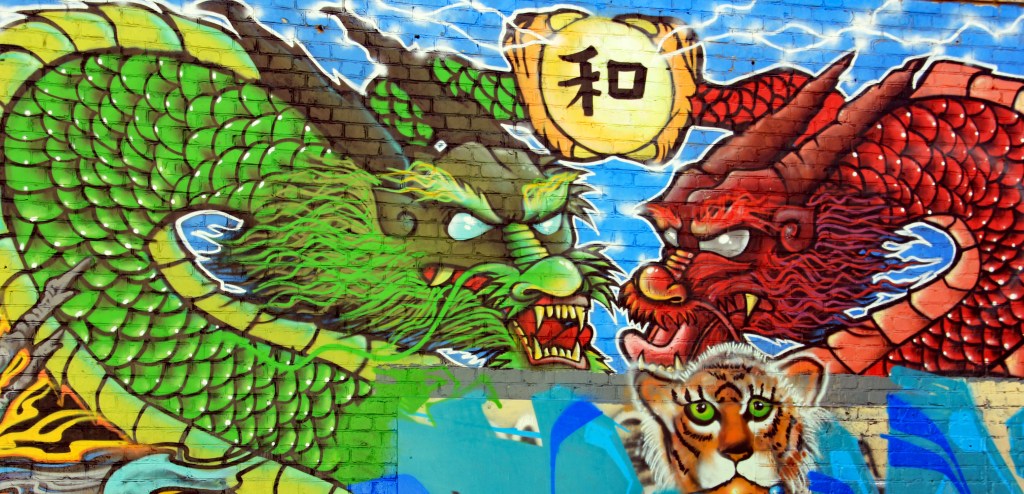
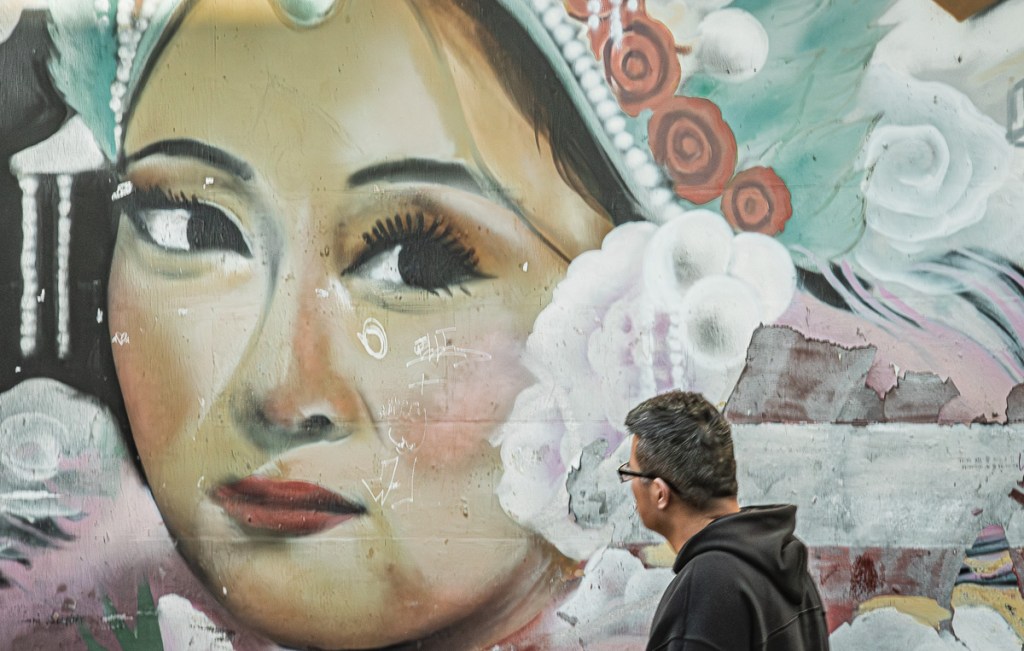
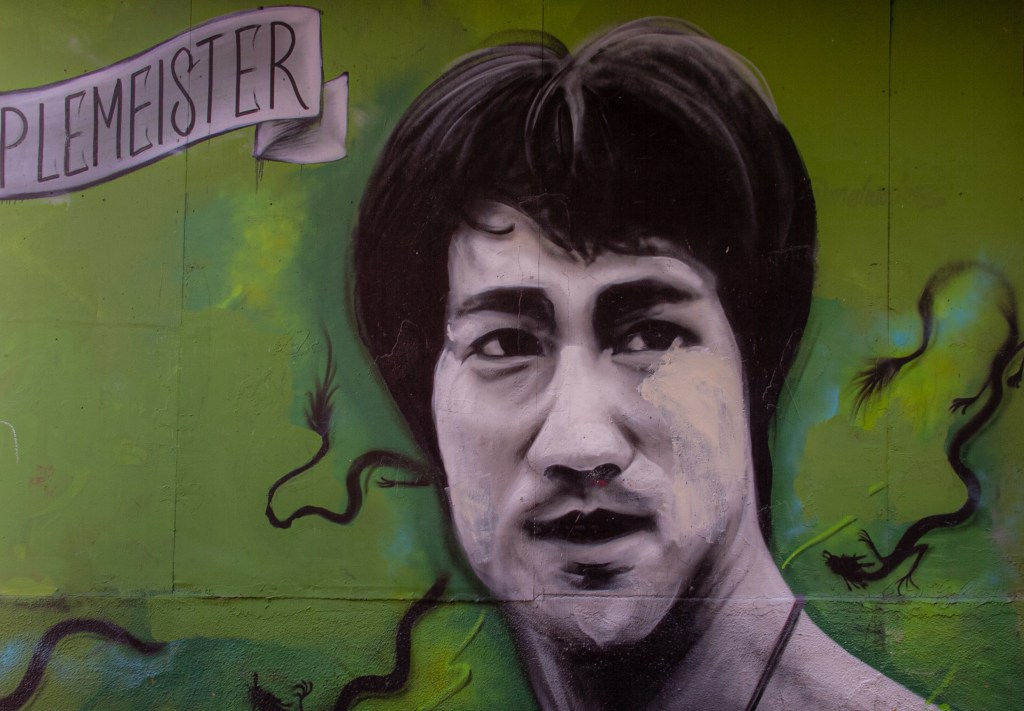
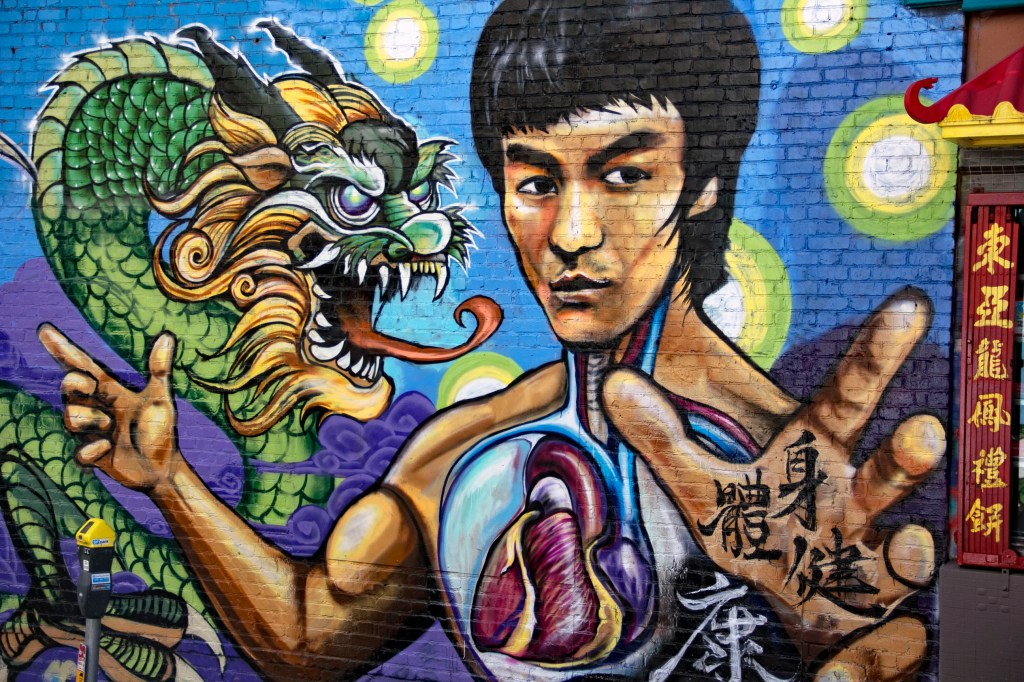
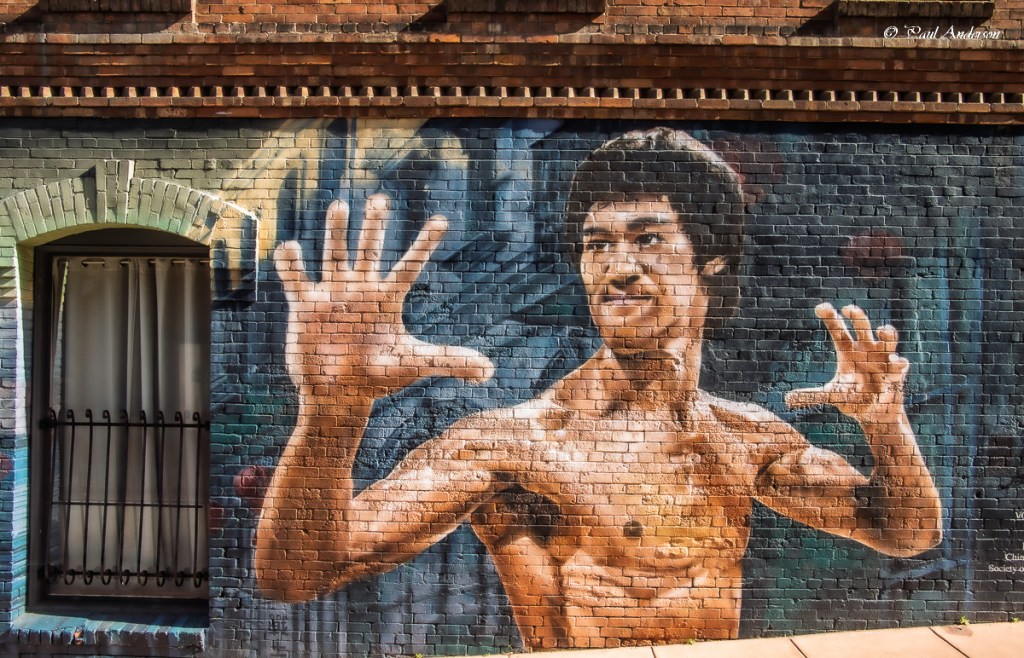
Bruce Lee is a Chinatown icon, though he spent relatively little of his short life in San Francisco. He was born at the Chinese Hospital on Jackson Street, about a half block west of Stockton Street. That was in 1940, and for those of us who watched his movies it seems implausible that he was born before the United States entered World War II. In the spring of 1959, Lee spent three months at 654 Jackson Street, just a half block from Grant Ave. Despite his short residency, the martial arts icon figures prominently in San Francisco with three murals dedicated to him.
Coming soon, The Rickshaw Lounge.
 The Life in My Years
I loved this post Paul–so colorful in pictures and narrative. It’s been more than 30 years since I’ve been to Chinatown in S.F. Your post brought it back to life for me. Thanks!
LikeLiked by 1 person
Hello Anne, I’m so glad that this post made such an impression on you. Even though the businesses come and go, Chinatown really doesn’t really change much. If you were to visit again, you could say that it’s both changed and remained the same.
For me nearly every excursion to San Francisco, which is at least twice a month, includes a stop in Chinatown – if I can find parking.
Paul
LikeLiked by 1 person
A wonderful love letter to Chinatown! The colours and chaos come across beautifully in both your photos and your descriptions. And you’ve reminded me to go back and reread The Joy Luck Club which is also sitting on my bookshelves, having similarly survived several calls.
LikeLiked by 1 person
Thank you for the kind words Sarah.
The nice thing about Joy Luck is that if you don’t want to reread the entire book you can just get a taste before turning off the lights before sleep.
Thank you for visiting
Paul
LikeLiked by 1 person
What a vibrant piece, full of atmosphere and love. It makes me regret that I simply don’t know America ( a quick sortie to Seattle when we visited Vancouver and area many years ago) and it’s unlikely to happen now. Travellers’ tales had put San Francisco firmly on the list of Must Visit places. Your writing about the city certainly brings it to life.
LikeLiked by 1 person
Hi Margaret, Thank you for the kind words.
It’s regrettable that people are either too afraid to come to America or too disgusted – or both. All due to one of the worst people in the world. We have big events on the horizon here – the World Cup, the 250th anniversary, and the Summer Games – and I dread the embarrasment of the certain clown show that will ensue.
Thank you for reading and commenting
Paul
LikeLiked by 2 people
It’s true, your country is sadly not an enticing destination just now. But it will pass. Won’t it??
LikeLiked by 1 person
Yes, I imagine that once the worst man in the country is no longer president and he’s taken his Hitler youth Chief of Staff, Stephen Miller with him along with the rest of his gang of desperadoes (hopefully to a prison cell), it should get better for visitors and (maybe)immigrants.
The damage that has been done in a mere 15 months won’t be corrected any time soon. Some of the damage will outlive me. Some of the damage is most likely irreversible.
A lot depends on the elections in November and the next presidential election. The Republican Party needs to conduct itself like an addict that has hit rock bottom and rehabilitate itself.
As I wrote in a previous piece the remains of the Trump regime and MAGA need to be ripped up branch and root, and thrown in a cleansing fire.
If the elections go favorably then the first stages of recovery will likely result in a more welcoming America
LikeLiked by 1 person
That was heartfelt indeed. You are part of a solid block of Americans who give us over here in Europe hope. Looking at America as presented by Your Leader and his Acolytes from the outside, as we have to, has been an unedifying experience
LikeLiked by 1 person
Hi Paul,
I always love when you write about Chinatown in SF. Of course, it makes me want to visit. The one here in Toronto and in Montreal pale by comparison — in colours, variety of shops, and murals. I loved Joy Luck Club so many years ago, and you remind me how good it was. The movie was ok, but didn’t live up to my imagination of the book.
LikeLiked by 1 person
Hi Eden, I probably have one more post about Chinatown in me. I’m starting to visit some other areas of The City that I’ve not seen recently or have never visited at all. Doesn’t mean that I won’t visit for some char siu or duck to take home.
I agree, about the movie. It was meh. For me that’s how it usually works with movies based on books that I really like. You expect the characters to come to life as you got to know them in the book, and maybe for some viewers they do, but I think that everyone relates differently to literary characters.
Thank you for visiting and commenting.
Paul
LikeLiked by 1 person