
An American’s observations of a first time trip to France.
“Brittany has something of Ireland’s melancholy and Spain’s passion, with its cliffs like fortresses and its villages like sanctuaries.” ~ attributed to Victor Hugo.
Every July, year upon year, almost without fail, I cruised the French countryside. I rumbled over the narrow cobblestone streets of quaint country villages, where I marveled at the centuries old churches that seemed to want to grasp the very heavens above. I traversed rolling hills, and cut through vast vineyards where row upon row of vines stretched so far that only the birds above could appreciate their boundlessness . I marveled at the magnificence of chateaus tucked in green valleys or perched on rocky hilltops. I journeyed on winding roads that snaked up mountains or provided panoramas of crashing coastal waves.
Every July I did that, and year after year it never dawned on me that I should take the time to see those sights in person. You see, every year I saw France through the eyes of the commentators covering the Tour de France. There really is no better travel video than a stage of Le Tour. And there’s a different episode nearly every day of the month of July. This was my annual journey to France until the long hiatus that came when the truth about Lance Armstrong emerged. The truth that cyclists like me wanted to believe was all vicious rumor – until there were no denials left to find in the bullshit bag.
During all those years, why did it never dawn on me to see the beauty of France, learn its history, and experience its culture?
In the end, it wasn’t even Le Tour that inspired us to go. Early in June of 2025, Cora and I, both of us history buffs, were watching a documentary about D-Day. As the film was winding down I turned to Cora and said, “Fuck it, let’s go to France.”
Done.
We started in Paris and then drove to Normandy (both documented in previous posts).
I’ve locked up the rental house in Ver-sur-Mer that was our Normandy home and we’re headed six kilometers up the coast to Courseulles-sur-Mer, one of the many little seaside resort towns that eighty-one years ago were the first to be liberated from the German Army.
Breakfast of pastries and coffee at Boulangerie du Port – Maison Trihan. Because when you’re in France you don’t pour yourself a bowl of Sugar Frosted Flakes. Even Tony the Tiger would concede that compared to a French croissant, Sugar Frosted Flakes are not so grrrreat!
We’ll be driving southeast today, slicing across the bottom of the Cotentin Peninsula and into Brittany. But not so fast. Just outside of Courseulles-sur-Mer is the Juno Beach Memorial where, on June 6th 1944, 14,000 Canadian soldiers landed. It’s a last brief stop to pay my respects to Normandy, and to take a few photos to share with Eden, my Canadian friend.
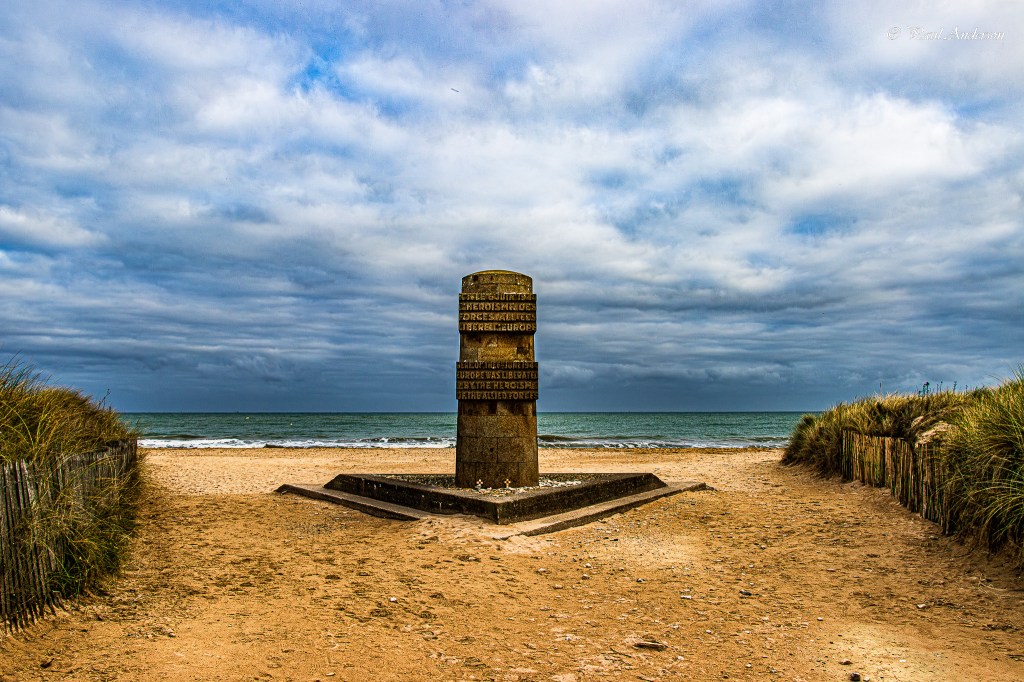
Below: The Signal Monument of Juno Beach. Designed to represent the bow of a ship coming from the Channel, this is one of ten similar monuments erected on the Normandy Coast.
Below: The “1 Charlie” Tank Monument is a Canadian AVRE (Army Vehicle Royal Engineers). At nine in the morning on June 6th, “1 Charlie” landed on Juno Beach. It soon became mired in a 65 foot crater. Of the crew of six, four members were killed and two badly wounded.
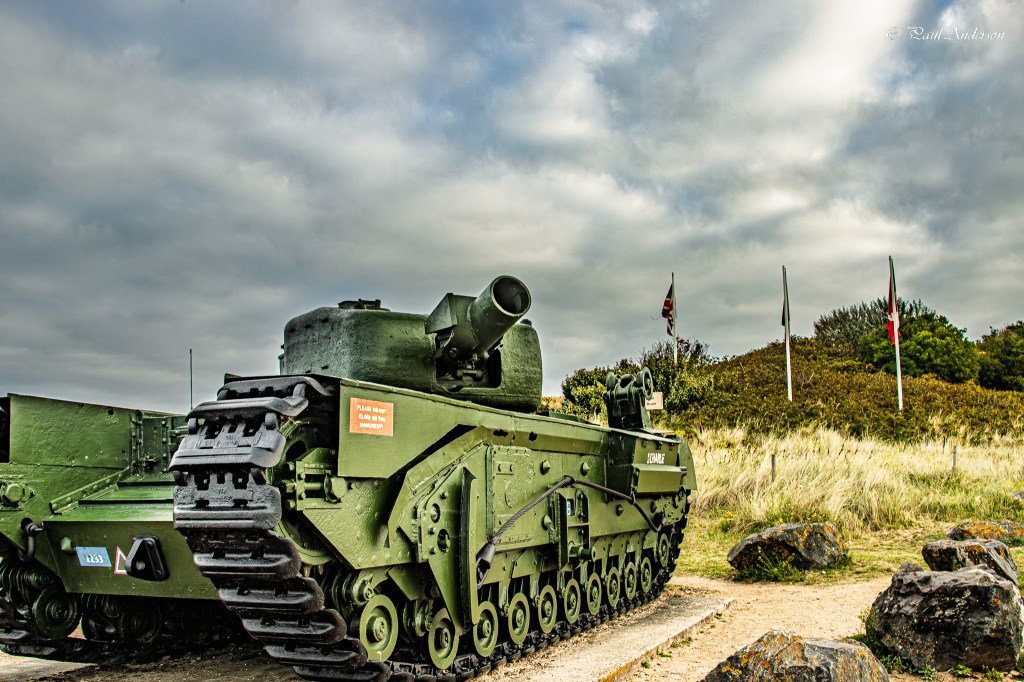
The tank was buried until 1976, when it was recovered and refurbished and placed as a memorial.
Bill Dunn, the driver of “1 Charlie” gave an account of what happened that day. Dunn described how the design of the tank restricted his vision. Because of his restricted view, and because the Germans had flooded the entire area, Dunn didn’t see a culvert in front of the vehicle before the vehicle plunged in. As Dunn tried to drive the tank out, the track snapped. The vehicle began to take on water.
Dunn said, “For me being in the front I was the last one out.” He continued, “The bullets were flying all over the place. I was the last man out and I started to swallow water. I was the last one out and as my co-driver got out he put his knees on both sides of my head . . . as he came out he dragged me with him.”
Dunn went on to describe how the crew took cover in the dunes. Shortly afterwards a mortar round struck, killing three of the men outright. One of the wounded attempted to crawl to get help but died after making it 100 yards. Dunn rolled to a place that he thought was safe but that turned out to be a minefield. With one leg fractured in five places, Dunn managed to run to safety.
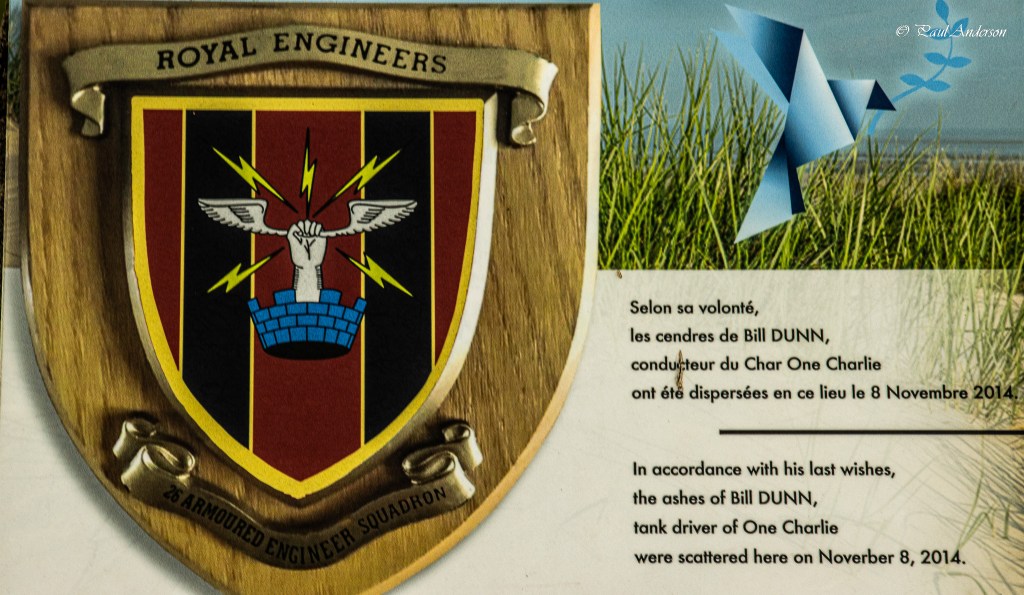
Seventy years later, Bill Dunn’s ashes were scattered at Juno Beach.
Further down the beach I come across the remains of a German pillbox.
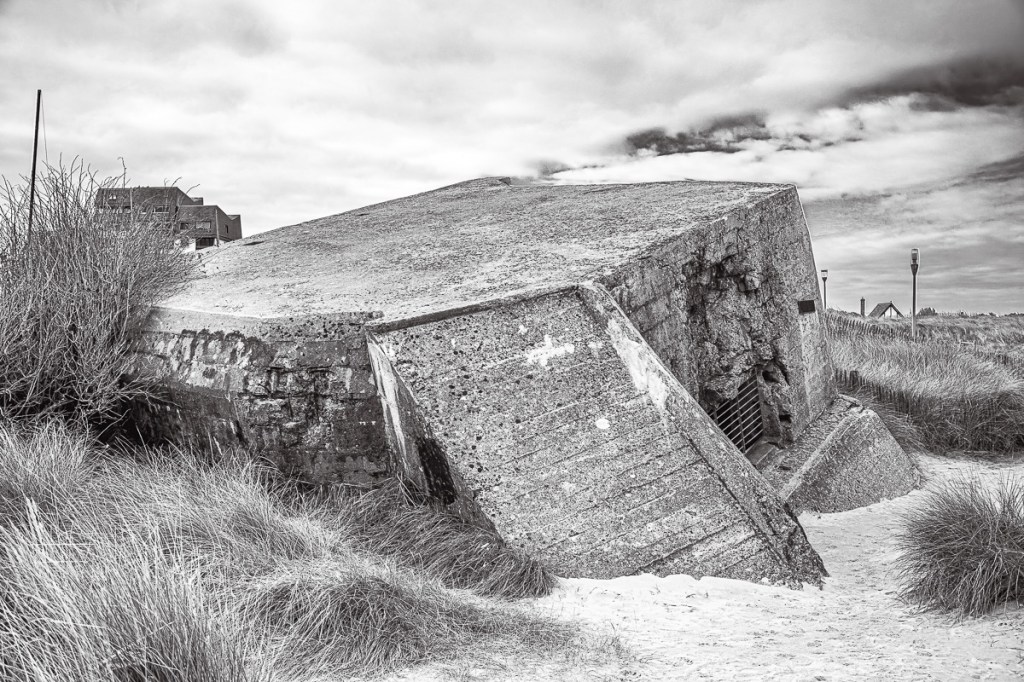
It’s enough. Time to go back to the car. Walking the beaches of Normandy you could shed enough tears to float a ship. You’re at once awestruck by the heroism, while saddened by the sacrifice and loss. You’re also left shaking your head at so-called leaders who are so ignorant that they feel that they can start a war on a mere whim. Because it’s not they who will be asked to kill, or to risk being killed.
Our first stop is the Côtes-d’Armor in the north of Brittany where Cap Frehel extends into the Bay of Saint-Malo. It’s here where Cora and I will step back seven centuries.
Fort la Latte
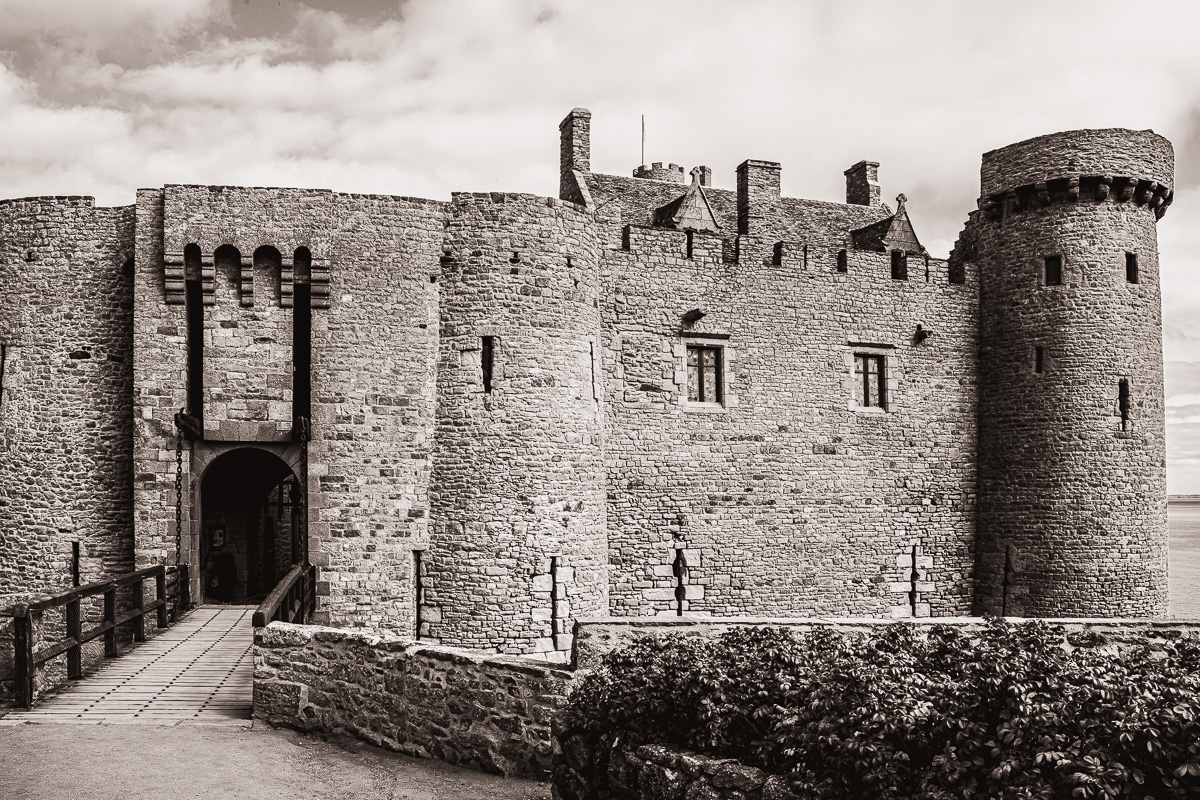
It’s a winding path through a small forest that travels from the parking lot towards the fort. Round a bend and then – there it sits on a rocky promontory jutting out into the Bay of Saint-Malo. It looks as if it could’ve jumped from a film screen. And it has. From the 1931 French film, Le parfum de la dame en noir (The Perfume of the Lady in Black), to a 2018 music video clip titled Tasnif-e magali Kurdi, by the French medieval band Soñj.
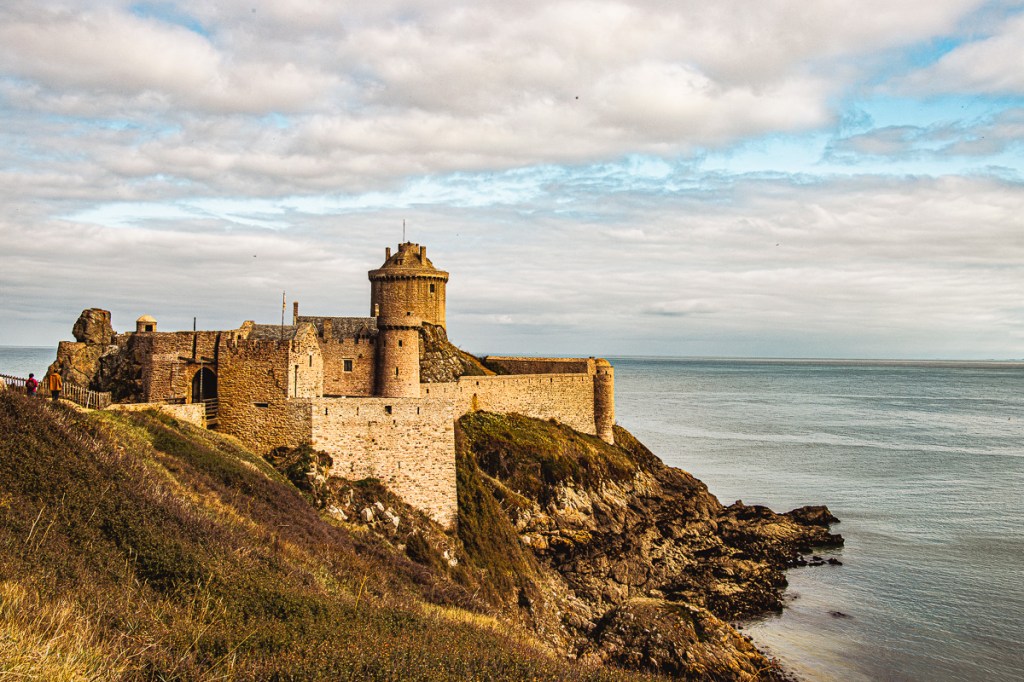
Construction of La Roche-Goyon (Castle of the Rock Goyon) began in the 1340’s, and was completed when a dungeon was added around 1370. Because what self respecting castle doesn’t have a dungeon?
During the Breton War of Succession the fort was besieged and captured by the French knight Bertrand du Guesclin, aka “The Black Dog of Brocéliande” (What a name. The stuff of movies).
In 1597, the castle was captured and burned during the Wars of Religion. Because you can’t have religion without over thirty years of war. Right? Just ask U.S. Secretary of Defense Pete Hegseth, who preaches death and violence while he quotes (and tortures) Scripture. But I digress.
Built with defensible approaches in mind, there are only two ways to get into the fort. One is to approach by sea and then climb the rocky cliffs. The other, the one approved by the local authorities, is to walk down the path. Because Cora can’t swim and neither of us are so young any more that we can clamber over boulders we’ve chosen the latter. The day is perfect for taking photos as the clouds provide for a magnificent backdrop.
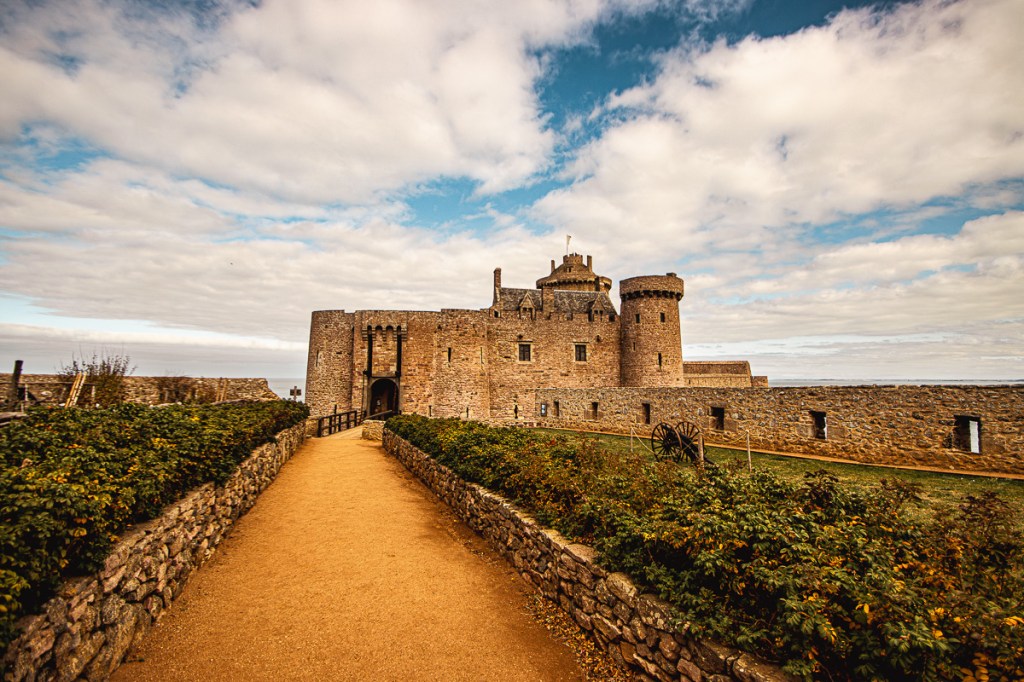
Off to the left of the entrance which has two gatehouses and a functioning drawbridge is a battering ram, only for use in case of an accidental lockout.
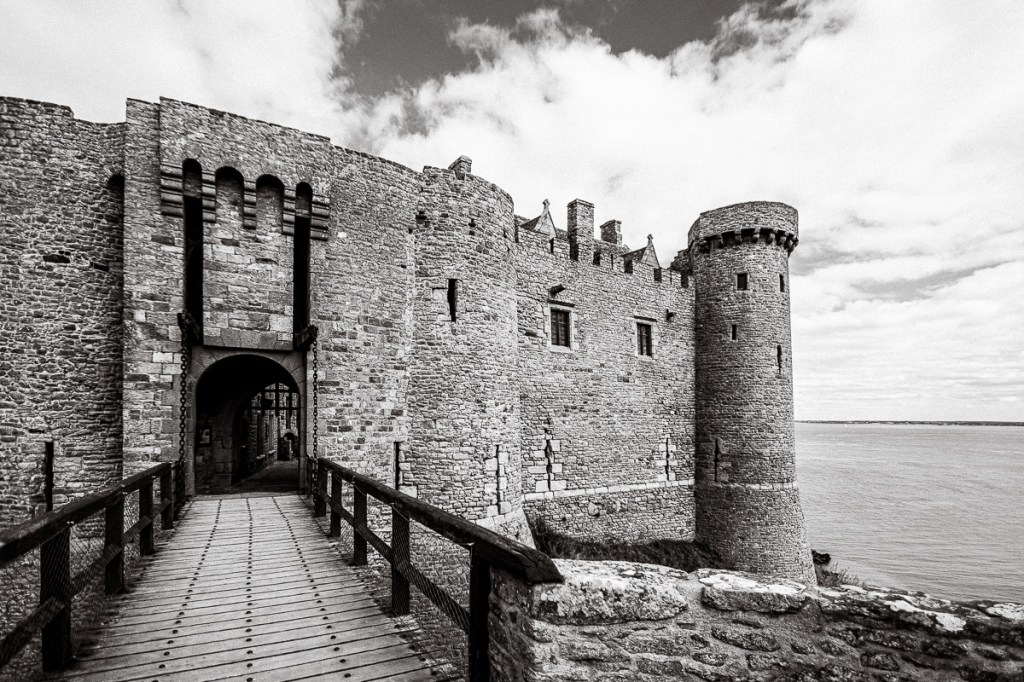
Once inside, Cora and I walk around and explore the courtyard.
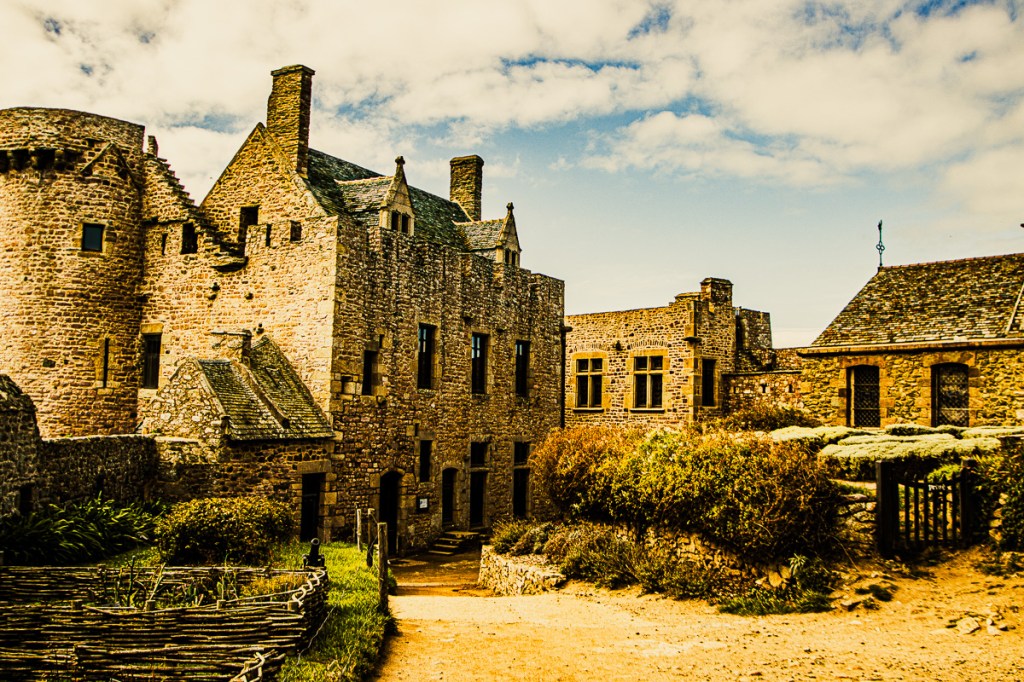
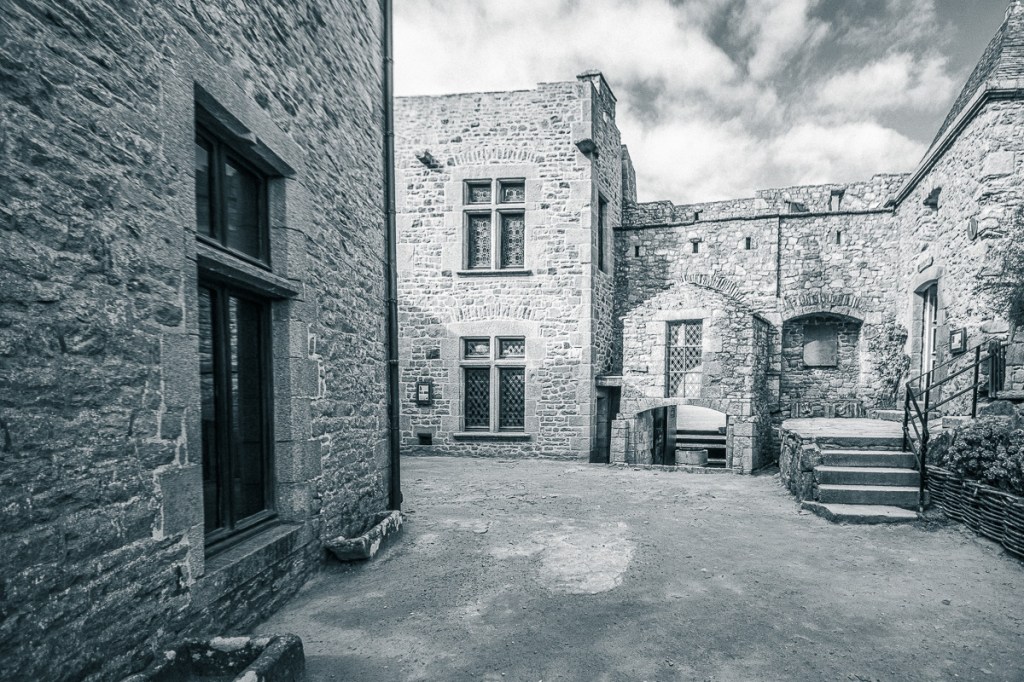
Inside the fort, there’s a small, simple chapel.
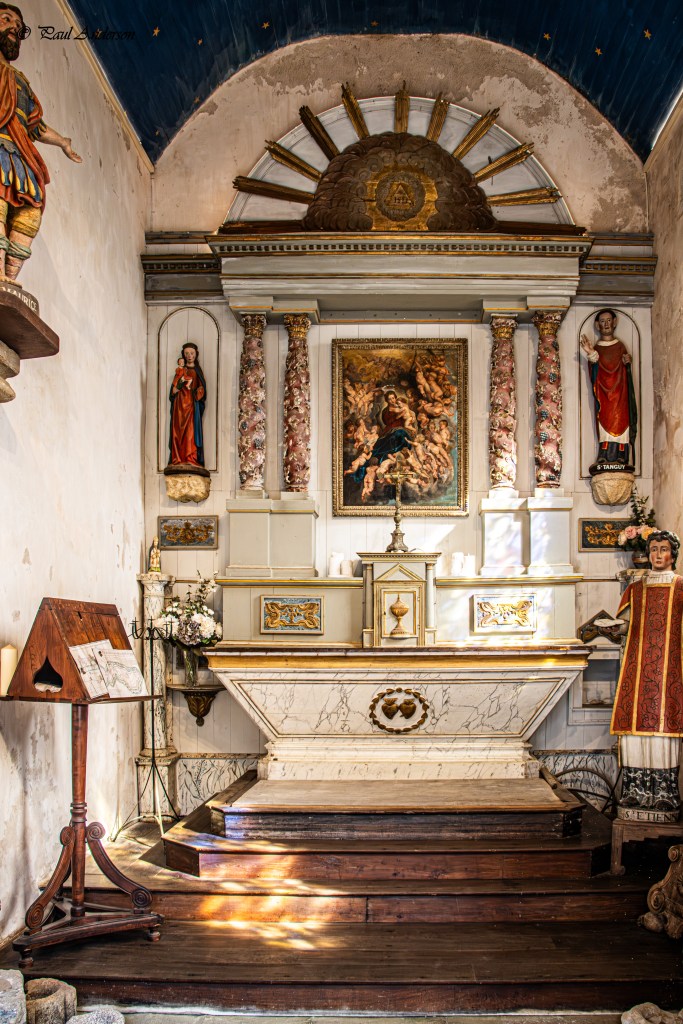
Okay, it’s simple when compared to the other churches we’ve visited.
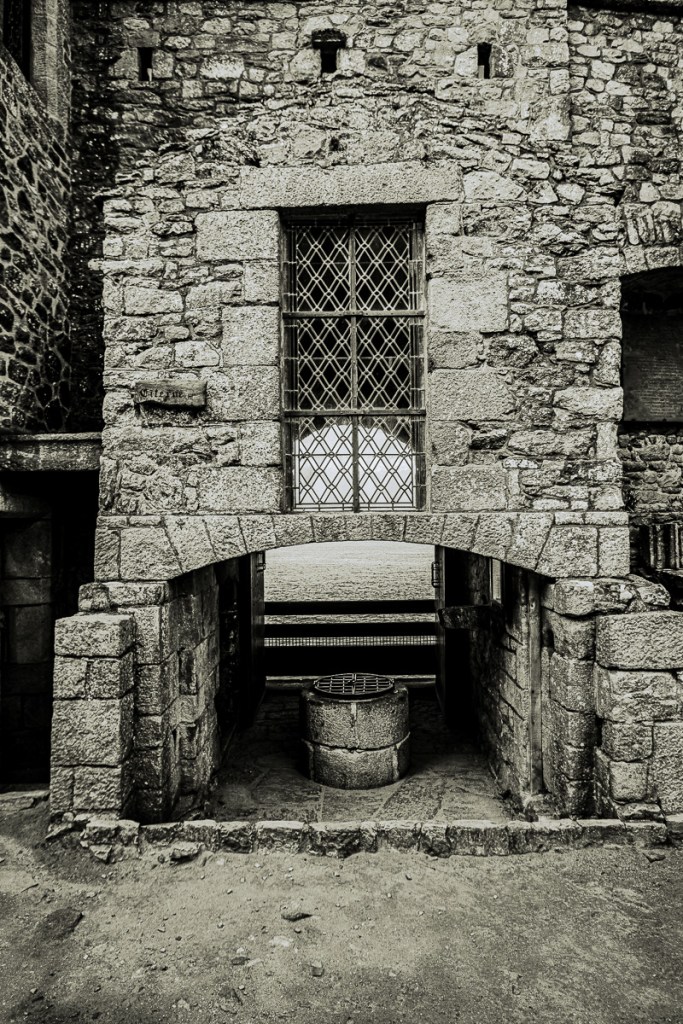
Below: The castle’s cistern.
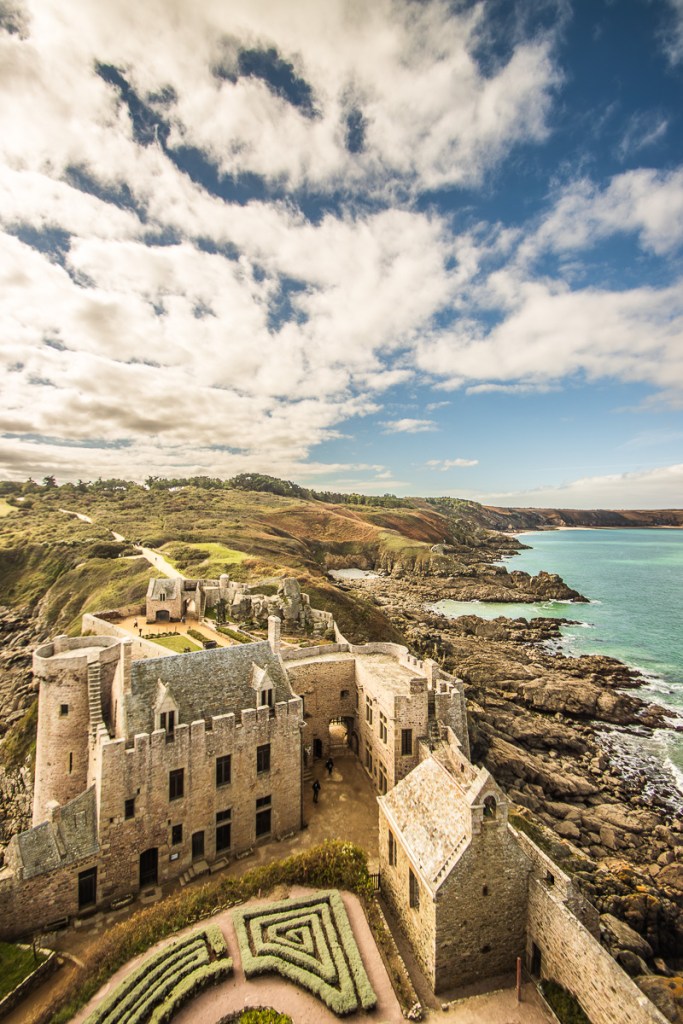
The best views are kept atop the castle’s keep (the keep is the large tower, often considered the last line of defense).
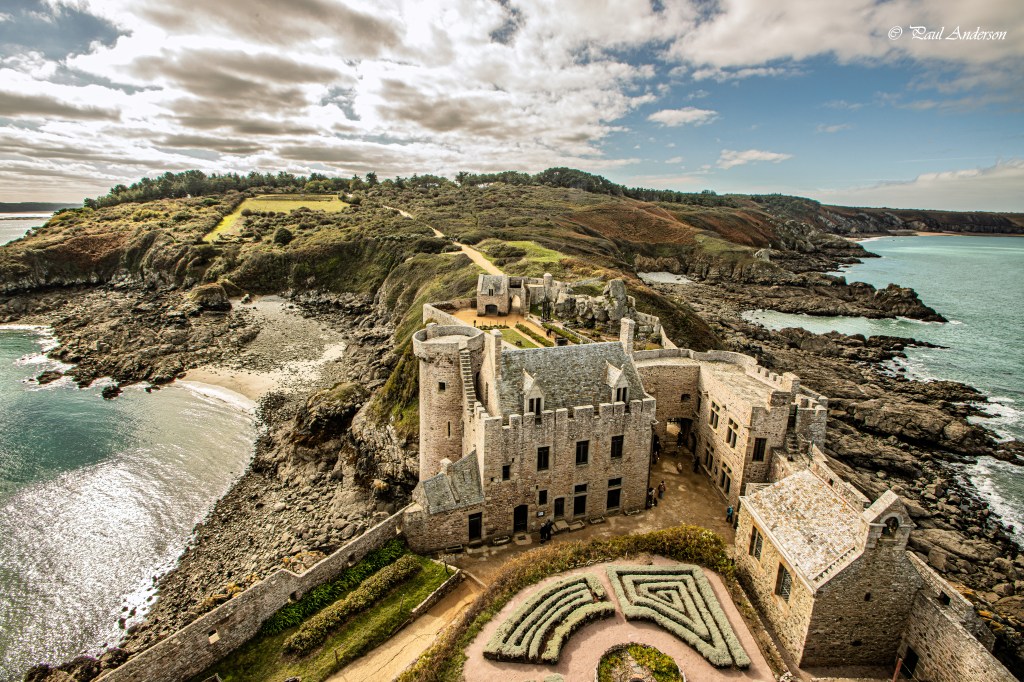
The challenge isn’t so much the number of stairs but each individual steps which can be uneven and narrow. The view is worth the climb.
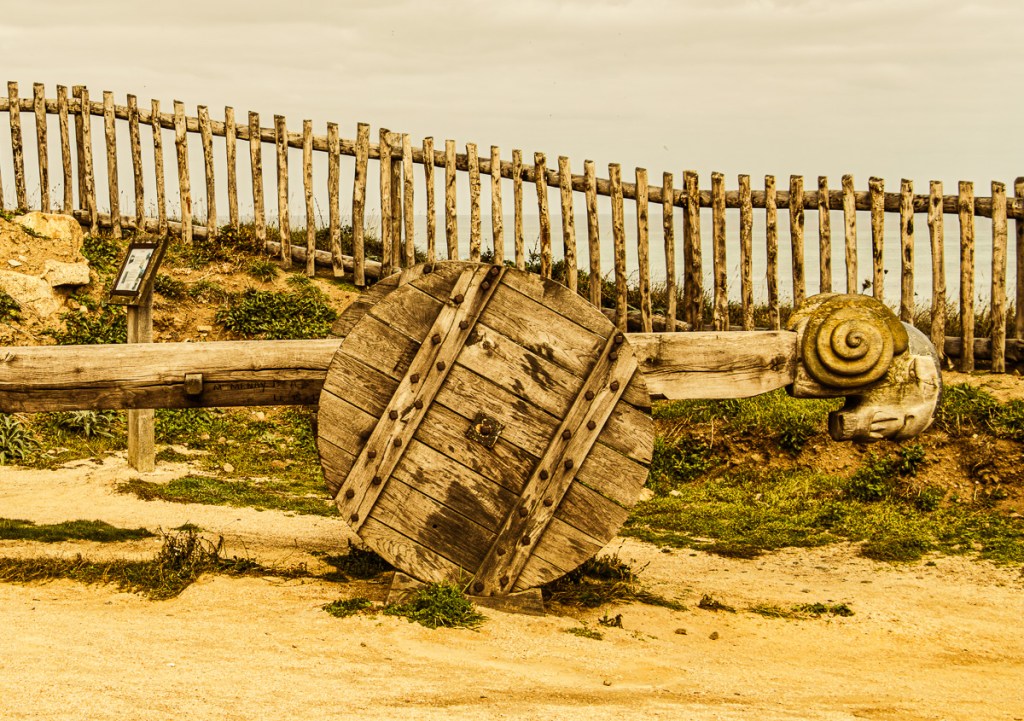
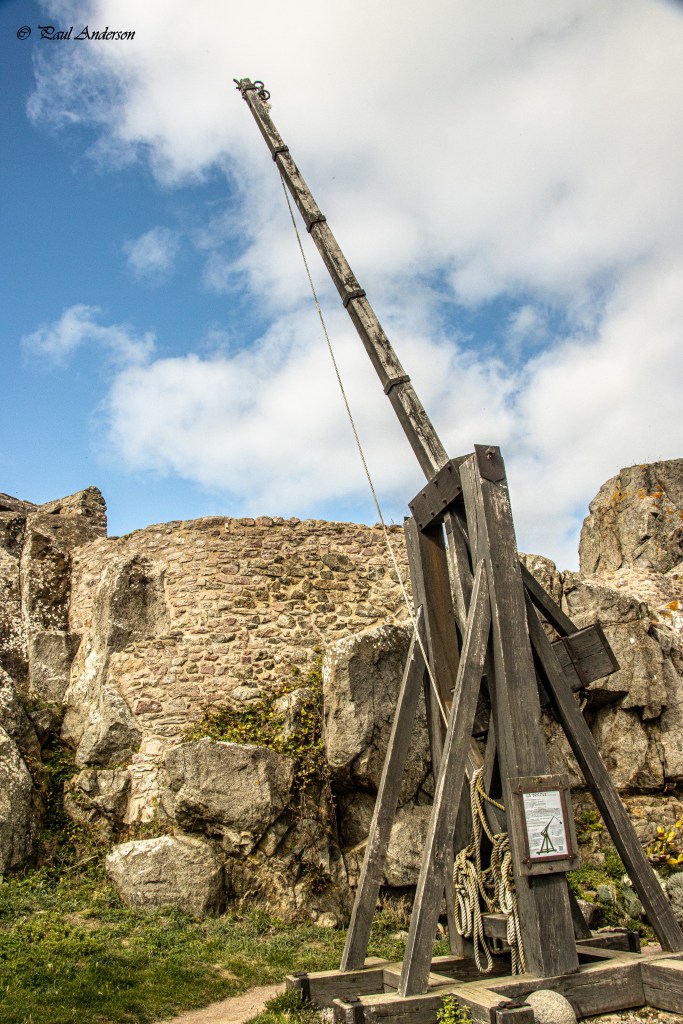
Also on display on the grounds is the implement shown below which comes in handy when invading armies, or solicitors trying to peddle a solar service, or their religion, show up at the front gate.
The walk back to the parking lot seems to never end There are other places on the itinerary today but some will have to wait until tomorrow. The others?
You can’t see everything.


Oh Paul, what a tour and what an opening to this blog. I love your writing more than your pictures, and that’s saying a lot because I love your pictures. How’s that for a run-on sentence! I’m looking forward to more from France.
LikeLiked by 1 person
Hi Anne, Thank you so much for the kind compliments.
Paul
LikeLiked by 1 person
Thanks for the tours and insights. I enjoyed this article very much.
LikeLiked by 1 person
Thank you Neil.
LikeLiked by 1 person
Now that’s a Proper Castle, and I love your account of it. And the French WWII beaches continue to be evocative and produce an emotional response, even as the survivors of those battles become fewer and fewer in number. On a lighter note, you will doubtless be jealous to learn that during our years in France, the TdF passed not once, but twice directly in front of our house!
LikeLiked by 1 person
Hello Margaret, It absolutely is a proper castle. A tall keep, dungeon, primitive weapons or war, paean to Christianity, and a cannon.
Yes I am jealous. How exciting. I would’ve been out front waving an Italian flag (my paternal family is Italian). Being on the route of Le Tour once is great luck. The second time would have me buying lottery tickets.
Thank you for reading and commenting
Paul
LikeLiked by 1 person
Hi Paul,
It’s good to get the accounts of war history, filtered through after you, especially after you’ve stood on the very grounds where it took place. I would’ve bawled buckets reading all the memorials.
We don’t learn from history, do we?
Pix, as always, are fantastic.
LikeLiked by 2 people
Hi Eden,
No we DO NOT learn from history. In fact here in America we (we being the current regime) take history and shape shift it, so that what ever is gleaned (which is not learning) is jingoistic fiction.
Thank you for the kind words.
Paul
LikeLiked by 1 person
That’s such a dramatic location for a castle, and you’re right, the sky really does add extra drama to several of your shots! Your comments about war are of course so apposite for our times and also a reminder that in that respect little has changed over the centuries. How we fight may have done so, but why we fight and the consequences of fighting remain pretty much the same, sadly.
By the way, if you like ancient castles you should visit Northumberland in north east England. It has over 70 – some mere ruins, some still inhabited today.
LikeLiked by 1 person
Hello Sarah,
Yes, why we fight has not changed, though Trump may have broken the mold because nobody, not even the regime itself, can provide a mutually agreed upon reason for why we’re mired in the current one. I fear that the way of war makes it so much easier to wage war. It’s detached. People, including non combatants, are images on a screen. Maybe war should be fought as it was in WWI so that the horror and the loss is not so abstract.
Cora and I have been considering the idea of visiting the U.K. I have a particular fascination with Scotland.
Thank you for the visit.
Paul
LikeLike