
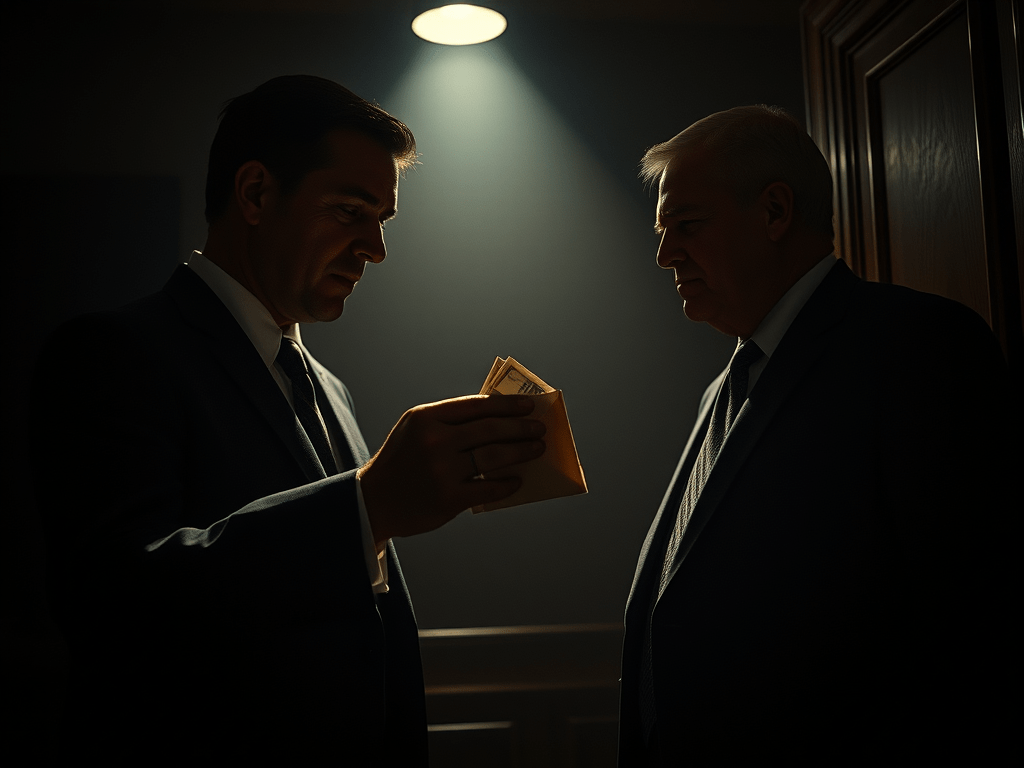
Jason Barone: “I’m starting to feel a little intimidated.”
Paulie ‘Walnuts’ Gualtieri (Tony Soprano’s brutal henchman): “As well you should my friend. A man who teaches skiing for a living, ought to look after his physical condition. Wouldn’t you say? His knees. You wouldn’t be in this situation had you listened to Tony in the first place.”
A scene from The Sopranos
Unless you live in the State of Indiana, you can be excused if you don’t recognize the name, Victoria Spartz. Victoria Spartz is the Republican U.S. representative for Indiana’s 5th congressional district.
Congresswoman Spartz was of a mind to bravely vote a “hard no” (her words) against House Speaker Mike Johnson’s (and Trump’s) budget reconciliation bill. I say bravely because for a Republican to try to swim upstream against the river Trump is to risk drowning in scorn and threats. CNN’s Manu Raju asked Spartz whether she would give in to pressure from her GOP colleagues. Spartz replied, “You don’t know me well enough.… You should know better than that by now. We cannot be weak, and we have to do the right thing for the people.”
That was until Donald Trump got Victoria Spartz on the phone.
Spartz was in the Republican cloakroom when she took the call. Her colleagues heard Trump screaming and berating Sparks, calling her a “fake Republican” and reminding her that he was the president.
As Spartz left the cloakroom, Speaker Johnson put a hand on her shoulder and said, “You know what you have to do.” There were no reports about whether or not Johnson was holding a lead pipe when he approached Spartz, or whether Johnson was accompanied by a guy named Silvio, wearing a tacky white gym suit, sporting slicked back hair and a menacing scowl.
Spartz flipped. Apparently doing “the right thing for the people,” took a back seat to the idea of getting politically “knee capped.” In the end, Spartz said, “I trust his (Trump’s) word.” Yeah, how many betrayed associates and stiffed contractors have uttered those words? “I trust his word.” Victoria Spartz is a liar, or a coward, or an imbecile.
Trump’s word. As reliable as Monopoly money. Given the fact that she’s facing the threat of the President of the United States, I’d like to give Spartz a pass, but no. At some point someone has got to stand up to Trump. Okay, you get primaried, you lose your congressional job, you’re out of work – find another job. Your own constituents who work for the government are being summarily fired in unheard of numbers, while being told, in insulting, ‘you didn’t do your job,’ terms, to go work someplace else and you, Ms. Spartz, are afraid of being primaried. Shame on you. You, as a congresswoman, have unlimited job prospects as opposed to those recently fired constituents who are staring into the void.
“I’m gonna make him an offer he can’t refuse” Don Vito Corleone
Wherever there’s a quid, a pro quo can’t be far behind.
What is a quid pro quo? Merriam-Webster says,
: something given or received for something else
also : a deal arranging a quid pro quo
The exchange can be perfectly legal, as in, ‘Sure you can borrow my truck for your move, but I want you to buy me dinner.’ Or, it can be perfectly illegal such as a payoff or promise of gifts by a contractor to a government purchasing agent in exchange for being awarded a contract to supply goods or services.
In September of 2024, New York City Mayor Eric Adams was indicted on five federal charges: bribery, conspiracy, fraud, and two counts of soliciting illegal foreign campaign donations. The government claimed it had Adams dead to rights, slam dunk case, caught red-handed; choose your idiom. Adams of course, denied the charges.
Two months later, Donald Trump was elected President.
Three days before Trump’s inauguration, Mayor Adams visited Trump at Mar-a-Lago and according to a statement issued by the mayor, the two “had a productive conversation about New York’s needs and what’s best for our city, and how the federal government can play a more helpful role in improving the lives of New Yorkers.” In his statement, the mayor added, “To be clear, we did not discuss my legal case …” (emphasis, mine)
Oh, perish the thought.
Three weeks into Trump’s term, and a week after being sworn in, brand new Attorney General Pam Bondi, a dyed in the wool election denier and Trump bootlicker, asserted that the Adams case, which a few months prior was considered by Justice to be a slam dunk, was suddenly, “no good.” It was ordered that the charges against Adams should be dismissed.
To be clear the prosecutor can’t just dismiss the charges. A judge has to approve a motion to dismiss. Prosecutors were instructed to go before a judge to make a motion to dismiss the case without prejudice, meaning that the case would be dismissed, but at the Justice Department’s discretion, could be resurrected (if dismissed “with prejudice,” the case would be dismissed forever). But why dismiss “without prejudice,” if the case is “no good?”
Upon receiving the order to make the motion to dismiss, the federal prosecutor in charge of the case, Danielle Sassoon, refused, asserting in her letter of resignation to Pam Bondi that the administration had in effect asked Adams for a quid pro quo. Sassoon wrote, in part, “Adams has argued in substance—and Mr. (Acting Attorney General) Bove appears prepared to concede—that Adams should receive leniency for federal crimes solely because he occupies an important public position and can use that position to assist in the Administration’s policy priorities.” (emphasis, mine)
Later in her same letter to Bondi, Sassoon is more direct in her accusation of a quid pro quo, “In your words, ‘the Department of Justice will not tolerate abuses of the criminal justice process, coercive behavior, or other forms of misconduct.’ Dismissal of the indictment for no other reason than to influence Adams’s mayoral decision-making would be all three.”
The Quid?
The Justice Department was offering Adams not a get out of jail free card but a ‘maybe you get out of jail free, but there’s a price to pay, and a sword over your head’ card.
The price, or pro quo?
The City of New York has numerous sanctuary laws which would make it illegal to, in certain cases, assist with federal immigration officials, in particular, U.S. Immigration and Customs Enforcement officials. Those bodies are prohibited by city law from operating in city facilities (jails for instance, and specifically Riker’s Island). Following a February 13th meeting with Tom Homan, Trump’s border czar and head deportation guy, Eric Adams announced that he would issue an executive order overriding the sanctuary law, something Adams doesn’t have the authority to do. It doesn’t matter whether one agrees with the law or not, Adams didn’t have the authority to essentially say, “don’t enforce this law.”
And the sword?
Recall that the motion to dismiss the Adams case is without prejudice, meaning that the Justice Department could refile the charges at any time, if, for instance, Adams wasn’t cooperative. A specious accusation?
On February 14th, Adams was on a broadcast of Fox and Friends. During the 20 minute interview he was sitting on a white couch with Tom Homan seated to his immediate left. During the interview, which was light and jolly, the hosts, Adams, and Homan were literally celebrating Adams’ “alliance” as host Brian Kilmeade called it, with ICE. The joviality was suddenly muted, at least on Adams’ end, when Homan in a still jovial but clearly ominous tone added, “If he doesn’t come through, I’ll be back in New York City. I’ll be in his office, up his butt, saying, ‘Where the hell is the agreement we came to?’” (emphasis, mine) At least he didn’t ask Adams what size he takes in cement overshoes.
During the course of the drama behind the motion to dismiss, six more prosecutors also resigned in protest. The last to resign, Hagan Scotten, wrote a blistering letter which said in part, “Any assistant U.S. attorney would know that our laws and traditions do not allow using the prosecutorial power to influence other citizens, much less elected officials, in this way (emphasis, mine). If no lawyer within earshot of the President is willing to give him that advice, then I expect you will eventually find someone who is enough of a fool, or enough of a coward, (emphasis, mine) to file your motion. But it was never going to be me.” Finally, a moment of righteousness and courage.
Scotten is not some hack ambulance chaser, or as Donald Trump might assert, a “DEI hire”. Scotten is a nine year Army veteran who served three tours in Iraq and earned two Bronze Stars. He is a graduate of Harvard Law School and served as a law clerk for future Supreme Court Justice Brett Kavanaugh, and future Chief Justice John Roberts. And, for good measure, Scotten is a staunch conservative.
One troubling aspect that looms is that the motion to dismiss is being presided over by Judge James Ho, a Trump appointee whose wife, an attorney, received large payments from the Alliance Defending Freedom, a conservative religious group that challenged the legality of the FDAs approval of Mifepristone. It doesn’t necessarily make Ho, a Clarence Thomas, but it is cause for my own concern.
Tyranny of the billionaires
Trump has a long history of intimidating witnesses and judges either through his own words or through the words of his associates. Those veiled threats and accusations of bias and “witch hunts” have resulted in public officials, court officials, witnesses, former Capitol Police, and numerous others being threatened and harassed. More subtle than a horse’s head in a bed, but when you’re a president and cult leader you can be “low key.”
And then there’s Elon Musk. In the wake of judges blocking the implementation of some of Trump’s executive orders and Musk’s DOGE cuts and firings, Trump, Musk and GOP lawmakers have been calling for the impeachment of those judges. Musk issued a blanket warning in a pinned post on X, “If ANY judge ANYWHERE can block EVERY Presidential order EVERYWHERE, we do NOT have democracy, we have TYRANNY of the JUDICIARY.” (caps are Musk’s)
Lucca Brasi held a gun to his head, and my father assured him that either his brains — or his signature — would be on the contract. ~ Michael Corleone in The Godfather
Musk hasn’t stopped at threatening judges. He’s allegedly going after private companies. Musk’s X has been pressuring the ad agency Interpublic Group to encourage its clients to buy more ads on Musk’s social media platform that has been hemorrhaging advertisers. An X lawyer contacted IPG in December of 2024 and warned of “consequences” if IPG doesn’t cooperate. The “consequences” could be interpreted as the Trump Administration throwing up some roadblocks when it comes to IPG’s $13 billion merger with media company Omnicom.
If you’re the richest man in the world and apparently the most powerful man in the country, with a president and a congress enabling your own personal tyranny, you don’t have to dirty yourself with tawdry Soprano tactics like bricks through windows, a little arson fire or broken wrists. All you need is the implied power of your wealth and the backing or the blind eye of the United States Government.
A lot is made of Trump’s petty antics; the Gulf of America, various statements about annexing sovereign nations, changing the name of Denali, and proclaiming English as the official language. Just a wild and crazy guy.
It’s the wild and crazy guy that gets so much mainstream media coverage, the little triggering things that make for great conversation and a viral news story. The nuts and bolts of extortion and intimidating the Judiciary? Boring and hard to understand, and, well what harm could it possibly do? What does it matter if IPG’s merger gets held up over a grudge?
In the argument he presented to Judge Ho, Emil Bove said, “This (motion to dismiss without prejudice) is preclusive and exclusive within prosecutorial discretion, and thus, even if there is a quid pro quo,” . . . “ Even if there were one, you have to do what we (the Justice Department) say.” (emphasis, mine)
In plain English, Emil Bove, an Assistant Attorney General, argued that the government can use the threat (and power) of the criminal justice system to extort; to compel defendants to do something.
Back to, what harm could it do and what does it matter? It’s the opening of the door, the setting of a precedent of abuse and coercion that can trickle down to the common guy who just wants to live his life in peace.
Projected ever so slightly, Bove’s argument opens the door for the government to threaten anyone with an indictment, and bring to bear the power of the federal government and all inconvenience and the expenses that most citizens can never cover, to compel everyday citizens to do something, or to cease doing something. It’s so much tidier and more subtle than Patel’s FBI breaking down doors.
Americans are asleep at the switch and they don’t know it. America’s internal crisis isn’t about the price of a dozen eggs or immigrants supposedly taking jobs, or even whether America should back Ukraine. America’s internal crisis is about an administration that is acting like a crime syndicate. If Americans don’t soon recognize the corruption and take steps to stop it, whether with the wallet, through protests, at the ballot box, or at town halls, then everything downstream is swept away – all is lost.
And when it’s lost, how long before its recovered?
Maybe never.
 The Life in My Years
Maybe never, indeed. It feels like any pretence of “aboveboard” is dead and buried.
LikeLiked by 1 person
Not in my lifetime, I’m afraid. Building back institutions doesn’t happen overnight. Building back trust when we flip-flop every four years? How?
Thank you for reading and commenting Jane,
Paul
LikeLiked by 1 person
Not in my lifetime for sure, especially the trust part. My heart is filled with hate, possibly for the first time in my long life.
LikeLiked by 1 person
I never thought I would live in a time when I was embarrassed and fearful for my country. Or is it my country any more? Thanks for your voice Paul!
LikeLiked by 1 person
Hello Anne, I agree with the embarrassment. The 2028 Summer Games will be hosted by the U.S. That should be a hoot. As for fear. Yes. Senator Chris Murphy is fearful that out democracy has six more months. Beyond that I’m fearful of what will happen in the midterms. Trump’s FBI head, his AG and his Secty of Defense are all acolytes. I really am fearful that if the midterms don’t go Trump’s way he will order some sort of state of emergency. It’s what authoritarians do.
All of that said, I refuse to concede my country to Donald Trump and MAGA. Trump did not get a mandate. This is your country Anne, and it is mine.
Thank you for reading and commenting
Paul
LikeLiked by 1 person
A friend on Facebook shared that letter from Scotten and I admired how he took such a strong stance, but I didn’t know the full story behind it. If only more people had his gumption!
LikeLiked by 1 person
Hello Sarah, Gumption is in short supply in both major parties right now. (Found your Travel With Me Page on FB).
Thank you for reading and commenting.
Paul
LikeLiked by 1 person
Well written as usual, Paul. I certainly believe that Trump is the most self-serving, corrupt, and corrupting official we have had in our lifetime, so I give a lot of credence to the statements made by Sassoon and Scotten. I wonder, though, how morally or ethically different the case dismissal and quid pro quo are from deals made when people turn state’s evidence or other plea deals are made. Perhaps one of your readers is an attorney and can enlighten me.
LikeLiked by 1 person
Hello Travis, I can do better than one of my readers. Here is an excerpt from the podcast Main Justice, hosted by Mary McCord, former Acting Assistant Attorney General for National Security of the United States, and Andrew Wiseman, Assistant United States Attorney. They addressed the very same question that I had.
Here is the answer:
McCord: Well, the difference here is that ordinarily in that situation, that cooperator, first of all, the agreement is all part of a memorialized written agreement and usually the cooperator is agreeing, if the cooperator is somebody who is criminally culpable, this is a completely different situation than just someone that’s a cooperating witness but doesn’t have any criminal culpability.
But if the cooperator is somebody, let’s say who has been charged already and is now saying, hey, I can tell you more about this case, I can talk to you about other conspirators, I can provide you evidence.
Andrew Weissmann: Sammy Gravano, the number two in the Gambino family, famous cooperator. I can tell you about the boss of the family, John Gotti and other people in the Gambino family and other organized crime films. Classic, classic example of a cooperating witness with a written cooperation agreement.
Mary McCord: That’s right. And they are accepting responsibility and saying, I’m accepting responsibility, I can also provide information government and the government says, let’s enter this deal and if you provide that information, we will make that known to the judge at sentencing and may even file something called a substantial assistance motion that would ask the court to go below sentencing guidelines and to reduce the sentence in return for that cooperation.
The person has accepted responsibility in these cases, it’s completely unlike a situation of Eric Adams who is of course denying any criminal responsibility and is agreeing to this agreement with the government by which he’s not cooperating in terms of providing evidence with respect to criminal cases. The other situation we hear of a lot is a situation where there’s a corporate defendant and a corporate defendant will sometimes enter into what’s called a deferred prosecution agreement with the government.
The podcast, Main Justice, can be accessed on the usual platforms for free.
LikeLike