
Warning: Graphic and disturbing content.
Nick Fuentes posed the word problem on a podcast in 2019. “If I take one hour to cook a batch of cookies and Cookie Monster has fifteen ovens working 24 hours a day for five years, how long does it take Cookie Monster to make six million batches of cookies?” Wearing a supercilious smirk on his face, Fuentes went on with his riddle for a little over two minutes.
It may have been a math problem for sixth graders, but it was not. It was in fact Fuentes’ weak attempt at humor in trying to discredit the fact that the Nazis exterminated six million Jews during World War II. Not surprising. Fuentes is certifiably odious; a self proclaimed incel, unapologetically white supremacist, and a Hitler and Putin fanboy.
We couldn’t understand, there was a chimney and the place was lit up when we got to Auschwitz when it was dark. ‘What is this chimney burning?’ Night and day, and flame is coming out. And the camp is absolutely lit up.” Barbara Stimler, Holocaust survivor describes arriving at Auschwitz.
The bus ride to travel the 66 kilometers from Krakow’s central bus station to Oświęcim, Poland, population 34,000, takes about 90 minutes. Why visit Oświęcim? Most people, at least those who don’t reside in Poland, wouldn’t recognize Oświęcim by its Polish name. More people, wherever they’re from, know the city by its German name – Auschwitz.
Must be a helluva thing when someone asks you where you live and your answer is, “Auschwitz.”
Helluva thing.
Why didn’t they just didn’t rename the town? Did they think that the world would forget? And while on its face that sounds like an absurd question consider this:
One in ten Americans never even heard of the word “holocaust.”
A 2020 survey found that among Millennials and Gen Z, 48 percent of respondents couldn’t name one single World War II concentration camp or ghetto (This is why when I talk to people about my trip to Krakow and bring up Auschwitz, I feel I have to qualify it with, “You know – the concentration camp?”).
People like Nick Fuentes have a large following of zealots.
Cora and I are squeezed into the second row of the bus, seated behind two Italian women who are deep into gossip. My rudimentary Italian only picks up a few naughty bits but whatever I can pick up keeps me occupied on a mostly bland bus ride.
We’re on the 8:40, out of Krakow, one that we just barely made. Squeaked on despite having left our hotel in Stare Miasto (old town) at eight. What was supposed to only take 20 minutes took 35. Turned out we took the correct tram but in the wrong direction and had to double back, and then we got off at what we thought was the wrong stop. As things worked out, the stop where we got off was closer to the station than the stop that Google had suggested.
We’re on our way to take a tour of the Auschwitz-Birkenau concentration camp and museum. I don’t know what to expect. All I know is that the tour lasts three and a half hours and that there’s plenty of security screening to get in. I have my camera with me but I’ve been asking myself since we planned the trip to Poland if I want to take photos.
Is it even proper to take photos?
We arrive at Auschwitz with an hour to spare until our tour so we decide to get something to eat in the cafeteria. After eating, I ask a security guard where to fall in line and when. He points past the milling, confused crowd to the entrance and suggests getting in line about 15 minutes before the scheduled start so that we can clear security with a little time to spare.
The entry building is modern, sleek and clean. Getting inside isn’t unlike international travel; your passport is checked, along with a quick look at your face to make certain you are who your passport says you are. Your bag is inspected and then you’re waved in. Inside it’s crowded and hectic with visitors milling about. Most wear expressions of, am I in the right place confusion mixed with the trepidation over what they’ll see and hear over the next few hours. A harried staff herds the various herds to the various places they’re supposed to be.
Once through security we join in the commotion, our heads on swivels, looking for our guide. A woman’s voice calls out, “English tour, 11 o’clock.” That’s us.
Outfitted with the standard, pain in the ear, universal earpiece and receiver our group heads out on a meandering walk to the main gate of the actual camp where we pause – apprehension.
At the main entry, there’s a crossing gate similar to those at railway crossings. On the gate which is in its upright position there is a sign that reads Halt. Ausweise Vorzeigen (Halt. Produce your papers). Just beyond that gate is the archway sign over the entry to Konzentrationslager Auschwitz that reads “Arbeit Macht Frei,” the mocking slogan that translated means, “Work makes you free.” The arch is probably the most emblematic feature of Auschwitz for anyone familiar with the history of the camp.
But as we’re about to find out over the course of the next few exhausting hours, none of us is really familiar with the history of Auschwitz. Sure, we’ve read the books and seen the documentaries. But how could anyone who didn’t survive it be at all familiar with it? Or for that matter, those who suffered before perishing from it.
Beyond the archway are neat rows upon neat rows of barracks. Looking up at the arch, and the barracks I’m struck by some sense of the reality, but the true reality is that we cannot in any possible way know the reality.
“We were pushed through to the main gate, and once we entered there we thought we’d entered hell. There were bodies everywhere, and there were these watchtowers with machine guns pointing at us…this terrible grey ash falling around us. There were the barking dogs, viciously walking around, there were loudspeakers always and these SS men walking around, with shiny boots and guns on their back. I mean, we were just frightened out of our wits.” ~ Mindu Hornick, survivor.
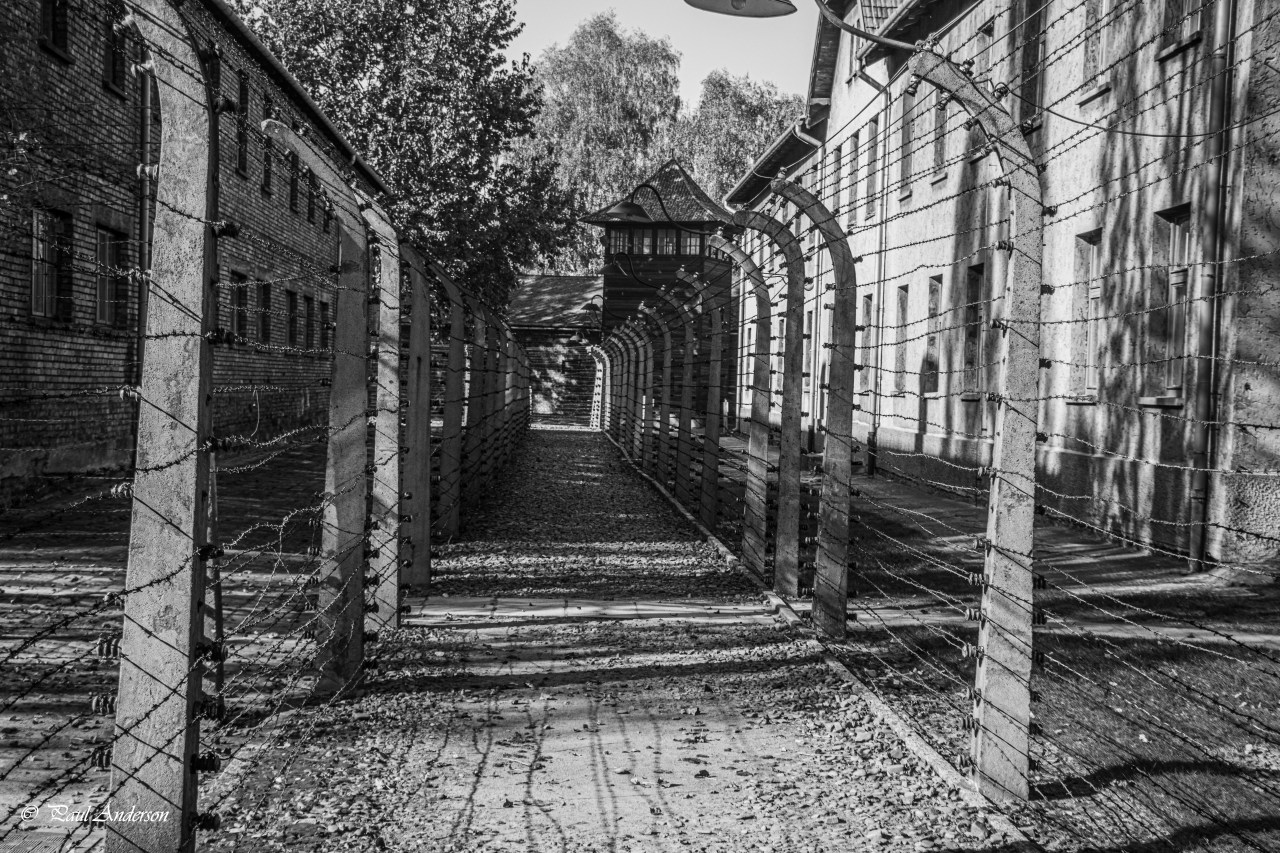
Our guide leads us on paved roads between the rows of barracks. In certain sections I can look down a road sprinkled with autumn leaves and lined with tall trees still dressed in fall orange and yellow, and almost imagine myself in a recreation camp in Midwest America. It’s as if our guide is reading my mind. She pauses at one of the quiet lanes and admonishes us not to be deceived by the harmonious setting. She continues, describing a typical roll call in which the prisoners were made to form lines right where we were standing. They were often made to stand for hours in freezing weather, wearing only flimsy striped prisoner uniforms and ill fitting wooden clogs with no socks.
“Every morning, four o’clock, they knocked on the door [for] roll call. I don’t know what was the purpose of it because nobody could escape—the barracks were surrounded by barbed wire, the barbed wire was connected to electricity and every morning in front of the barracks was piled up naked dead people.” ~ Billy Harvey
“It was winter and the cold burned us; all the camp was flooded and muddy. They took our winter clothes and in exchange, gave us light clothes that looked like striped pajamas.” ~ Jakob Blankitny
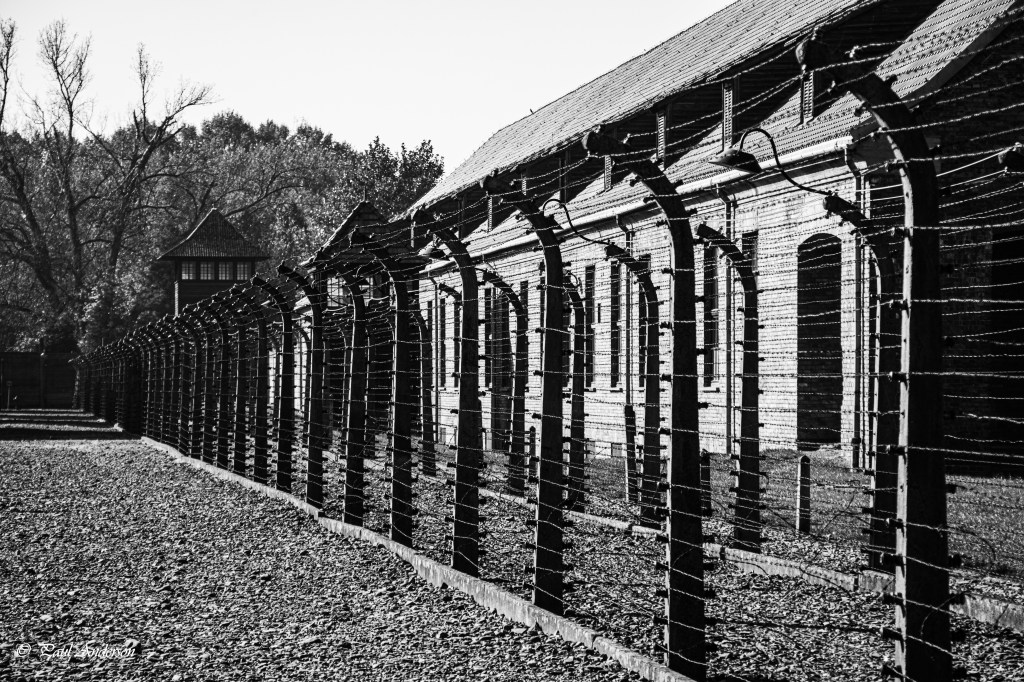
We continue on and turn a corner and reality strikes again when I see a guard tower at the end of a road. Throughout our walk we pass the omnipresent double rows of electrified barbed wire fences. A grisly irony of the fence is that, constructed to prevent escape, for many it was the final, tragic desperate method of escape. In Polish the common term for this form of deliverance was, “Pójście na druty or rzucenie się na druty” (“flinging oneself onto the wires”).
“And every morning, prisoners who had decided to kill themselves could be seen lying dead by the electric fence surrounding the camp.” ~ Irene Safran
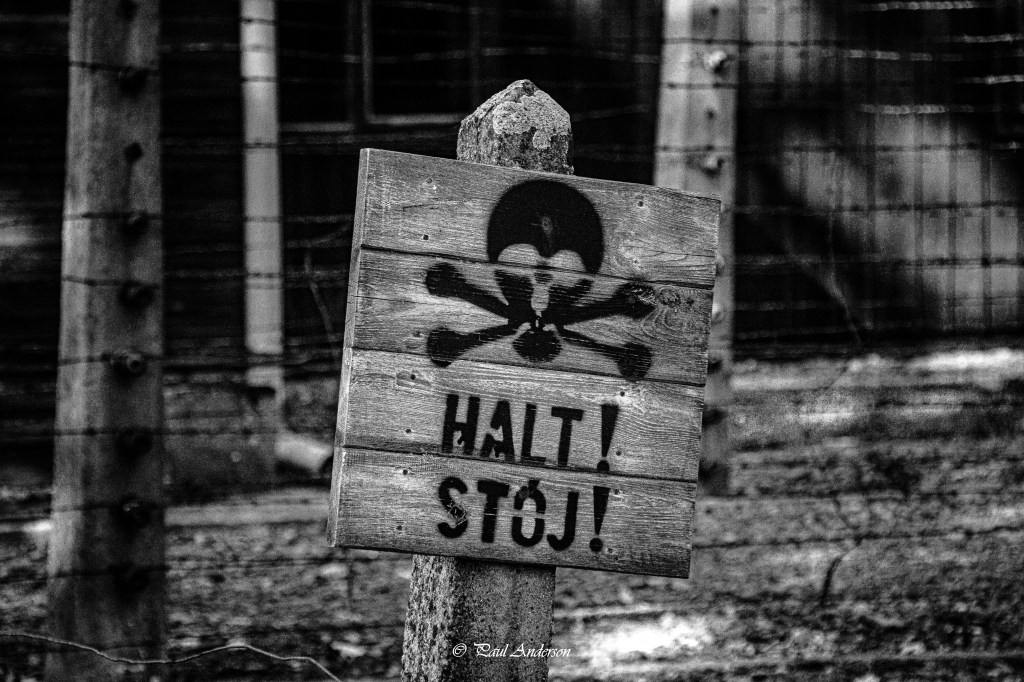
Reality ~ posted intermittently along the fence lines are little wooden signs emblazoned with a black death’s head and the words “Halt” “Stoj.”
We pass through one building in which the walls display scores upon scores of the original photographs of the prisoners; the Nazi’s version of mug shots. Each prisoner had his or her photograph taken in three different positions; full face, profile, and at an angle – men wearing a cap, women a shawl. Every head, male and female, is shaved. The faces wear different expressions; stoic, fear, confusion. Occasionally one notices an expression of hatred or defiance. Most show emotional scars, some show physical ones. Looking at each face I have to ask myself, “Did he survive? Did she survive? What about that little girl?” The faces of the children bear some remaining semblance of innocence. There’s one photo that has followed me like a phantom. The man’s face wears a look of absolute terror as if he’s seeing a ghost; maybe the ghost of his own future.
We continue on through various barracks. Some contain displays of confiscated goods; piles of eyeglasses, stacks of crutches and prosthetics, and mountains of shoes. Kept for what?
In one display is a massive collection of luggage that describes the purposeful insidiousness of the entire operation. Each suitcase is marked with a name and number. Before their bags were confiscated, the prisoners were told to label their luggage so that they could be reunited with their property after processing. Too late the prisoners would discover that it was all a ruse. But to what end? They were captives, overwhelmed by shouting armed guards, barking German Shepherd dogs, and their own terror and confusion.
In another barracks is a display that might be the most nightmarish. Behind glass partitions are mountains upon mountains of human hair, shaved for the making of textiles.
“We were told to remove our clothes and place them in the cubicles provided. We were given soap and took a group shower, after which we were led into another room where all hair was shaved from our heads and bodies.” ~ Irene Safran
Before entering this room the docent admonishes us not to take pictures. As if on cue, a woman pulls out her cell phone and begins taking pictures. Her companion, a twin sister, shakes her head angrily as she punches the woman in the arm. I can’t even imagine taking a photo of this display. The memory should be record enough. Is this to remind you of the evil that the mind shouldn’t forget or simply to post for likes on Facebook?
The shop of horrors continues in barracks after barracks. Before entering a barracks designated Block 11, we’re again admonished not to take photographs. Block 11 was known as the punishment block. Our docent’s description of what occurred here defies the imagination. I have to wonder if these docents don’t develop some version of PTSD after having to describe, day after day, and hour after hour, the depravity that took place at Auschwitz.
We’re done with Auschwitz but not done with the day. I’ve learned something today; Auschwitz consisted of three camps, Auschwitz I, Auschwitz II (Birkenau), and Auschwitz III (Monowitz). The other thing I’ve learned is holocaust semantics. Auschwitz I and Monowitz were concentration camps where, as our guide pointed out, the purpose was to make the prisoners work (if necessary to the death). Birkenau was a death camp where the purpose was self-explanatory.
We’re taking a break before boarding a bus for Birkenau. The soles need a rest. The soul needs it more.
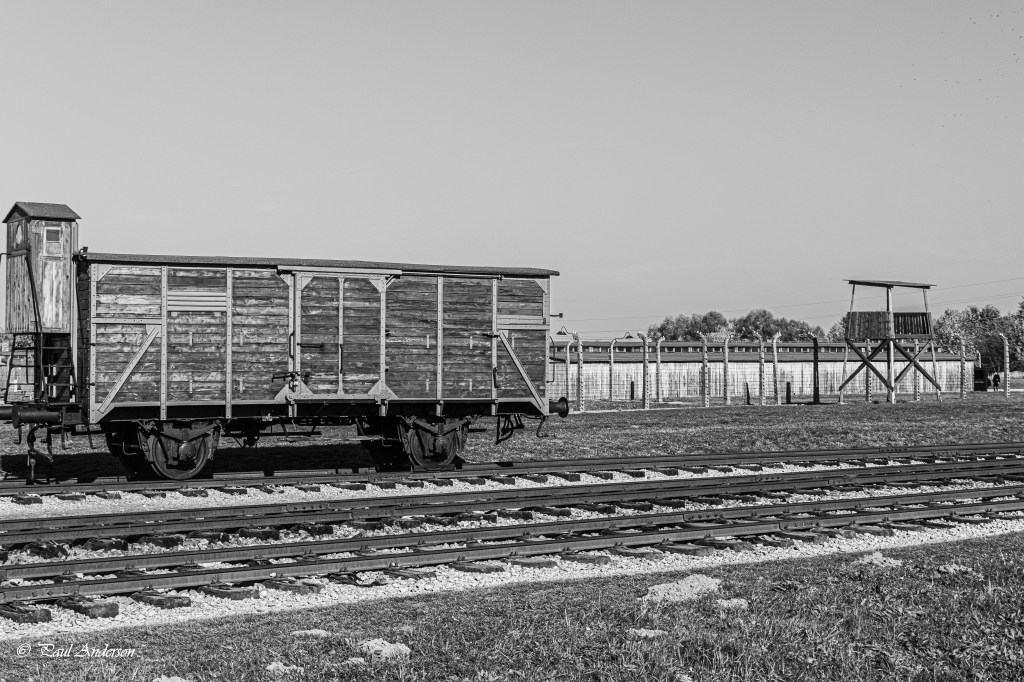
It’s a short ride to Birkenau where the bus drops us in front of the main gate. A rail spur passes below the brick arched gate, into the camp and terminates at the far end of the facility. It’s at the far end that the gas chambers and crematoriums were located.
Prisoners were offloaded from railroad boxcars and went through a separation process. The SS went through the charade of reassuring the prisoners that they would be given showers and afterwards would be taken to a labor camp and given ‘hot soup.’ As the prisoners filed off the train SS physicians separated out those who were deemed too old or too weak to perform labor. They were taken directly to be killed.
“It was dark when the carriages stopped and we were ordered to get off. Soon we were divided into two groups. The men had to stand separately from the women. What I experienced I shall never forget, I still see it before my eyes. Mother took me by the hand, father took my little brother by the hand and thus we proceeded with the rest. With my mother we approached a place where there stood one or several Germans. The German asked my mother how old she was. Clearly life had not yet taught her to have sufficient foresight, because she stated her real age instead of saying she was younger. Unfortunately, for this truthful statement we would have to pay a very heavy price. They told her to head in a different direction to mine. At the time I did not yet know that my mother’s route led to death, whereas mine meant life.” ~ Rachela Grynfeld, survivor.
Our guide takes us for a long walk on crushed rock to the end of the rail spur where sits an international monument to the murdered at Auschwitz-Birkenau. A dedication in 23 languages reads:
For ever let this place be a cry of despair and a warning to humanity
Where the Nazis Murdered about one and a half million
men, women and children, mainly Jews
from various countries of Europe.
Auschwitz-Birkenau 1940-1945
On the way back to the bus to Auschwitz I our guide brings us into one of the few barracks at Birkenau that is still structurally safe to enter. Inside are rows of bunks which sit three high parallel to the walls. Our guide explains to us that the bottom bunk (which is actually the floor) was the least preferred as the occupant of the bottom tier received the filth from his/her bunkmates above who were often too weakened by exhaustion or diseases such as dysentery to move.
“We were brought to Lager C, a barracks filled with three-tiered beds, with wooden boards serving as mattresses. Fourteen people slept on each tier and shared one blanket. We were like sardines. When one person wanted to turn, everyone had to turn. For years afterward I had a black mark from lying on my side on that wooden board.” ~ Irene Safran
The two bus rides, the one back to Auschwitz I, and the final one to Krakow, are quiet and somber. Being a student of history, and particularly the Second World War, I always thought that I had a grasp on the Nazi reign of terror. I was wrong. The experience was emotionally exhausting. Everyone on the bus back to Krakow is wrung out. Over the course of three and half hours I found that the books that I’ve read and the documentaries that I’ve watched over the years never did describe the indescribable.
On July 2, 1947, the Polish parliament established the Auschwitz-Birkenau State Museum.
Why? Why not raze the whole thing to the ground and replace it all with a park?
That question is answered on the UNESCO World Heritage Convention website: “Auschwitz Birkenau, monument to the deliberate genocide of the Jews by the German Nazi regime and to the deaths of countless others, bears irrefutable evidence to one of the greatest crimes ever perpetrated against humanity. It is also a monument to the strength of the human spirit which in appalling conditions of adversity resisted the efforts of the German Nazi regime to suppress freedom and free thought and to wipe out whole races. The site is a key place of memory for the whole of humankind for the Holocaust, racist policies and barbarism; it is a place of our collective memory of this dark chapter in the history of humanity, of transmission to younger generations and a sign of warning of the many threats and tragic consequences of extreme ideologies and denial of human dignity.”
Wrote Auschwitz survivor Henry Appel, “There is only one thing worse than Auschwitz itself … And that is if the world forgets there was such a place.”
But forgetting is what humanity does. And not out of a lapse. We work diligently at the task.
In the United States, 27 states do not require a curriculum on the Holocaust. And of the states that do, recently enacted laws that prohibit so-called ‘divisive concepts’ are hamstringing teachers when it comes to teaching about the Holocaust. Divisive concept laws prohibit teachers from touching on subjects such as race, sex and history that might be ‘controversial.’ Because God forbid that high school students should be required to think about and to discuss controversial subjects.
And while schools tip-toe around the Holocaust, galactic idiots like Marjorie Taylor Greene give it short shrift, such as when she compared congressional rules regarding masking during COVID, to the holocaust, saying that victims were “put in trains and taken to gas chambers in Nazi Germany. This is exactly the type of abuse that Nancy Pelosi is talking about.”
It took Greene three weeks to apologize but by then the damage had been done.
And rewriting is what we do.
Because there are the unapologetic Holocaust deniers such as Nick Fuentes and Ye who the President elect feted at a dinner in Mar-a-Lago. That this get together wasn’t a bridge too far for 77 million voters is troublesome. Add to that the Hitlerian rhetoric of the President elect and his occasional off handed praise for Hitler and troublesome gets elevated to disgusting. But apparently not unacceptable. (Ye is the former Kanye West, a man who is accomplished in the art of stupidity who once said, “”I love Jewish people, but I also love Nazis.”).
While writing this I’ve been asking myself why I chose to visit Auschwitz. I asked myself that question well before the visit as I was making the reservations.
The Auschwitz-Birkenau Memorial website says, “It is essential to visit both parts of the camp, Auschwitz I and Auschwitz II-Birkenau, in order to acquire a proper sense of the place that has become the symbol of the Holocaust of the European Jews as well as Nazi crimes against Poles, Romas and other groups.”
Indeed, the Auschwitz-Birkenau Memorial isn’t just a symbol of the Holocaust, it’s a symbol of man’s capacity to unleash unspeakable depravity and cruelty on its fellows. It’s a plea to future generations that these kinds of atrocities should never occur again. And yet, since the day that the last prisoner left Auschwitz, atrocities have continued at various times and in various locales by depraved madmen, while the apologists, deniers and false editors of history have been doing their nefarious work, lurking in dark corners. Frighteningly those apologists and deniers are gaining more light and are being given more oxygen. To this day, atrocities are still carried out and given distorted justification by the perpetrators.
Speaking for myself, my reason for visiting Auschwitz came down to a lifelong thirst for learning; both the good and the horrible. It’s why I visited the American Civil War battlefields of Gettysburg, Antietam and Spotsylvania.
And still I have to ask myself if a walk through Gettysburg helps one better understand the brutality that was the order of the three days, and the ensuing 51,000 casualties. I took a run through the Gettysburg Battlefield one morning. Even on a busy tourist-filled afternoon the place can be quiet, pastoral. In the early morning, before the buses, the cars, and the throngs, Gettysburg is positively idyllic. My run was accompanied by a soundtrack of rustling leaves and chirping birds. Standing atop of Cemetery Ridge on a quiet summer morning, it’s hard to imagine the slaughter.
It isn’t quite so at Auschwitz. Certainly there are tree lined lanes and neat rows of buildings but a mere shifting of the eyes to one side or another reveals a guard tower or a barbed wire fence or the pervasive wooden signs bearing the death’s head.
The next day.
It’s our last in Krakow before going home. We toured Wawel Royal Castle and had a late lunch. I’m on my last walk through Stare Miasto and I’m about as depressed as one can be because I’m never happy about returning to a dysfunctional (un)United States. Stopped for a pretzel at one of the many stands throughout the old town. The pretzel is doughy, tasteless, and stale and after a few bites I toss it. That’s fine. The old boy selling the pretzels is out to make a meager living and I’m only out a few cents U.S.
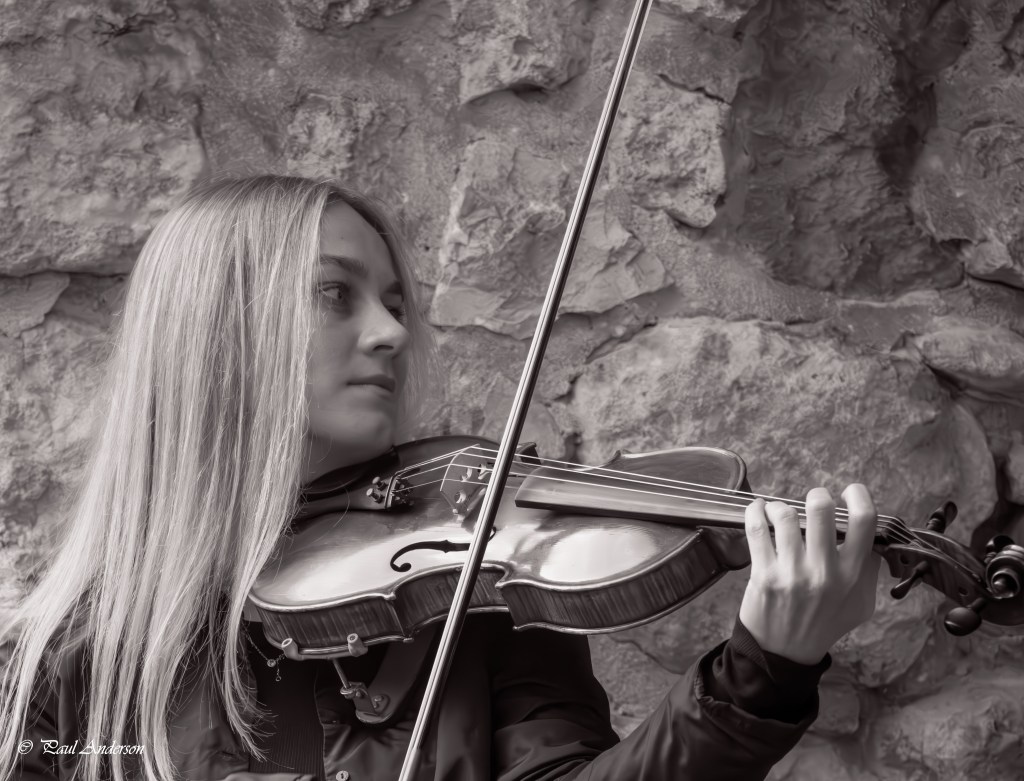
As I near the Barbican, Krakow’s ancient wall, I’m drawn to the strains of a violin. The musician is playing Cold Play’s Viva La Vida.
Found.
She’s at the 14th century, St. Florian’s Gate. A small crowd, mostly ephemeral, is gathered. Take a photo, drop a couple coins in her violin case and move on. I guess I need the music so I linger. Costa Coffee is right there on the corner so I grab a coffee and a pastry.
She starts into the theme from Schindler’s List and I have to step outside. I’m feeling that ironic longing to feel pain. You want to hurt. There’s a feeling from deep in your soul that compels sorrow.
With just a few hours left in Krakow I have about $30 dollars worth of Polish zloty in my wallet. It’s not enough for the money changers to deal with so I drop it in her violin case. An exchange of smiles and nods.
Back to the hotel.
Be well Krakow.
 The Life in My Years
I’m sorry Paul but I couldn’t read this post. I have no lineage after my maternal grandparents immigrated here from Poland in 1913. After WWII my grandfather searched but couldn’t find any family alive. Two of my friends’ parents were in concentration camps. But the story does need to be told and retold.
LikeLiked by 2 people
Anne, Absolutely no apologies needed. I’m so sorry.
When we were back at SFO, standing in the endless customs line I was chatting with a woman. We shared stories of our respective trips. It was a lively conversation that broke the frustration of the line. I told her that we’d been to Krakow and she asked me about it. When I told her that we’d visited Auschwitz she said, “I could never. I’m Jewish.” At that moment I felt so small.
I thank you for your comment
Paul
LikeLiked by 2 people
When we were in Germany, I couldn’t go to a concentration camp either. My fear is what will happen during the Trump administration.
LikeLiked by 2 people
I’ve never visited Auschwitz. I had the opportunity when in Krakow for a large Virtual Tourist meet back in 2010 (I think) but decided not to go as those meets were usually fun, convivial affairs and I was concerned my companions would be a distraction from what we would be observing. From the accounts of those who did go I was wrong, as the mood of the group changed the moment they entered the camp. So I’ve always slightly regretted turning down the opportunity as, however harrowing, I feel it’s important to continue to keep alive the memory of what happened by actively engaging with it. The closest I’ve come to the sort of experiences you describe here would be our visits to Tuol Sleng and to the Killing Fields in Cambodia. You speculated about the guides at Auschwitz having a form of PTSD – our guide in Phnom Penh left us to explore both those places on our own as she said that although she felt it was important to bring visitors to them, she couldn’t handle regularly touring them herself.
I did once meet a Holocaust survivor and that was a very powerful and moving experience. She had written a book for young people and came to talk to a group in one of the libraries I was managing. I fear such a visit wouldn’t happen in many US states, from what you say, and her book not bought or shared with young people. Does the US mark Holocaust Memorial Day, I wonder?
LikeLiked by 2 people
Hello Sarah, On reflection, I think that the best way that I can put it, is that it was a necessary visit for me. And that’s hard to explain, so I won’t even try.
Krakow is a beautiful old city with a tragic past. So many places to visit and too many harken back to the 1930’s and 1940’s.
We visited Oskar Schindler’s factory which is less about the factory and more about the Nazi occupation, but still very instructive. We saw the The Empty Chairs Memorial, which symbolizes loss.
The holocaust book you speak of? No doubt it would be banned in certain states. I can confidently say that without having even seen the book. Maus was banned in the state of Tennessee and for the most ridiculous of excuses – a partially bared breast. And believe me, it was an excuse. I was delighted when my grandson chose to read Maus and I was even more delighted when I learned that his teacher was delighted that he was reading Maus.
I guess we will find out about the marking of Holocaust Remembrance Day on Monday. I wouldn’t hold my breath waiting for a statement from our disgrace of a president.
Thank you for reading and commenting
Paul
LikeLiked by 2 people
I suspect that if your president does make a statement it will be more about him than the victims, sadly
LikeLiked by 2 people
It is my belief that the current POTUS, as a conscience raising exercise, should be made to walk in the footsteps of those prisoners (without socks in ill fitting shoes and preferrable with lightweight clothing in winter). And if he still doesn’t get the message, a stint as a plantation worker in the southern US under the hot summer sun might also enlighten him about the experience of slavery (and lead him to revise his thoughts about BIPOC persons in general). Stewart
LikeLiked by 2 people
Hello Stewart, I share your belief but there’s a slight rub to the theory and that is in order to raise a conscience, there must at least be the seed of a conscience. From what we have lived through for the past 9, going on 10 years, and what we have learned during that time about his past, the evidence is clear that the man is absolutely without any shred of conscience, decency or morality. He is a historically evil.
Thank you for reading and commenting
Paul
LikeLike
Hi Paul,
It’s unlikely I will go to Auschwitz and Birkenau as even in reading your post, I felt my heart in my throat the entire time. It’s a beautiful piece Paul, despite the painful subject matter.
My former father in law was a Holocaust survivor. He used to go to schools and talk to young kids about his experience. I always thought the key to building empathy was via teachings from those who lived the horror firsthand. Of course, with the passage of time, this will become impossible.
If education doesn’t teach it, future generations will eventually forget. Worse yet, events can be erased altogether. It’s happening already, as you say. Atrocities are simply regarded as convenient hoaxes for political gain.
It infuriates me that the past is being rewritten in real time for those who don’t care about history or are too lazy to delve deeper. This ‘dumbing down’ of the human race serves no one but the grifters with power and money. I don’t need to tell you who I’m referring to.
LikeLiked by 1 person
Hi Eden, Another that slipped through. Sorry about that.
Krakow is a beautiful city but a sad one because there are so many reminders of that piece of history. Aside from Auschwitz, in the city itself are the Schindler factory and the Empty Chairs in the Jewish Heroes Square.
I can’t wrap my head around the brutality and hatred then, that seems to be resurfacing again.
Thank you for reading and commenting
Paul
LikeLiked by 1 person
You’ve written a beautiful piece, Paul, and I’m grateful for it. My husband and I have not yet visited but I do feel it’s important as more and more people who lived through that time are passing on. This post shows how gut wrenching it will be but still, I feel like it’s important to bear witness if we can.
LikeLiked by 2 people
Hello Laura, So sorry for the late response. Thank you for the kind words and for reading and commenting.
Krakow is a beautiful old city. If you visit, you will find a number of memorials and sites that are reminders of that horrible time. The old Jewish district was in disrepair until Spielberg used that district for the filming of Schindler’s List. Now it is becoming a vibrant section again.
We visited the Schindler factory which I would recommend. It is self guided and while there isn’t much about the factory itself, it does serve as an excellent historical museum.
Make advance reservations for both Auschwitz and Schindler.
LikeLike
Learning or not, you’re brave, though. That would be a hard tour to deal with on so many levels. What’s amazing to me about the deniers is that people are still alive who were there or had family who were there. Where that impulse comes from, to say no, it didn’t happen, baffles me. It must be from a deep, buried sense of grief and guilt that they in no way could ever consciously face and turn it into hate instead. That’s my take, anyway.
LikeLike
Hi Stacey, I would like to think that the deniers and the haters are suffering from repressed grief. It’s a charitable way of looking at it.
The Jews have been hated for centuries. People of color have been marginalized for centuries. In my opinion, the haters and bigots are just bad people. Maybe it was upbringing that goes back generations and just gets cemented into a family psyche. Maybe it’s the feeling of feeling threatened. Maybe it’s finding someone to blame for their own personal failings or the problems in society. Maybe it’s just plain ignorance. Probably it’s a combination of some or all of the above. I wouldn’t give Nick Fuentes the benefit of the doubt. He’s just an evil punk.
Thanks for reading and commenting. Hope you’re doing well.
Paul
LikeLiked by 1 person
Yeah, there’s a lot of baddies out there and lack of education definitely doesn’t help. I wish more people were like a friend of mine who grew up in North Carolina amidst a Maga family and became the epitome of a black sheep he was so opposite to what they espoused and believed. But I guess it’s hard to break out of brainwashing…unless you’re unique or have a strong curiosity instead of just blinding accepting what you’re told. This Nick Fuentes guy–I thought the name sounded familiar. Looked him up. Now, he IS a bad person–or is playing at one. It’s incredible what people will do these days to get in the spotlight. We’re fine here (so far). Thanks for asking. 🙂
LikeLiked by 1 person