
16, October, 2024
Munich has been dank and gloomy throughout our visit. It’s the risk the traveler runs when choosing to vacation in autumn. It’s part of the trade off; you’ll take dodging raindrops in exchange for dodging the hordes of travelers. The irony of being a traveler and wanting to avoid the hordes of my own vacationing species doesn’t escape me. I am what I’m trying to avoid, what I often curse.
“Damn tourists.”
The city woke up to a low fog that obscured the top third of the magnificently, architecturally busy, neo-gothic Rathaus (town hall) in the Marienplatz, the city’s old town square. The shroud has lifted but the murk persists.
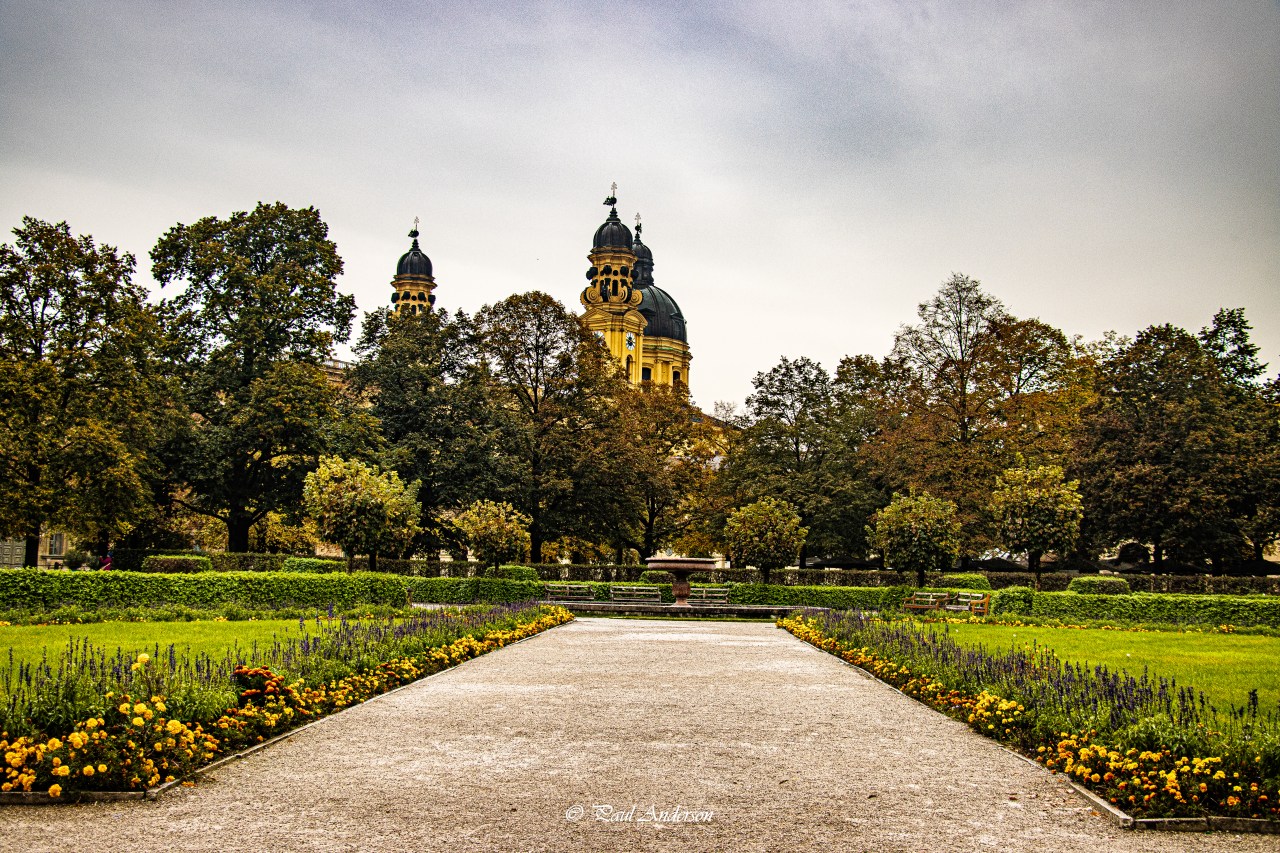
Cora and I are walking through the Hofgarten, a pleasurable peace (yes, you read that correctly “peace”) of green in the center of bustling München. It rained last night, and the macadam path before us is pocked with puddles. We’re drizzled on by occasional spits of mist that have kept the park largely devoid of visitors. The garden is left to those of us who’ll accept muddy outer soles as a small inconvenience for the benefit of an inner soul cleansed by a walk in the park.
An old fellow eats his lunch on a bench, sitting close by his equally old bike which leans against the end of the bench. A few younger people are strolling the path or sitting on benches, all likely taking a midday break from work. A short pause for serenity in a city that, if you judge from the madness of the underground, is anything but serene on any given weekday.
We’re flanked on either side by rows of trees that stand in perfect lines. Wooden soldiers. It’s autumn and these soldiers are clad in neither steel gray nor green camo, but in brilliant yellow.
Soldiers.
Wooden soldiers.
That’s the tag that the Germans wear.
They’re grim, rigid, officious, much too serious, and overly scrupulous. Prone to being engineers, scientists, staid pipe smoking philosophers, and uber patriotic soldiers. It’s the cross of iron that the Germans bear.
And it’s bullshit.
A visit to any biergarten or rathskeller will disabuse you. It’s rousing, jovial, and communal. No reservations. Pull up an empty spot on a bench, sip your beer and munch your pretzel next to a stranger who, before that stein is half empty may just become your friend.
Hell, how staid can the Germans be, given that they invented Christmas – at least the one most of us celebrate, the one with trees, lights and Santa Claus. You know, the fun Christmas.
At the same time, an American’s first visit to a German restaurant can seem a bit off putting. Don’t expect a perky, “Hi, I’m Kimmie and I’ll be your server today. Here’s our list of signature cocktails.”
Nope, you’ll get pointed to a table, and handed a menu, sometimes wordlessly. The server will return and likely say, “So?” or maybe if you’re lucky, “Bitte (please).”
At mealtime’s end, they aren’t going to come by your table and bring you a check. That’s on you. And that’s a paean to hospitality – and something of a repudiation (gasp) of capitalism. Stay as long as you want. Linger over your coffee. Don’t want more coffee? No beer? No schnapps? No problem. There’s no bourgeois rush to turn tables. Hell, in a coffee house where there are often servers who, one would think, would love to see a healthy turnover of tables, there are racks of newspapers for coffee sippers to choose from and linger over.
Go to a hofbrau and you shouldn’t be surprised to see regulars, often dressed in traditional Bavarian garb, hovering over a chess game or just shooting der Scheiß while nursing beer in steins big enough to hold enough brew to fill up a Benz fuel tank.
In America the server drops off the check and says, “No rush.” Loosely translated that means, “Hurry the fuck up. I need to turn this table.”
This Hofgarten was laid out in 1613, but it’s all relatively young. The lush lawns, manicured hedges, and brilliant trees belie the desolation that this patch of peace was reduced to during World War II. In 1945, it was less arcadia and more moonscape.
We leave the Hofgarten and walk through the quiet lanes of the Lehel District towards Kirche St. Anna (St. Anna’s Church).
Kirche St. Anna is rather unassuming by the standards of the ostentatious European churches. One might say that its relative simplicity is more reflective of what Chrisitanity is supposed to be all about, rather than the gaudy, gilded frescoed cathedrals with towers built sky high so that the elect could be closer to God’s heaven.
Cora sits in one of the pews, contemplates, and does her religion thing, as she does whenever we visit a church. I leave her to it while I take some photos (when the church allows).
On our way out we pass a small display explaining the history of Kirche St. Anna. It’s in German. We can’t understand any of it except for the photo that was taken in 1944. There’s no misunderstanding there. The church was a pile of crushed stone.
From our apartment window, far from the city center, we can see the towers of the Frauenkirche (Women’s church). At the end of World War II those towers were damaged and the church itself was left an empty shell.
The Residence Palace was heavily damaged and the Catholic, Court Church of All Saints, within the palace complex, was also pounded by Allied bombs. The church was not reopened to the public until 2003.
The Old Town Hall in the Marienplatz was also damaged by Allied bombs.
Before the war was officially a war (when does a war officially become a war?) Hitler ordered the destruction of Munich’s primary Jewish synagogue.
Walking through the vibrant city, weaving through the crowds, stopping for a pastry in a cafe or currywurst from a street vendor, it’s hard to believe that in 1945, the city was in ruins. Because Munich was considered the epicenter of Hitler’s Nazi movement, the city was targeted as much for propaganda purposes as for strategic ones. Germany’s third largest city, Munich was bombed over 70 times and 90% of the historic Alstadt was destroyed. Casualties numbered over 21,000 dead and wounded.
Walking through the vibrant city, it’s also hard to imagine the mixtures and changes of emotions that ran through Munich between the early 1920’s and the days, months and years following the war. The nationalist adrenaline rush of those caught up in the rise of Hitler’s popularity contrasting with the fear of those who suddenly found themselves scapegoated targets.
And then there were those, some in positions of influence, who thought the clown with the silly mustache was a harmless fad who would fade quietly into history with all the other momentary fools of history. Some in power thought that they could harness Hitler’s energy and then dispose of him when he’d used up his usefulness. Talk about fools of history.
Walking through a beautiful city in full flower it’s hard to imagine the scenes between 1920 and 1945. Hard to imagine bands of untethered street thugs along with Hitler’s paramilitary Sturmabteilung, the Brown Shirts, roaming the streets, threatening and terrorizing the marginalized. They would be joined by uniformed military and the shadowy Gestapo. One didn’t dare speak out, verbally, in print or in any other form, against Hitler’s regime.
Hard to imagine the quiet of the Hofgarten broken by the pounding of jackboots on cobblestones and tank tracks clanking on nearby streets.
Hard to imagine the nationalist wave ebbing into uncertainty and weariness as the tide of war shifted.
And then all that was left was to pick up the pieces.
All of the history, the art, the cultural icons destroyed or damaged. Munich rebuilt herself back to the splendor of old. Four hours on the autobahn, to the west, Frankfurt said fuck it and went modern, the glorious past left for the books. My daughter visited Frankfurt just before we were in Munich. She told us that, with the modern buildings and the fact that English is common, she might just as well have been in San Francisco. A past that goes back to the 8th century obliterated by the vainglory of madman.
Cora was the one who wanted to visit Germany. I was lukewarm on the idea. I like history and much of the history of Germany that we’re seeing is a rebuild. It all struck me as somehow inauthentic. The war decimated Germany. Much of what we’ve seen during our visit isn’t the original. Hitler tossed over the puzzle and then pulled the pin, took the easy, coward’s way out and left it to the survivors to fit it all back together again. At their rotten core, autocrats are cowards.
It wasn’t just the physical pieces, but the emotional ones. There’s actually a name for the remorse that the German people felt following the war – kollektivschuld – collective guilt. Many, 70% according to a survey done in 2015, have come to terms. And that’s fine. Just don’t forget it. The problem is that’s where the human race fails time and time and time again. They forget it, or they deny or, worst of all, they rewrite it.
Kollektivschuld resides in some measure in Markus. We met Markus at a little bakery in Fussen. He needed a place to sit and we just happened to have a place at our table. And so we had breakfast together. During a wide ranging conversation he asked about our itinerary. When I told him that we would be visiting Krakow, he said, “Krakow is a beautiful city.” He paused and added in a tone of sad reflection, “But an unfortunate reflection on our own history.” (The story of Schindler’s List is largely the story of World War II Krakow).
We’ve drifted out of the Altstadt-Lehel district and onto the Odeonsplatz, a public square that dates back to the 19th century. At one end of the Odeonsplatz is the Feldherrnhalle (“Field Marshals’ Hall”), a monument commissioned in 1841 by Ludwig I to honor the Bavarian Army.
You wouldn’t be wrong if you called the Odeonsplatz the epicenter of the epicenter. It was here in 1923, that Hitler’s, Beer Hall Putsch came to a bloody end in a clash between Hitler’s followers and law enforcement. It ended here with the death of 14 (the actual figure fluctuates depending on what you read) Nazis and four police officers.
Cora asks me what the Beer Hall Putsch was and I give her the simple answer, that it was an attempt by Hitler and his followers to disrupt a meeting by Bavarian leaders in order to stage a coup. An uprising staged to disrupt a legislative meeting. Where have I heard that before?
“You could say,” I tell her, “that it was Hitler’s, January 6th. He went to jail and while he was there he wrote a grievance filled autobiography/manifesto. When he came to power he declared fallen Nazis to be patriots and martyrs. Does any of that ring a bell?”
Anyone walking past the Feldherrnhalle during the period of the Third Reich was expected to raise the Nazi salute. We all know what happened after Hitler had served his time in jail. Recidivist as fuck.
My father was a veteran of World War II. Having gone through North Africa and then Italy, he never saw Germany. Being a son of the Greatest Generation, I’ve always had an interest in that war and to this day I still study it. And so, here in Munich, I can feel its presence. It’s almost as if I can see, on the walls of the buildings, the silhouettes of the many players; the monsters, the craven, the willing, the victims, the brave resistors and the legion of believers who found themselves shocked when their beloved fuehrer turned on them. It’s what autocrats do.
It took over 20 years to physically rid Germany of Hitler. In his wake, the wake of one horrible little man, were left the millions of dead, the millions wounded physically and emotionally, the physical and political destruction, the geopolitical restructuring of the world, and the attendant ramifications that came with all of the loss, destruction, and triage.
And still, Hitler has never left. There’s something about an evil cult of personality that lingers. Even in present day Germany, the neo-Nazis still lurk; slithering, ugly creatures that emerge from time to time from under the slimy wet rocks hidden in the dark recesses of society. In the United States, neo-Nazism and it’s demonic cousins, the evangelical right wing and various nationalist and paramilitary groups, have been emboldened by its own autocrat in waiting.
What’s that old saying? “Those who fail to learn from history …” Blah, blah, blah. That fucking thing is a regular feature on Facebook. Repeat it time and again and there are always deaf ears for it to slam against.
As I walk with the ghosts of Munich’s past I can’t help but feel their American resurrection. A grievance filled man who lusts for power and portrays himself as the champion of the true, pure, citizens who are threatened by the contamination by “them.” Because there always has to be a “them” for the autocrat to save the nation from.
Hitler portrayed Germany as a country victimized by nefarious forces; the impure, the foreigners, the elites and the professors, the press, the homosexuals, the Communists, the ones who didn’t fit the proper physical, religious or cultural mold. And of course, the ones who dared to oppose his agenda.
Does any of this ring a bell? Or does the chime clang against deaf ears?
Autocrats portray themselves as messiahs and their closest apostles spread a twisted gospel of national redemption through the one chosen leader. Said Hermann Goring in 1934, “There is something mystical, inexpressible, almost incomprehensible about this one man. … We love Adolf Hitler because we believe, deeply and steadfastly, that he was sent to us by God to save Germany. … There is no quality that he does not possess to the highest degree. … For us the fuhrer is simply infallible in all matters political and all other issues concerning the national and social interest of the people.”
“There has never been and probably never will be a movement like this again,” wrote Trump’s then campaign manager, Brad Parscale, in 2019. “Only God could deliver such a savior (Trump) to our nation, and only God could allow me to help. God bless America!”
“I believe that I am instrument of nature to liberate Germany.” said the man with the funny mustache in an interview with the Nazi newspaper, Völkischer Beobachter.
“I am the only one that can save this nation,” said the orange complected man to his crowd of devoted acolytes in Bedminster, New Jersey.
Banner photo: Munich’s Hofgarten.
 The Life in My Years
You made the comparison so well, and again, people can’t see it.
LikeLike
As well-written and deeply thought as always, and absolutely spot-on. As Anne says, people (some people) just don’t seem to be able to see these similarities. As for the learning from history thing, it seems every generation has to make its own mistakes. We think we are different, we know better, we can work things out for ourselves without the need for ‘advice’ from the past.
LikeLike
Brilliant piece Paul. I’m not sure of Cora’s motivation to see Germany, but it seems you got a lot out of it too, especially at this time in your own country’s history.
As for the old saying? “Those who fail to learn from history …”
I think the combination of hubris and desire for power means we will never learn from history. What’s happening with tRump is not even subtle, the similarities to past dictators stark, and yet here we are …
Holding my breath for this next phase.
LikeLike