It shouldn’t have come as a surprise that the six right wingnuts on the Supreme Court would pave an autobahn towards autocracy, closing out the SCOTUS session and in effect, closing out the scattered remains of democracy.
The timing was both ironic and convenient. Ironic in that SCOTUS issued its decision shit canning the whole idea that The United States is not a monarchy (or autocracy) mere days before we celebrate the signing of the document, 248 years ago, that condemned the monarchy it was getting read to overthrow. The decision is also convenient for the American autocrat in waiting, one convicted felon named Donald John Trump, who’s firing up the engine on his redesigned MAGA to take a ride on that very autobahn.
Martin Fredericks IV is a pull no punches blogger whom I’ve been following for some years now. He puts the most recent SCOTUS outrage in proper angry perspective. Please read Martin’s piece, U.S. Supreme Court Clobbers Democracy.
Rickwood (baseball) Field, Birmingham, Alabama. June 20, 2024. Baseball has been played at Rickwood since 1910, making it America’s oldest active baseball park. A baseball game will be played at Rickwood today. For over a century, thousands of baseball games have been played at Rickwood; Major League Baseball’s (MLB) spring training games and exhibitions, semi-pro, and Negro League games. For a time, the University of Alabama’s Crimson Tide used the field. Rickwood has even starred as a movie set
Today, Rickwood will star again, this time as the host of a regular season Major League game between the San Francisco Giants and the St. Louis Cardinals. This game will be more than just any other in the long 162 game grind that starts in the promising spring, grunts through the hot summer, sweats out the dog days of August, ending in the crisp birth of autumn.
Today’s game is a celebration of the Negro Leagues, a celebration that’s long, long overdue. It’s also an unexpected celebration of one of the Negro Leagues’ and MLB’s favorite sons, Willie Mays, who, at 16, began his stellar professional career at Rickwood as the starting center fielder for the Birmingham Black Barons. Mays passed away two days ago in the San Francisco Bay Area, at the age of 93. It’s almost as if the baseball gods had preordained the convergence of events.
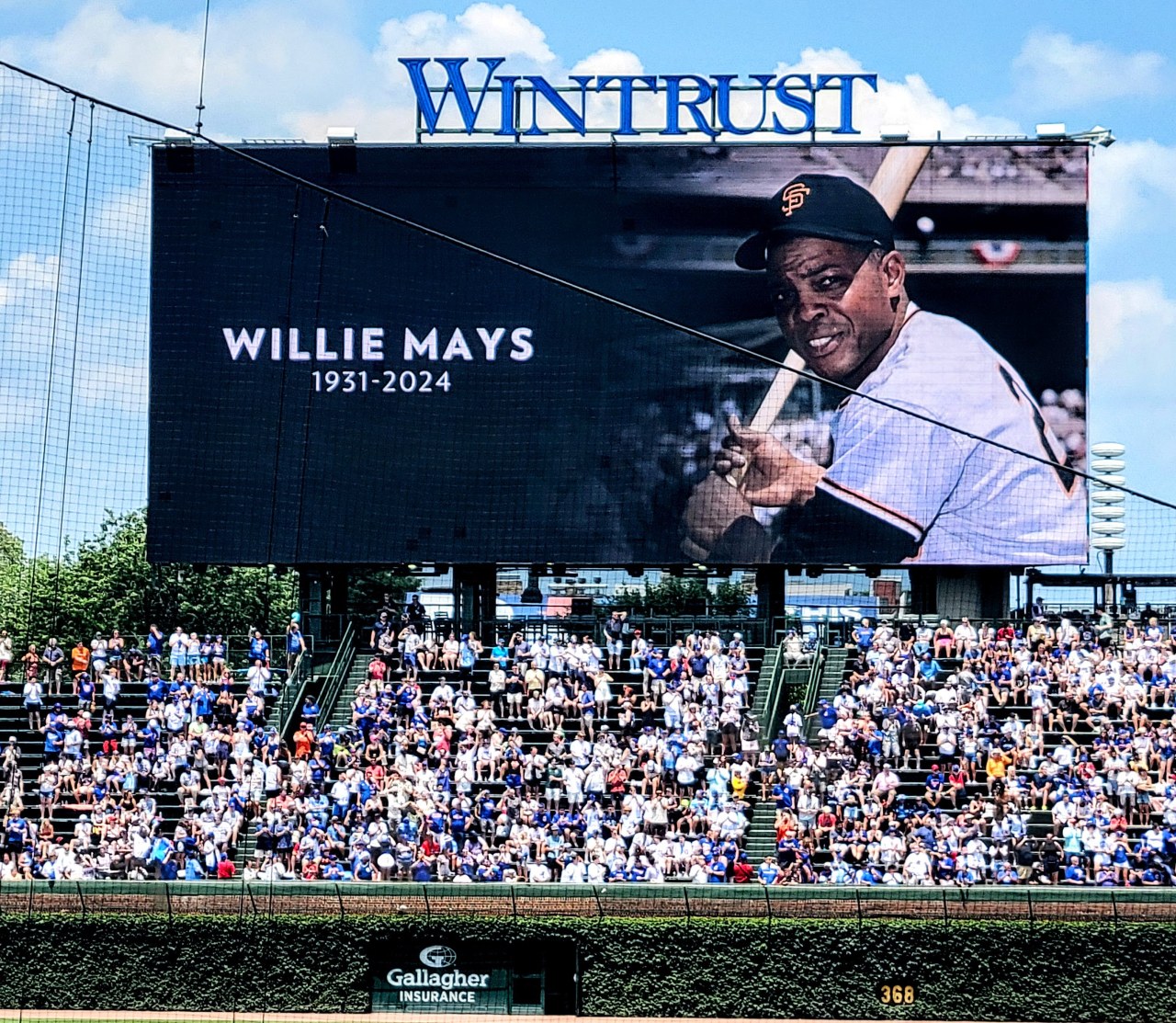
Banner photo: I shot this photo before a baseball game between the Chicago Cubs and San Francisco Giants, at Wrigley Field in Chicago, on the day after Willie Mays passed away.
June 18, 2024. My wife and I were sitting, lower box, along the third baseline in Chicago’s Guaranteed Rate Stadium. The buzz started sometime in the early innings as the White Sox were playing the Houston Astros. I heard the first murmur from someone a few rows down from us and to the right. I only heard the name, “Mays.”
When it comes to baseball the name Mays, isn’t just a name. Willie Mays is baseball. Pick a sport, any sport and you’ll find that there’s an ongoing debate as to which player is that sport’s greatest. In baseball, the name Willie Mays is always mentioned beside Babe Ruth and Hank Aaron as the greatest player in baseball history. It’s one of those never resolved sports debates that takes place in a stadium or a bar or early morning in the office break room as people pour their morning coffee and dip into the donut box.
For me the choice is easy – it’s Mays. Maybe that’s because I watched him play so many times, though I did see Aaron a time or two. Ruth? I may be old but I’m not that damn old.
So in a baseball stadium, I suppose it would make sense that the name Mays would come up. Or not. Willie Mays, who spent most of his career playing for the New York/San Francisco Giants never played for or against the White Sox. Never, to my knowledge, did he set foot in Comiskey Park, the stadium that the Sox called home. So, I wondered, why the buzz? Because now it wasn’t just one lone mention. The name Willie Mays was circulating around the park.
The murmurs continued throughout the game, always at a distance. And then a man stopped to chat with a woman seated behind me. That’s when I heard the news that Willie Mays had passed away at the age of 93.
As the Sox and Astros, played my mind drifted from the game. Numb, hit with the now all too familiar realization that yet another precious piece of my life had been taken. As we get older the pieces just tumble away like bricks from an aging building. It might be a death, or the closing of a cherished institution, or the destruction of a building or monument. The pieces crash to earth and get bulldozed aside by time, and we find ourselves less one more fragment. When the World Series is done and the Giants have completed another season of mediocrity will June 18th even register in my failing memory?
A short time after the buzz began, rumor became official as the public address announcer shared the bad news with the stadium crowd. The crowd rose and a long standing ovation followed and every face, even those of the players on the field, turned to the picture of Willie Mays displayed on the scoreboard. I wasn’t the only one who had lost another fragment. All of baseball was feeling the loss.
We hadn’t planned on going to that game. The White Sox are one of the worst teams in baseball this year and the only reason to go would be to knock another stadium off the list of stadiums that we’d visited. It was a last minute decision that very afternoon to go online and buy tickets.
Irony? Destiny? Shithouse coincidence? Whatever it was, it was certainly fitting that I heard the news of the passing of baseball’s greatest while I was sitting at a baseball game. I guess it was equally fitting that the next day I would be watching the Giants play the Chicago Cubs in Chicago’s Wrigley Field.
There I was, on November 8th of 2016, standing in line at the polling place, minding my own business when my conscience tapped me on the shoulder, “Dude, you aren’t going to vote for Hillary, are you?” “Why not?” I asked. “Better than Trump.” “No shit. Hemorrhoids are better than Trump. Dog shit is better than Trump.” “So what’s your point?” “Hillary’s a shoe in. No way Trump wins. There can’t be that many stupid people in America. I say, write in Bernie.” “I’m not going to write in Bernie. You fucking crazy?” “If you don’t write in Bernie I’ll hold my breath till I turn blue,” said my conscience as it stomped about. “Fine then, I’ll vote for Bernie.”
A few hours later, Hillary Clinton took the stage at her headquarters. Cora and I watched, stunned, disappointed and afraid. “Last night, I congratulated Donald Trump and offered to work with him on behalf of our country. I hope that he will be a successful president for all Americans. This is not the outcome we wanted or we worked so hard for and I’m sorry that we did not win this election for the values we share and the vision we hold for our country.”
I remember the camera panning to staffers who were openly weeping. That’s what staffers do after losing a hard fought slog of an election. But they weren’t weeping over the loss. They were weeping over the notion that Donald Trump was going to be president. My memory of turning to Cora and saying, “Fucking Donald Trump is President of the United States,” is as clear as if it had happened just last night.
Hillary should have won. Hillary could’ve won. Nobody in their right mind thought that a boorish, racist, reality show con man could be elected to the most powerful office on Earth.
And so I and the legion of conscience soothers who voted for Sanders, or Jill Stein, or plain old Jill Smith down the street, because we just couldn’t stomach Hillary could only bury our heads in our hands and hope. Hope that during the ensuing three months the new boss would take a crash course in “how to act responsibly at being the most powerful person on Earth,” and actually learn it. We hoped, as the world did, and as some of his handlers promised, that he would grow into the job.
Hope dashed. Promise not kept.
Four years later, or, after 1461 days, or 2,103,840 seconds, because some of us were literally counting the seconds until the madness of Trump’s presidency would end, Joe Biden took office. But not until a struggle, an attempted coup, and a violent insurrection had taken place. The wicked witch is dead, we thought. There were tears again. Tears of relief and of joy.
The tears hadn’t even dried when Trump and his office holding sycophants and his cult of weirdos and idiots went on a four years long rant of whining and lies and threats of retribution. Trump and his gang of pirates refused to go quietly.
And here we are, with just five months and change until the next election. The same two guys who the majority of people don’t want. I suppose that the plus to having this unpopularity contest is that each of the candidates has a presidential term that the voter can evaluate and base his vote on.
We have a fair sense of what we’ll get with a second Biden term. If we get a reprise of the past four years we’ll get stability and an honest shot at bipartisanship from a man who will hold to the promise of being president for all Americans (notwithstanding the MAGA claims to the contrary). We’ll get a president who will hire a competent bureaucracy, and if necessary, won’t nominate a flaming ideologue to the Supreme Court.
We’ll also get the Biden who drives me to distraction. The guy who isn’t sleepy Joe, but slow off the mark Joe. His handling, or mishandling, of three significant issues has marred his presidency.
For more than two years, Biden acted as if the crisis on the border would somehow go away of its own accord. By the time Biden reacted, the border was inundated and the Republicans have since taken politcal advantage of the full blown crisis.
Biden’s initial handling of the Russian invasion of Ukraine has always been three or more steps behind the curve.
“Should we just go ahead and sign up for Apple TV?” I asked my wife, Cora. “It’s only ten bucks a month.”
“Sure why not.”
“Alright.” I answered. “The Giants are on Apple tonight, though I think it sucks that they’re starting to stream sports. Anyway, I’ve been wanting to watch Masters of the Air.”
I walked to the home office and let out a sigh of resignation. Signing up for anything Apple meant that I would have to eat a small helping of crow – feathers, beak, and all. You see, I don’t have a love/hate relationship with Apple. No, I have a hate/hate relationship with Apple. I’m a hater. Yes I’m a dyed in the wool, bonafide, 100% pure hater of all things Apple.
My animus isn’t so much directed at Apple’s products and services as it is towards the Apple cult. Yes – cult (not unlike the MAGA cult only technologically discerning), Ask anyone of us, scum of the Earth, proletariat, lowlife, trailer park trash who uses a Dell computer or, horrors, an Android phone. We’ve all at one time, or many times, been denigrated by some Apple – head for being antediluvian slime.
For me it started in the early 1990’s with a coworker named Chris Smith. Chris took in the Apple snake oil intravenously and he made certain that the other four of us in our little purchasing office knew that we Windows users were lesser beings. Chris had even managed to convince management to allow him to set up his own personal Apple based system for office use while the rest of us were on a Windows platform.
On any given workday, the slightest Windows hiccup resulted in derision from Chris, followed by an annoying cackle that sounded like a dyspeptic goose.
Every year, Chris would take two days off to attend the annual, Apple convention and Steve Jobs love fest, held at San Francisco’s Moscone Center. So many idolaters would show up at Moscone to hear the apostle Steve Jobs deliver his homilies, that two blocks of Howard Street had to be closed off.
I never attended, of course, so I could only imagine what went on in that holy of holies. No Coors and chips there. No, I imagine they served oysters Rockefeller, tuna tartare, and of course Royal Beluga caviar. There was probably a 39 month aged Parmigiano-Reggiano served on slices of French baguette flown in from Paris which began as Cheese Whiz on Ritz until the apostle Steve transformed it by waving his staff and muttering a few divine incantations. Rumor had it that the Almighty Jobs stayed at a hotel in Berkeley (because, Berkeley) and walked across San Francisco Bay to preach at the convention.
After a few glasses of Veuve Clicquot Ponsardin Champagne, the guests could continue to the massage station where vestal virgins would rub out the cricks from the necks of pilgrims who had been holding their noses too long in the air.
“I say Jaspar,” said the distinguished man in a pink Gucci polo to Miles who was adjusting his Mulberry silk ascot. “Have you sampled the latest iPhone?”
“No, I missed that one. I walked 23 miles to the Apple Store a month in advance of the introduction and then stood in line braving three tornadoes and a blizzard. It was a ghastly experience and I was only able to survive by holding onto the faith that I would be able to lay my hand on that sacred device. Sadly, I didn’t manage to get in. I have tried the latest MacBook. It’s smashing, simply smashing.”
Jaspar took a sip of his Chardonnay that had hints of strawberry and oak.
Yeah, I’ll give ya a fuckin oak to sip on, ya hifalutin bastard.
Oh yeah, about those lines that form outside of Apple Stores when the latest communion, er, phone, is introduced. This is the kind of behavior I used to see when teens lined up to get the latest Jordans. But seriously, grown ass adults waiting to be the first on the block to get the latest phone which is allegedly already obsolete (Apple denies planned obsolescence, because any large corporation would deny such malfeasance)? Grow the fuck up.
Chris Smith moved to Colorado some time ago and took his cackle and his Macbook with him.
It’s the battle cry dujour. Google, “save democracy,” and you’ll get an almost endless list of articles about throwing America’s drowning democracy a lifeline. There’s even a 10 week course on how to reboot America’s democracy. As if 10 weeks would be enough.
The pundits and the hacks are all over “Saving the American Democracy.”
“Save the democracy,” says Jake Tapper on CNN. “Our democracy is at stake,” cries Alex Wagner on MSNBC. Jesse Watters over on Fox also wants to “Save America’s democracy.” As do Sean Hannity, Jen Psaki, Tim Miller, Jon Favreau, Mike Murphy and a legion of other opinionators.
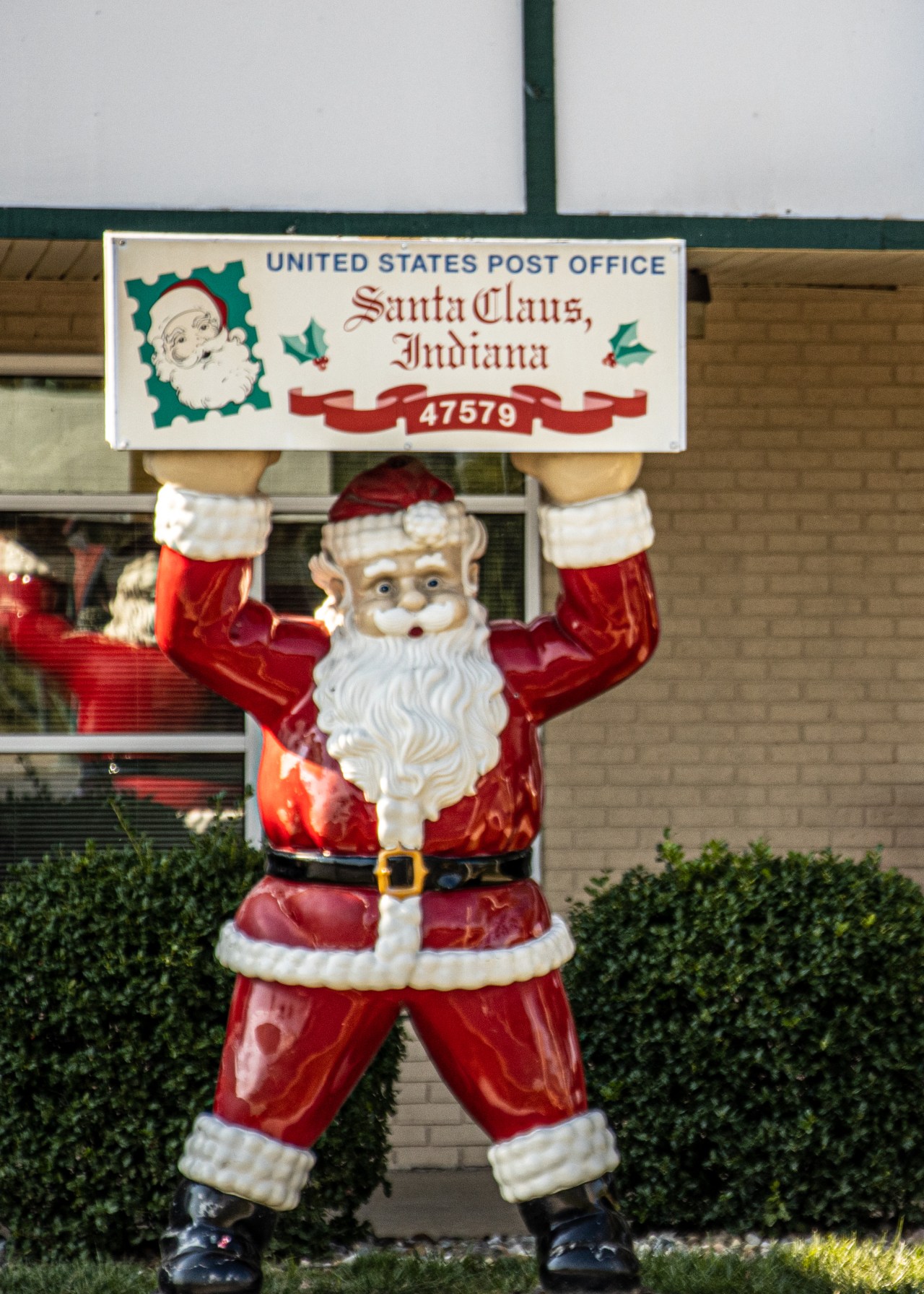
Santa Claus strikes me as being a bit creepy. But I’m getting ahead of myself.
After getting over my Bruceville gloom (see previous post), I set out, eastbound, for French Lick, hometown of hated former Boston Celtic, Larry Bird. “The hick from French Lick,” they called him. Still do I guess. Back in the day, I had other choice names for him. None quite so flattering as “hick.” It was the 1980s, the era that many consider the golden years of the National Basketball Association.
I was a Los Angeles Lakers fan and naturally my favorite player was Earvin “Magic” Johnson. The Johnson and Bird rivalry that went back to their college days when Johnson’s Michigan State Spartans defeated Bird’s Indiana State Sycamores to win the 1979 NCAA Championship captivated basketball fans worldwide. That classic matchup still ranks high in number of viewers.
You were either Bird or Magic. There was no in-between. No self respecting Laker fan could feel anything but enmity towards Bird. “Larry Legend,” could’ve cured cancer and then walked across the oceans to feed the world’s hungry and he would still be that fucking guy. Of course, the ill will went both ways. And still, fans of the one bestowed grudging credit to the hated other.
So why drive eastbound, halfway across Indiana to French Lick when I should be heading due south to New Harmony?
Because.
Because decades after the rivalry that was so magical, a rivalry that literally lifted the NBA out of the doldrums that it had been languishing in, I’m feeling a pull. Fucking Larry Bird broke my heart countless times during that fabulous decade, but still, I realize that without Larry Legend, that golden age of basketball would’ve never existed except maybe in some cheap sports novel. I have to pay homage to the villain of my early adulthood.
“Leaving home was one of the easiest big decisions I’ve ever made. But once I left home, continuing the journey until it reached some kind of sensible conclusion or fully played itself out, was another matter – one of the hardest things I’ve ever attempted.” ~ William Least Heat-Moon, Blue Highways.
‘Just drive,’ I tell myself. ‘You’ll get over it – again.’
I’m a month into the road trip and the next stop is New Harmony, Indiana.
I hadn’t planned on New Harmony when I started this trip. In fact I hadn’t planned on most of my destinations with the exception of Omaha, where I landed, and from where I’ll depart back for home.
I decided on New Harmony only a week ago while staying in a Best Western in Hannibal, Missouri. I’d already planned the next two stops. Two nights in Springfield, Illinois to visit the Lincoln Presidential Library and then two nights in Marshall, Illinois as a base to go take in the Parke County (Indiana) Covered Bridge Festival.
Where to after that?
Fuck if I know.
Stuck.
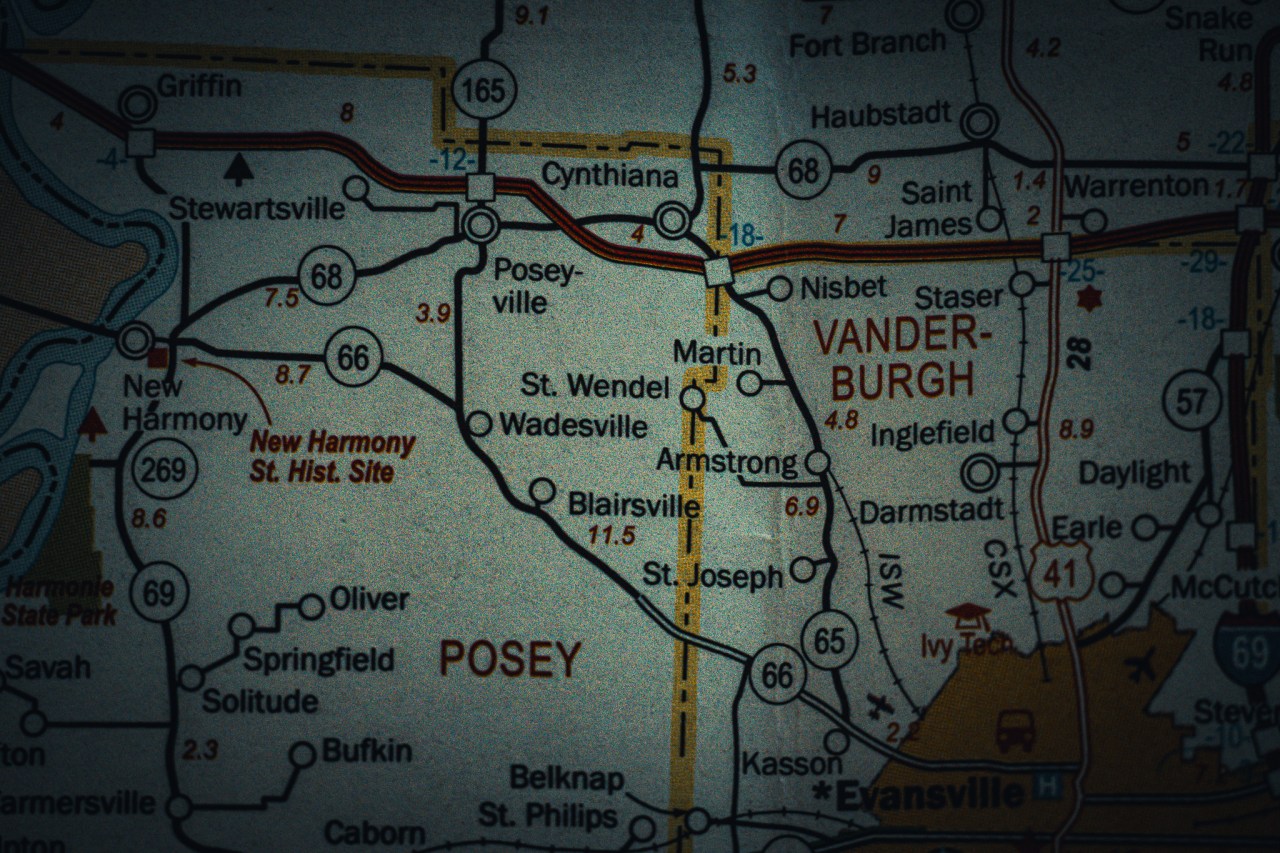
With a mind to drive into Kentucky and then touch West Virginia, I spread some maps out on the bed. I’m not averse to using Google but spreading out a paper map or three provides a bigger picture.
Part of the goal of this excursion has been to hunt for some names that stand out. I’ve touched Nimrod, Ten Strike, Athens (not Greece), Paris (certainly not France), and Virginia (not the state). Scanning the maps I saw, Princeton (likely not the university), Poseyville, Mt. Vernon (not New York) and Geneva (absolutely not Switzerland). I found the town of Santa Claus which I considered for half a moment before trashing that notion. I can only stomach Christmas for three weeks max and certainly not in October. Hell, in some of the places I’ve been, the retailers are already jamming Christmas down our throats and it’ll only get worse.
There, in the southwest corner of Indiana was New Harmony.
Harmony is a good thing. Right? New Harmony, contemporary harmony, any old harmony; one can never get enough harmony. New Harmony it was. Not only did the name attract me, but its location, on the shore of the historic Wabash River, helped close the deal.
Lodging was an easy find. There it was, The Old Rooming House. The Old Rooming House, in New Harmony. It doesn’t get any more seductive than that. The price per night was a mere sixty dollars. There was no online reservation system so I phoned the number and got Jim. Jim was chatty and started giving me a tour of New Harmony even before I told him I was looking for a room. Was I talking to the innkeeper or the tourist bureau?
When I made the reservation Jim told me he only takes checks or cash. That was fine with me. He also instructed me what to do if he wasn’t there when I arrived. He explained that around the side of the building near the little parking area there would be a chalkboard which would have my name and room number. Just walk in and make myself at home. Final payment could be made by leaving the check or the cash in my room if he wasn’t around. There was a lot of trust involved. When I told a friend of mine about the arrangement she was convinced that Jim was a fool. I felt otherwise. Jim trusts in the goodness of people and lives by that, and if someone takes advantage it’s more the perpetrator’s problem.
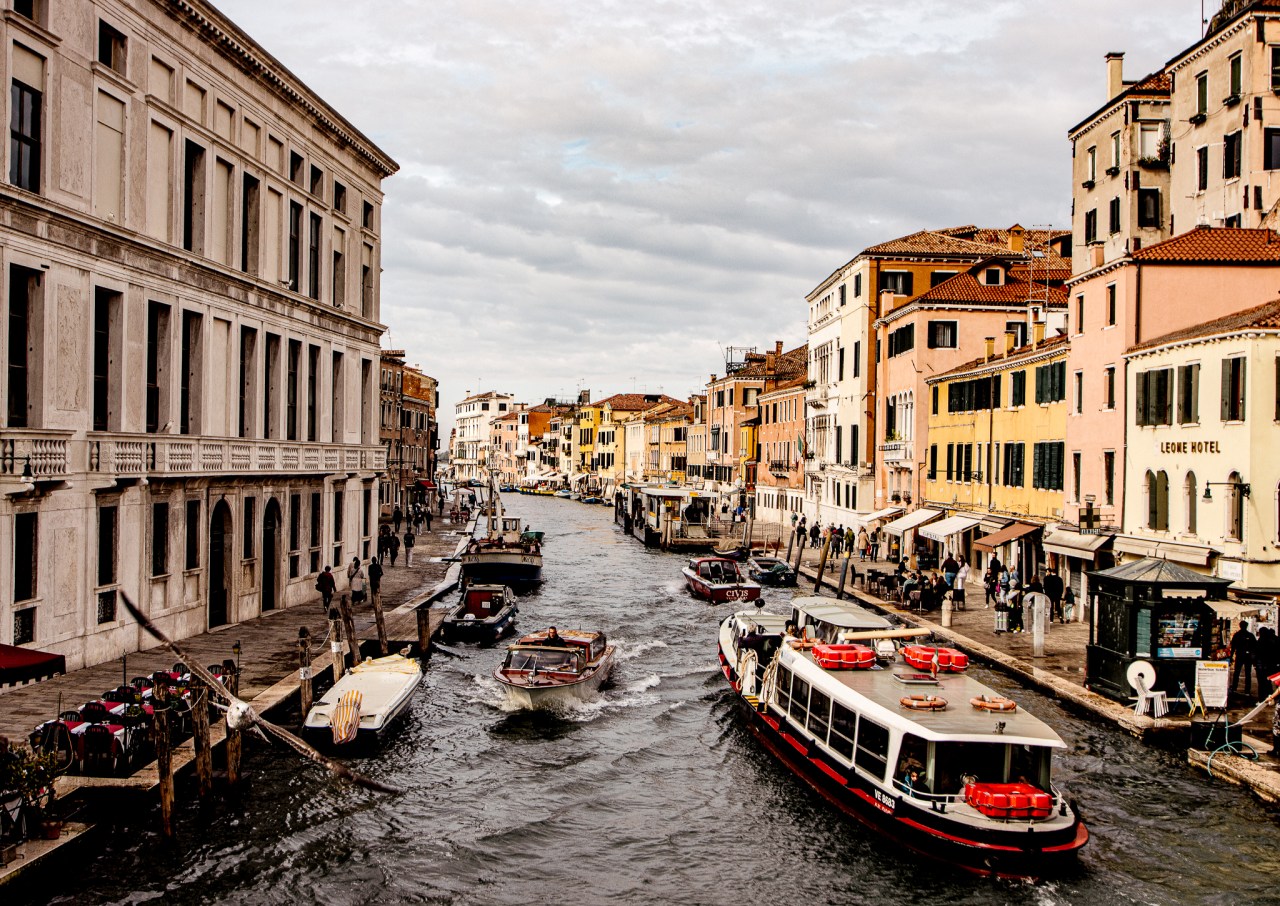
The aircraft is on approach, circling the regal city known as “La Dominante.” Forehead leaning against the window I look down and easily pick out the features. There’s the Grand Canal, busy with water traffic; vaporettos, working boats, and pleasure craft. I can even see the gondolas, little water bugs bobbing on canals big and small. Over there is Piazza San Marco and across the water the distinctive Basilica di Santa Maria della Salute.
Venetzia.
As the plane circles, my view becomes blurred by tears. My heart, the heart that has always rested in the warm Tuscan soil, is happy. The ancient voices of the Caesars speak to me. Il Tevere, (the Tiber River) courses through my veins. The delicious aromas of i mercati di Roma kiss the air I breathe. Looking down I realize that the pull I’ve always felt is stronger than I could’ve known; an irresistible connection. Even though I’ve never spent more than a month in Italy at one time, this feels like my homecoming.
I was nurtured in the Italian way by my mother, an Italian war bride, and her mother, my Nonna Maria. They molded our family culture and founded our traditions. My ties to Italy have tightened, as the country of my birth, the place where I’ve spent all of my life has turned into an angry place, a dis-United States that has pivoted from the place I’ve known, loved, and been proud of, into a burgeoning autocracy, ruined by a cheap carny turned president who, with the help of his acolytes, has ripped away the decency of the office, torn down national traditions, and disdained the Constitution. Now I turn to bella Italia for solace.
The plane completes its lethargic arc and straightens its approach. As we lose altitude I watch the highway of boats, the vaporettos and swift water taxis maneuvering between an aquatic highway delineated by strips of buoys. The water, even from high above, appears choppy and I worry about how Cora, a non-swimmer, suspicious of boats, will fare.
***
Close to touchdown, water looms. It isn’t unlike landing at SFO, where you get the unnerving feeling that the plane will splash down rather than touch down. Old timers like me know the drill at SFO. Just a moment after you see the strip of airport hotels on the San Mateo Peninsula to the west, you look down and there’s land.
Of course old locals like me can remember back to 1968, when a JAL DC-8 ditched into the fog bound bay near Coyote Point, two and a half miles short of the runway. There were no casualties except for the egos of the pilot and the copilot, and the jangled nerves of passengers, but had the plane landed a short distance further from the runway it would have exploded into a public park.
Call this a memory jogger. Or call it a cautionary tale. Call it both. This is a look back to that period between June 15th, 2015 and, well, now. It’s also a peek into what America’s future might look like.
The way we were
We didn’t know it at the time, but that June day in 2015 kicked off what was one of the darkest periods in the history of the world, certainly of the United States. That was the day that Donald Trump announced his candidacy in what was not so much a speech as it was an angry, racist rant. It was also a warning of what was to come. A warning that wasn’t heeded in November of 2016 and what might be ignored again this coming November.
There was no ambiguity at all. Trump laid his filthy cards on the table for all to see. In the best known riff from his speech, Trump put his racism out for the world to see as he blamed Mexico for willfully consigning criminals to the U.S. “When Mexico sends its people, they’re not sending their best. They’re sending people that have lots of problems, and they’re bringing those problems with us [sic]. They’re bringing drugs, they’re bringing crime, they’re rapists. And some, I assume, are good people.”
Trump’s announcement warned us all that he and the truth are not on speaking terms. Hell, they’re barely acquainted – if at all. Among his lies that first day, Trump claimed that the Islamic State had built a hotel in Syria. Well, they didn’t build a hotel, they appropriated the Ninawa International Hotel after it was closed down in the middle of a war. And they didn’t run it as a hotel. And, it isn’t in Syria, it’s in Mosul.
With his boorish behavior on that day in June, Trump flashed a bright yellow warning light that told the world he’s a lowbrow, no class, asshole.
In those early days, most Republican office holders saw the impending iceberg and started heading for the lifeboats. Over the successive days, weeks, and months to come, when it appeared that Trump’s populist snake oil was being bought by the electorate in giant, economy sized jugs, that iceberg started looking more and more like an ice cube to far too many of those Republicans and they decided to take a ride on Trump’s ship of fools. (My apologies for the mixed metaphors. Sometimes I can’t help myself.)
Trump showed everyone exactly who he was when he publicly humiliated his opponents. He called Marco Rubio, “little Marco;” Jeb Bush “an embarrassment to the Bush family;” and called Ted Cruz’s wife ugly and his father an accessory in the JFK assassination. And all of those individuals showed just how cowardly and feckless they could be when they all folded like cards and ended up as disgraceful, whimpering lap dogs to Trump.
The whole world witnessed the mayhem that characterized Trump’s term. His foreign policy, if you could call it that, was an abject disgrace. He cozied up to Kim Jong Un while North Korea bloated its nuclear stockpile. He lionized Putin. He withdrew the U.S. from international agreements and institutions. He nearly broke up the NATO alliance.
At home? The list is long and undistinguished. He botched the COVID response that left millions to die when they probably didn’t have to (remember the dark comedy about injecting bleach?). He passed a tax cut for the rich that was supposed to benefit the middle class, but was just a game of three card monty that screwed the people who needed the relief the most. He packed the Supreme Court with two conservative hacks who likely perjured themselves, and one religious zealot. It’s a court that has done more to take away rights than any previous court in history.
And of course there was the boorishness, the misogyny (“grab them by the pussy”), the racism (fine people at Charlottesville, and the mingling with known racists), the meanness (remarking about a trip to a WWI cemetery that contained American dead, “Why should I go to that cemetery? It’s filled with losers.”), the autocratic leanings, and the countless episodes of turning on people who weren’t reverent enough for his liking. The wretched cur that bites the hand that feeds him.
He was an absolute disgrace. He refused to hang Obama’s presidential portrait in the White House. When he invited the National Champion Clemson University football team to the White House he feted them with stacks of McDonald’s hamburgers (who in the fuck does that?). There were the temper tantrums that left ketchup on the White House walls. There was the violent removal of peaceful protesters at Lafayette Square, done just so that he could pose in front of a church, while holding a Bible (a book he’s never read).
After criticizing President Obama for taking a few golf trips (98 over four years) and promising he would be too busy, Trump spent all, or part of, over 260 days on the golf course at a taxpayer expense of over $144,000,000 (in his first term, Obama played 113 rounds of golf).
And then there were the lies. Donald Trump proved to be a world class liar. During a mere four years, Trump tallied an estimated 30,373 lies, from little stretchers to colossal whoppers. That comes out to an eye popping 20.9 prevarication per day. And that only accounts for the ones that could be reported. It’s actually a truly marvelous feat that could be worthy of a spot in The Guinness Book of World Records.
And it all culminated on January 6th, 2021 with an insurrection. That, after he damaged American’s faith in the legitimacy of elections.
For nearly four years, Trump has been throwing a nationwide, oh woe is me, pity party. Hardly a day goes by that we don’t hear, “treated unfairly,” “treated badly,” “persecuted,” and his all-time favorite, “witch hunt.” All of this from a pathetic snowflake who has made a career out of bullying people. Any parent would send such a petulant child to timeout, if not a trip to the woodshed.
Trump’s reckless, self-centered behavior has caused destruction that will likely not be repaired for years if not decades. As my wife often says, “He’s ruined this country.”
And maybe the most maddening part is that the ruination was caused, not by a man with a political philosophy or a cogent world view, but by a mean spirited two bit con-man; a narcissistic charlatan without a cause.










 The Life in My Years