The tenth in a series of occasional posts about tripping along U.S. Highway 395.
Antelope, Oregon marks the terminus of State Route 293 and the junction with State Route 218, which takes me back to U.S. 97 and the one time, “Wool Capital of the World.” Route 218 is just as isolated as 293 which brought me to Antelope. The isolation doesn’t make it unattractive.
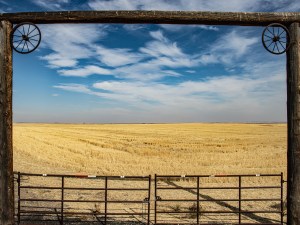
This is Oregon’s grassland, where ranching and wheat share top billing. I’m navigating past a sea of grain. Yellow-gold reaches out for miles and an occasional breeze whips up rolling amber waves – just like the song goes. At a junction I come upon a wooden gateway that frames the shimmering body. It’s desolate out here, but not unnerving. I’ve been on secluded roads and felt uneasy. This isn’t like that. This might be out in the middle of nowhere, but it doesn’t feel that way. I’m in middle Oregon’s sea of tranquility.
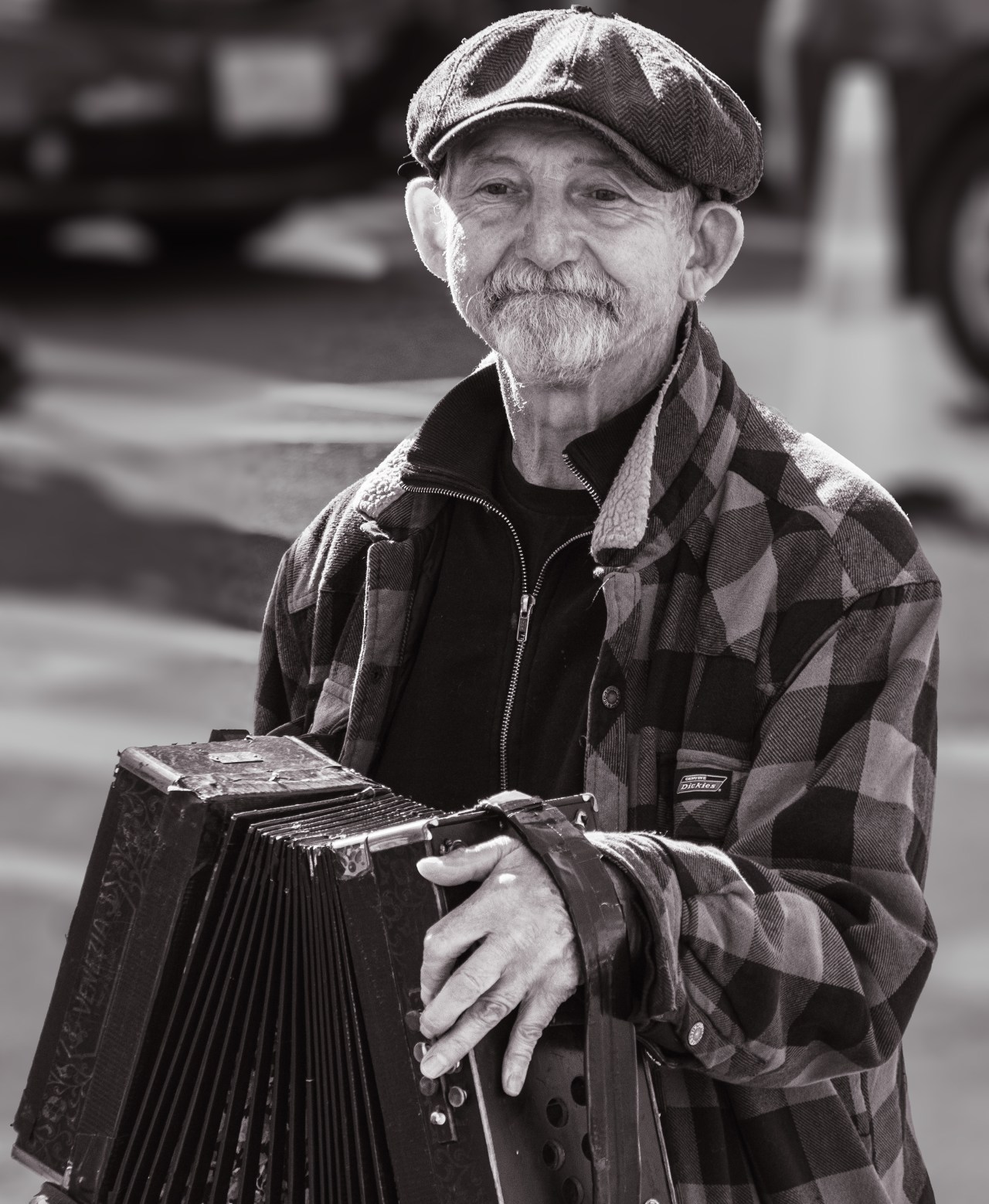
John, author of the site Journeys with Johnbo, leads this week’s Lens-Artists Challenge with the topic, Faces in a Crowd. (Note: Some of my images in this post have appeared previously).
“Who sees the human face correctly: the photographer, the mirror, or the painter?” ~ Pablo Picasso.
I vote, none. The photo, the mirror and the canvas each express a brief moment in time, and there is no single moment that can reveal the experiences that have been carved into the face.
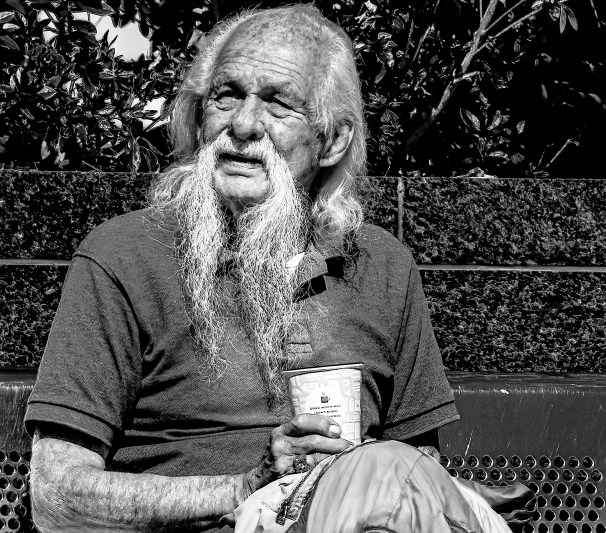
Union Square, San Francisco, California.
The man in the photo below was sipping his coffee, while watching the world around him. This fellow has the look of one of San Francisco’s many street people. But, who knows, maybe he’s a retiree who decided to let go, be a little eccentric. He might just be spending a day at the park before going home to his million dollar San Francisco flat. In any event, he’s somebody’s son, maybe a father and a grandfather. There are stories in that face.
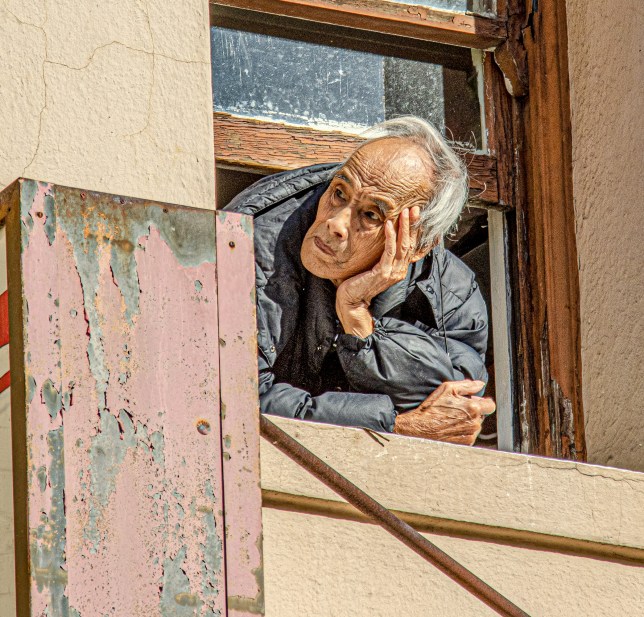
Chinatown, San Francisco, California. “The man is at the window,” said Jack Nicholson in Easy Rider.
I was walking around Chinatown, one of my favorite places to visit with a camera, when I looked up and saw this man lost in thought.
I was staring down into the well of my martini, twirling the toothpick that speared the olive. I’d shut out the sounds around me; the ballgame on the TV, the usual bar chatter and the clatter of utensils on plates. Focused on the wakes in the crystal aromatic liquid, I asked myself the questions. “What is it that haunts you?” “What are the ghosts that visit you during those times when you least expect it?”
The questions caused me to pull a notebook and pen out of my orange book bag. I didn’t have to pause for thought as the list of demons flowed abundantly.
A voice briefly cut through my fog of concentration. I looked up, “Pardon me?” I asked.
“Do you want to order food?” The bartender almost seemed impatient with my absorption.
“Oh yeah. Sorry. Garlic fries.”
I refer to the list every now and then. The paper is spotted with grease from the fries. Every now and then I pull out that list and add to it. It’s frightening how easily it grows and never shrinks. One of the early entries to my list was the specter of incompetence.
***
The plumber got up from his knees and set down his wrench. After hiking up his pants, to make that distracting crack disappear, he set about explaining how he was going to fix my leaking pipe. As he spoke, he noticed me pressing my hand against my cheek. “You got a toothache?” he asked. “You know, I can fix that. I have my dental tools back in my truck.” He turned the subject to dentistry. He talked – I listened. Fifteen minutes later, I was convinced that he was the only one who could fix my problem. An hour later, less three teeth, none of them the problematic one, I was howling in pain, and searching the internet for a dentist who could put my mouth back together.
Bad shit happens when you hire someone who isn’t equipped to do the job.
***
Most of us try our level best to make judicious decisions when shopping for goods and services. We stress over a search for an auto mechanic who we can rely on, who won’t throw a lot of automotive word salad at us, with the sole purpose of emptying our bank accounts. We might spend months in search of a caterer who won’t turn our upcoming event into a reenactment of a Three Stooges episode. Hell, we even spend an hour or more on Yelp, searching for a place to get a decent burrito.
So why is it that once in the voting booth some people pull the lever in favor of an unqualified, shrill, imbecile as their representative in Congress?
A poll taken by Pew Research in April of this year gave Congress an approval rating of 26%. We’ve hired them and now we don’t like them. By and large, people compare Congress to a sandbox filled with quarrelsome two year olds, where cooperation is a curiosity, and immaturity commonplace. Why is that? Well, some of it is due to the fact that a good many people don’t trust politicians – period. Some of it is due to people being happy with their own representative, but not the representative from the next district over. And then there are the voters who just want to stick it to the system. “I want someone who’ll shake things up.” Isn’t that how we got the 45th President?
The ninth in a series of occasional posts about tripping along U.S. Highway 395. Note: This post rated R.
It’s six o’clock in the morning and the day didn’t begin as planned – I overslept. Next stop is Pendleton in Northern Oregon. It’s a six and a half hour drive, and I’d hoped to get out earlier. That’s six and a half hours, straight through with no stops and no detours, except to fuel up the car and the inner man.
I don’t do road trips that way anymore. I used to, until it dawned on me just how much you can miss when your final destination is the only destination. I’ve learned since, that the destination of a road trip is not a place on the map that you reach at the end of a day’s drive. The destination is not a single place at all. It’s all the places, experiences and people that you encounter from the starting point all the way to the terminus. The destination is the quirky signs along the road. It’s the museums that celebrate things like Spam, barbed wire, Jell-O, and Tabasco; things that you never realized were worthy of a museum. The destination can be a small-town, somewhere out in the boonies, ice cream shop that’s gained national acclaim through word of mouth because the milkshakes there are so fucking, awesomely delicious.
For so many years, my final destination was the only destination, and it makes me wonder just how much I’ve missed.
***
Today’s drive will take me north, with a slight skew to the east, up U.S. Highway 97 to where it ends at Biggs Junction on the southern shore of the Columbia River, the border with Washington State. From Biggs Junction I make a hard right onto Interstate 84 to Pendleton and my rendezvous with U.S. Highway 395, which, in a sense, is the real start of this road trip; an exploration of one of America’s loneliest highways.
***
I spent the night at a Super 8 Motel, located next door to a Pilot Travel Center. Before going to sleep, I put down my reading and listened to the sounds of the big rigs at the travel center; the rumble of idling diesels punctuated at times by the hiss of air brakes. These are sounds that keep some awake, and prompt them to post complaints on travel websites. “I couldn’t sleep for the sound of big rigs all night long.” Well, maybe you should’ve realized that you’re parking your head a few hundred feet where long haul drivers are parking their rigs. Me? I enjoy those sounds. They remind me that I’m embarked on the adventure of a road trip. They’re sounds that lull me to sleep.
The eighth in a series of occasional posts about tripping along U.S. Highway 395.
Eugene Charles Valla spent four years of his young life hanging onto the edge of his boyhood dream. Valla was 21 years old in 1947, when he was signed to a minor league contract with the New York Yankees organization. His dad, also named Eugene, was a fleet footed outfielder who spent eight seasons in the minor leagues, most with the San Francisco Seals. Minor league balls was in the genes.
Gene (later known by his nickname, “Duke”) spent two seasons with the Ventura (California) Yankees, followed by a split season with the Kansas City Blues and the Newark Bears, before he was shipped back to Kansas City. Valla learned the grind of minor league ball. He played for love and a pittance. He rode buses to play against teams with odd sounding names in cities that longed for the majors, just as their players did; the Toledo Mud Hens, Indianapolis Indians, St. Paul Saints, and Louisville Colonels.
“Duke” never wowed the Yankees enough to get a taste of the big club. He was 25 years old when he appeared in only 20 games for his hometown team, the San Francisco Seals, and then found himself out of baseball for good.
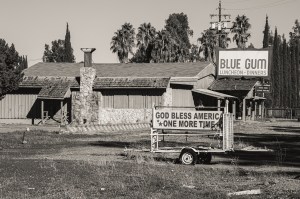
Gene Valla would later assume ownership of his father’s business, The Blue Gum Restaurant and Lodge, just south of Artois, California. Valla died in 2009.
***
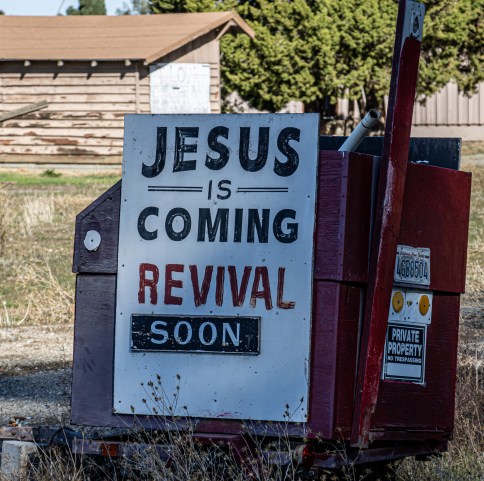
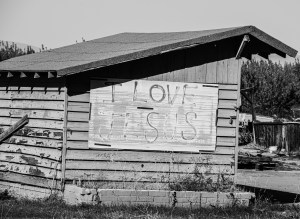
I’m stopped outside of The Blue Gum Restaurant. By accounts it was a popular place in its day. Now it has the sad look of a place that will never see another paying customer, and will continue to deteriorate until a “mysteriously set” fire puts it out of its misery. A passerby called the new owners, or maybe they’re just squatters, “a bunch of Jesus freaks.” I stopped to wander around out of morbid curiosity, drawn less by the building and more by the “Jesus freaks” signs. One of the signs announcing that Jesus is Coming Soon is placed next to a No Trespassing sign. I can’t help but wonder if no trespassing applies to Jesus as well as the rest of us. In any case, I did note the irony. I mean, isn’t Christianity supposed to be a welcoming thing?
After wandering around I head back to the car. I’m not about getting into it with some pissy, and possibly armed, “Jesus freaks”.
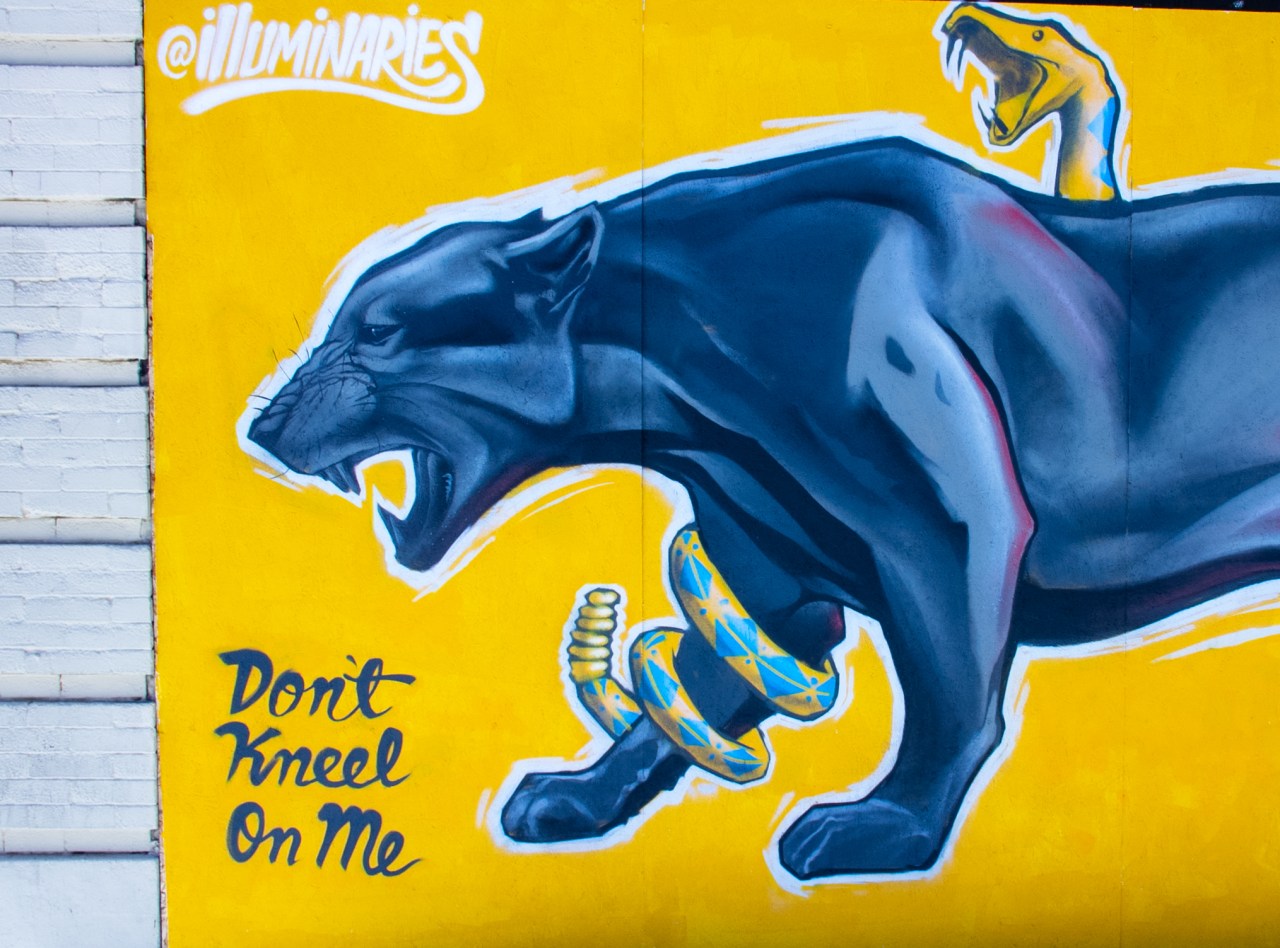
Banner photo: Detail of a mural in Oakland, painted in the aftermath of the slaying of George Floyd
Tim Scott said it. Nikki Haley said it. Both are running for president and both are out on the campaign trail road testing the lie that’s become a GOP shibboleth. That these two are people of color is what causes my eyes to bug out and my head to shake.
“America is not a racist country,” they said.
Taken at face value, that statement is a myth.
In the interest of transparency, Joe Biden and Kamala Harris have said essentially the same thing. It is after all, the realpolitik thing to do.
That said, there are differences. While Biden, Harris and other Democrats might say that America is not a racist country, they recognize that racism exists in America and they are quick to call out its instances. Republicans, on the other hand, not only consistently refuse to call out racism, some have been busy little bigots in their promotion of policies that are clearly racist.
From the Democrats, ‘America is not racist’, is a statement describing values and hope tempered by the reality of existence. From Republican mouths, ‘America is not racist’ is fantasy and campaign hooey.
There are examples aplenty but one need only focus on two recent events to prove that the GOP is doing everything but making the white sheet its party uniform to demonstrate that it has a race problem.
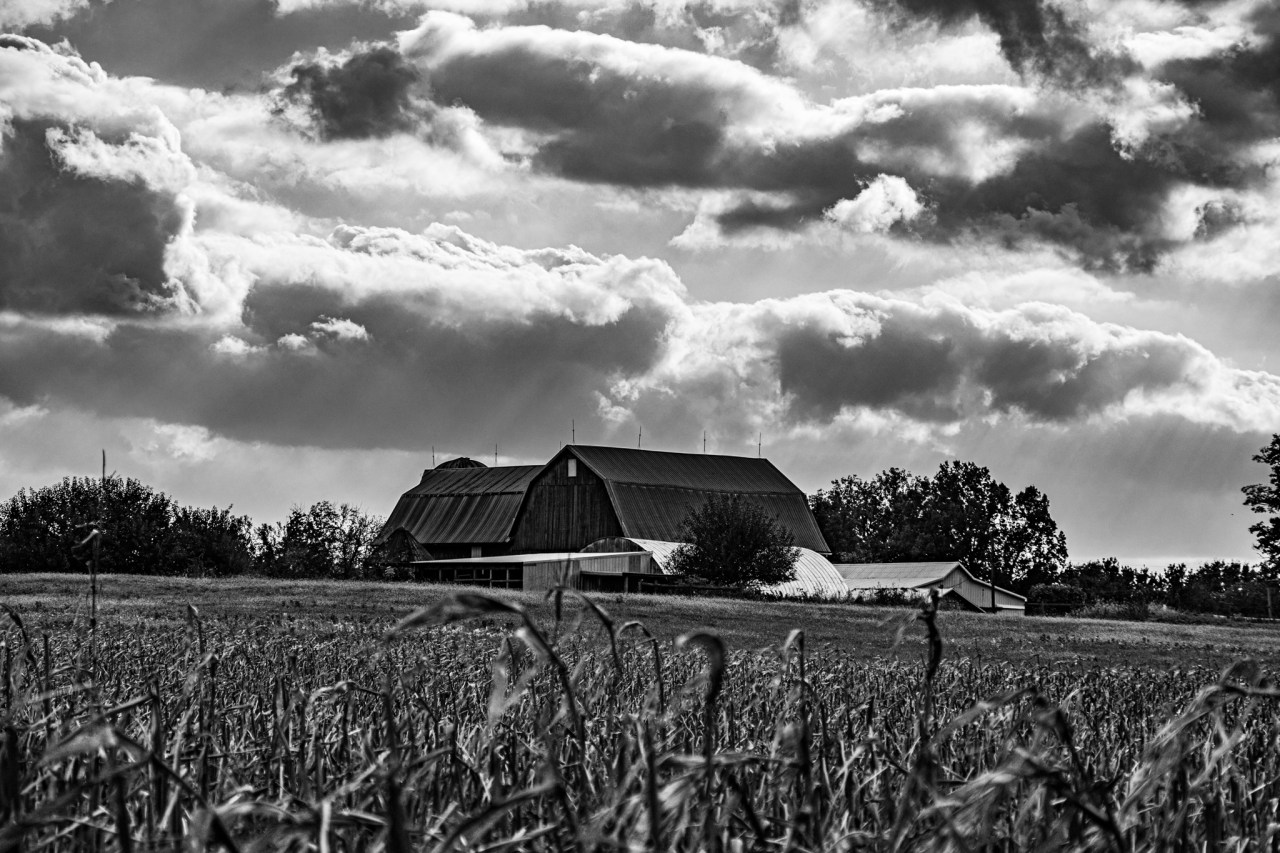
Dan, author of the site, Departing in Five Minutes, leads this week’s Lens Artists Challenge, and he’s selected the topic, Unbound: Escaping Your Confines And Seeing The World. Once again, I’m combining the Lens Artist Challenge with my Monthly Monochrome series.
Dan writes, “From a day trip to a road trip to a great escape to a far away place, you have the thrill of a new experience.”
For me the much of the thrill is in leaving the planned itinerary to see where an offramp goes and what an unintended detour leads to.
***
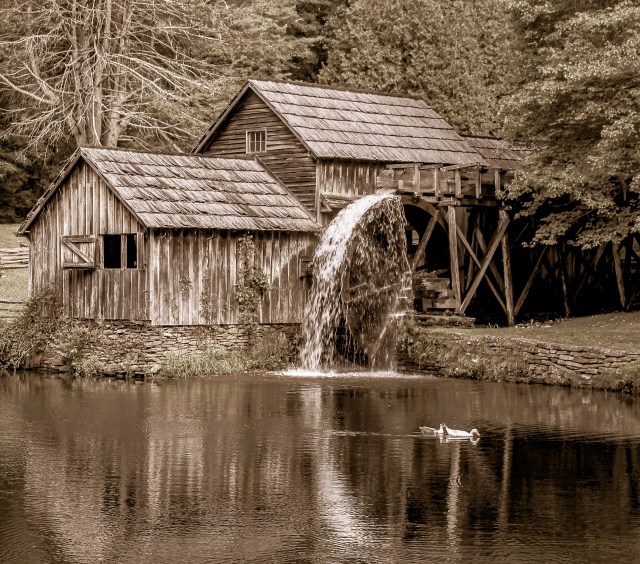
Mabry Mill, Virginia
In 2015, Cora and I took a trip to Washington D.C. to see the San Francisco Giants play the Washington Nationals. We extended our stay in the nation’s capital and then took a road trip through Virginia. On the way towards Richmond, our final destination before flying home, I detoured to see the Mabry Mill.
Edwin Boston Mabry began construction on the mill in 1903. It started as a blacksmith and wheelwright shop and then, in 1905, became a gristmill. Five years later, Mabry had installed a double-bladed jigsaw, a wood lathe and a tongue and groover, converting his operation into a combined gristmill and sawmill.
In 1938, the National Park Service acquired the mill and by 1942, the mill was completely restored. Since then, the Mabry Mill has become one of the most photographed structures in America.
“It can hardly be a coincidence that no language on earth has ever produced the expression, ‘As pretty as an airport.”
― Douglas Adams, The Long Dark Tea-Time of the Soul
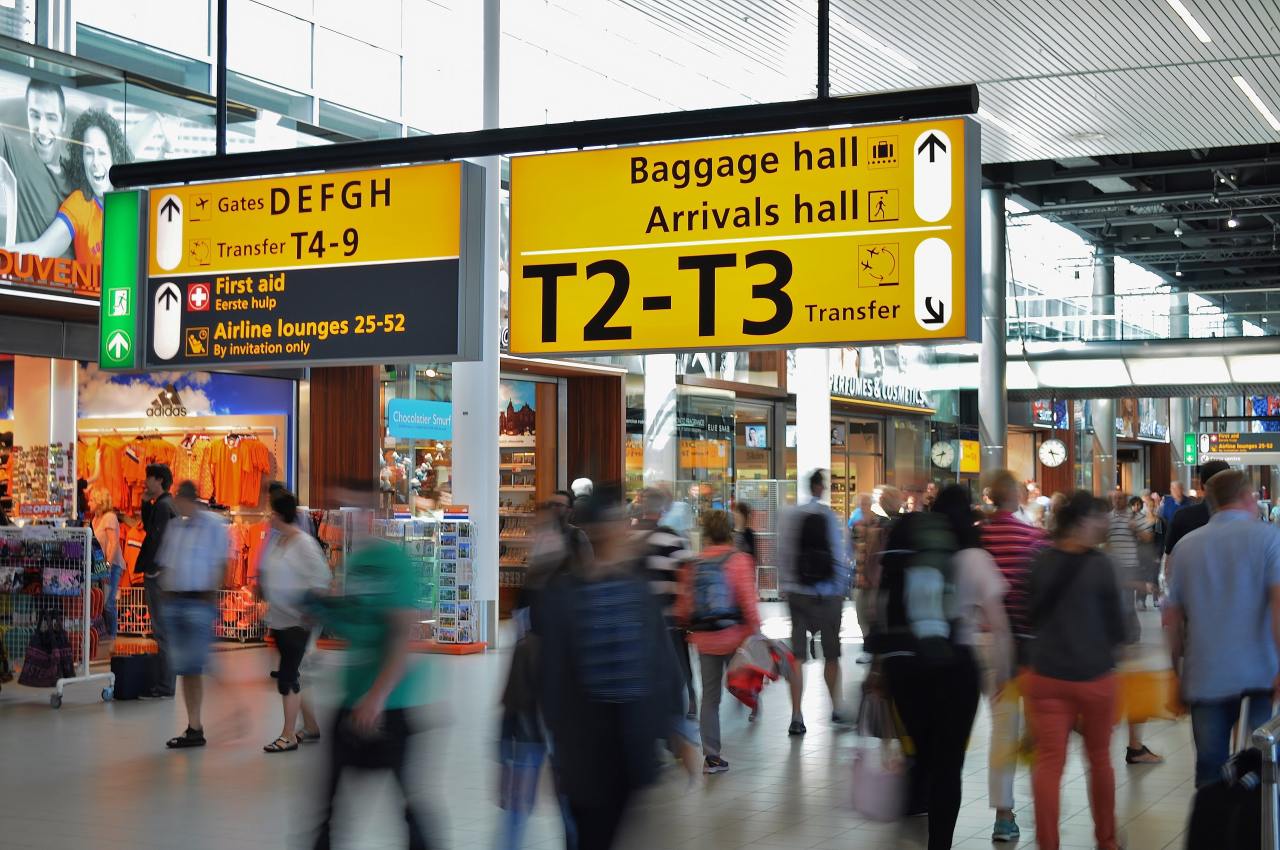
It’s a constant migration. Every hour of every day of every year. A single year’s migration consists of more than 200 million travelers on over 2 million flights. Short hops and long hauls, they pass through podunk airfields and airports that are self contained cities. Not unlike the Arctic Tern, the travelers are moved by an instinct. Unlike other species that migrate for food or reproductive instincts, the travelers are driven by an impulse to see new things and new places and to meet new people.
It all seems so chaotic. Imagine if a giant hand were to peel the roof off of San Francisco International Airport. From an airliner’s eye view, the observer might think he was looking down on an ant colony. A horde scurrying in all directions, each individual with his or her own mission.
Cora and I were gliding on a moving walkway in the Dallas Fort Worth Airport, one of those city sized airports. The long steel belts can seem like a Godsend after you’ve unfurled yourself from a cramped airline seat and are faced with a trek from one end of a boundless terminal to the other end. That’s when they work. If you’ve caught a walkway that’s worn out from hauling the migration then you pack it and hack it. We’d just deplaned from San Francisco (SFO) and were headed for another terminal far, far away to catch a flight to Madrid.
As we were swept along with the mass, moving without moving, I watched a hollow eyed multitude, confused and harried, being hauled unconsciously along the steel belt and I thought of parts on an assembly line. They dragged bags, kids and the elders who couldn’t keep up, and wore polar expressions of anticipation and exhaustion.
As I glided along in my own stupor, it occurred to me that there was something Orwellian about this airport migration. Directed by LED status boards and the instructions of a spiritless omnipresent voice from unseen loudspeakers, the weary travelers reminded me of automatons; silent, weary, eyes front, unflinching and unquestioning, conveyed from one unknown point to another.
The moment we enter the airport we give ourselves and our persons over to various agents, guards, attendants, handlers, assistants and machines. From one line to another and through detectors and into a scanner that sees through our clothes but, ‘not to worry,’ we’re assured, the scanner doesn’t reveal the goodies.
When was it that the excitement, the glamor and the romance of the airport turned into a temporary layover in purgatory? Was it when armed nuts demanded that planes be diverted to Cuba? Was it Bin Laden or that other nut who tried smuggling a bomb in his shoe? Maybe it was when the airlines decided that stock prices count more than the comfort of the flying public. I mean, what’s the traveling public gonna do about it? Take the bus? I guess it’s some measure of all of it.
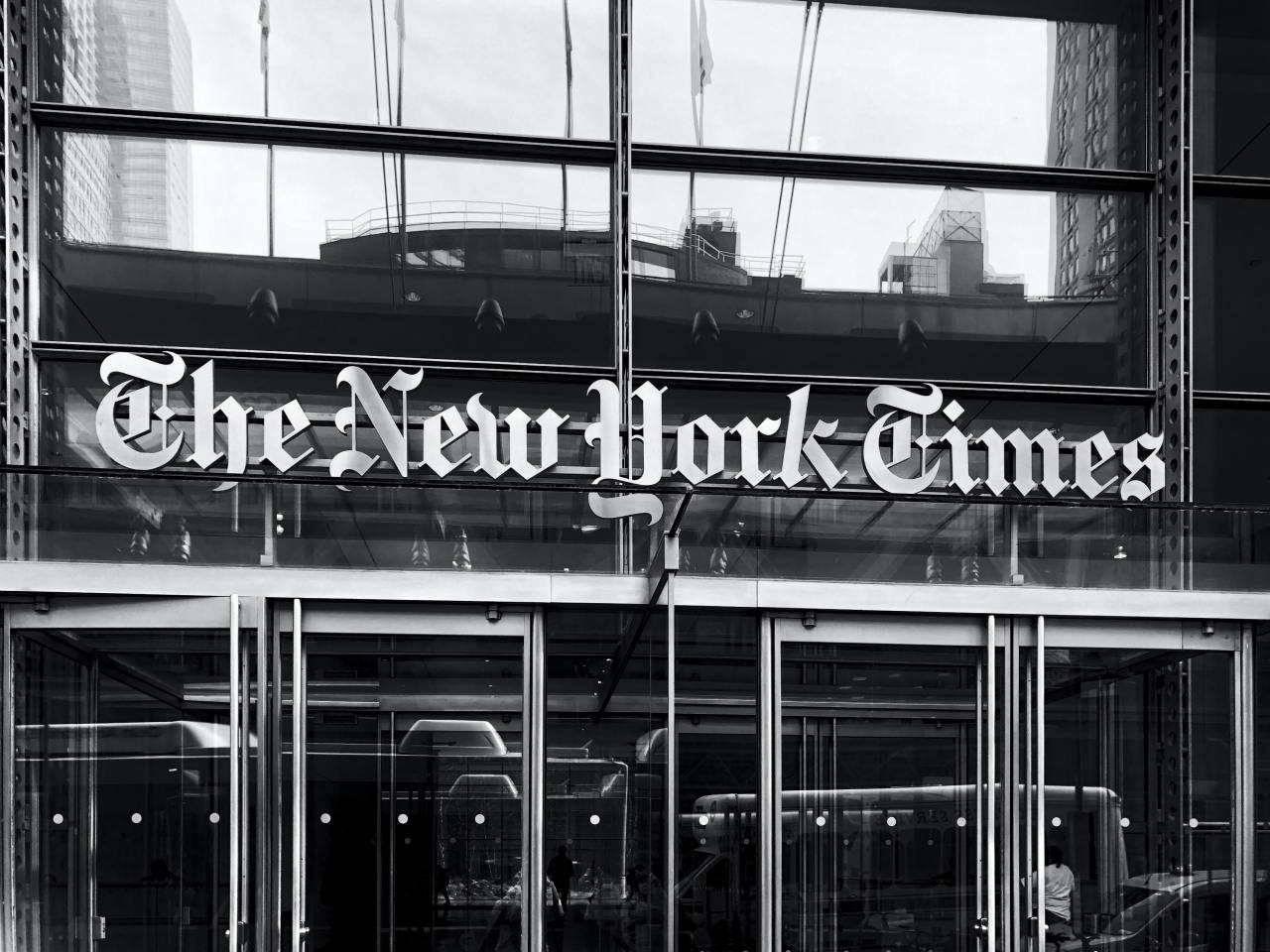
My good friend Marc David is a journalist, author, avid runner (he has an outlandish, blows my mind, years long streak of consecutive running days without a day off), cross-country coach, teacher’s aid and traveler. When he learned that The New York Times killed its venerable sports section and shipped the body parts to its online site, The Athletic, Marc wrote the piece below. It’s a short poignant reminiscence about his years as a sports writer, the death of The New York Times sports section and the demise of sport journalism in general.
***
When I think of the New York Times, I think of a sports department teeming with legends. I think of Red Smith, Dave Anderson, Michael Katz, Roy S. Johnson, William Rhoden, George Vecsey.
I think of a young sports writer in the 1970s approaching Red Smith at a National League playoff game at Veterans Stadium in Philadelphia and introducing himself. “Mr. Smith. My name is Marc. I just wanted you to know how much I enjoy reading your articles. It is great to meet you.”
Today, the Times sports department is a thing of the past, swallowed whole by The Athletic. The Times purchased The Athletic eighteen months ago, so it is not as if those perusing the seminal newspaper’s website will go sports-less … they will be guided to another website. Still, this is the latest blow to the written word and another in a long line of counter-punches that have rocked the newspaper industry since many readers chose the Internet to get their (sports) news.
It is a sign of the times. Thirty-six years ago, I had to make a choice of taking a sports editor position at a small Caribbean daily or becoming a copy editor at the Arizona Republic. I opted for the former. Today, even if I was 36 years younger and infinitely more talented, I doubt whether any newspaper offers would come my way.
Most of us have learned to adjust. It’s a brave new world we live in today. I still write sports articles occasionally for newspapers. However, I no longer consider myself a newspaper journalist. I gave that up 11 years ago.
Philo is the host for this week’s Lens Artist Challenge and he chose the topic, Simplicity.
Simplicity isn’t necessarily such a simple thing, so I decided to take my cues from the host. In his post Mr. Philo suggests making a single subject the star.






 The Life in My Years