
The twelfth in a series of occasional posts about tripping along U.S. Highway 395.
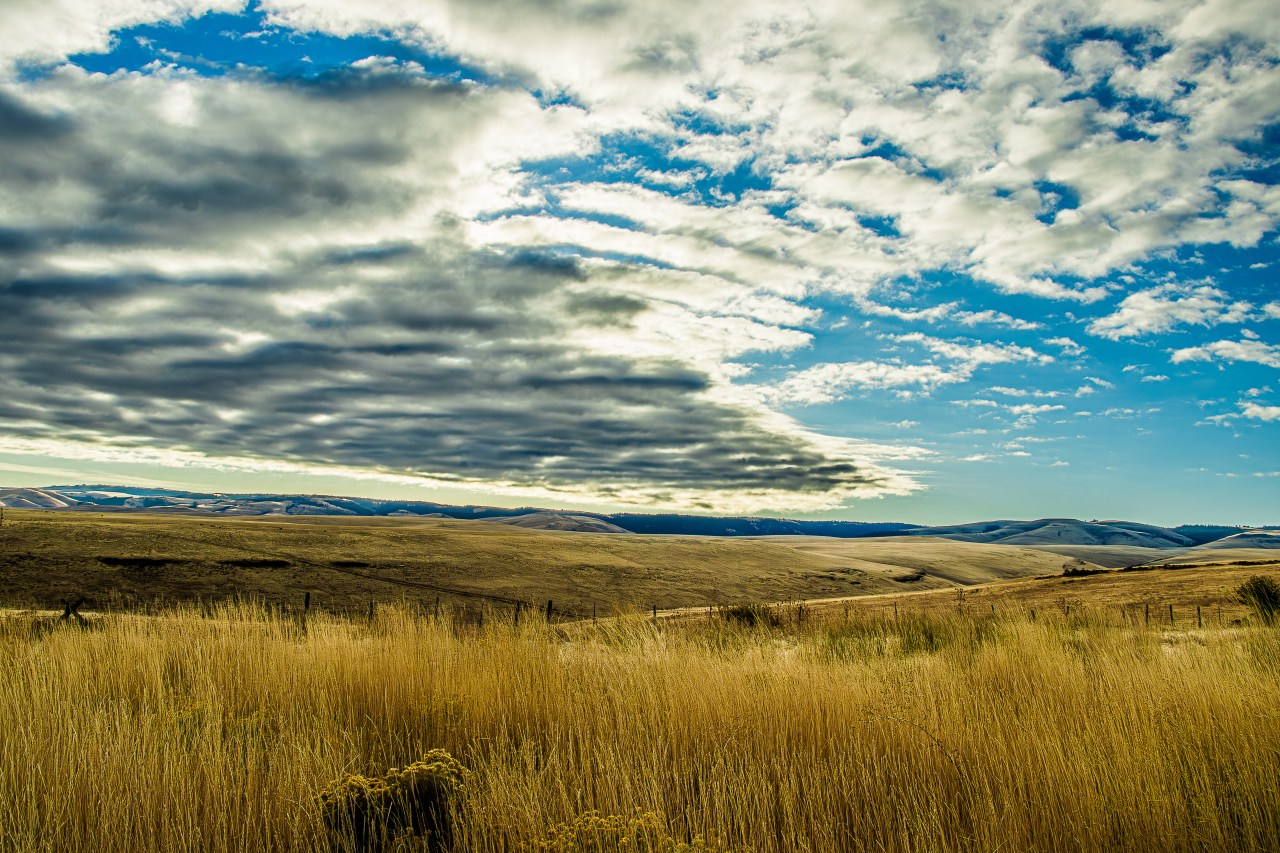
I’m southbound out of Pendleton, Oregon on Highway 395, a two lane sluice through broad fields of ranchland on either side of this solitary highway. Acres of yellow cheatgrass undulate in a light breeze and a bright morning sun just topping the horizon transforms the landscape into an ocean of shimmering, golden waves.
Highway 395 is billed as one of the loneliest roads in America and out here? Yeah, that’s no lie. Over the course of 30 minutes, not including passes through the towns of Pilot Rock, and Nye, I’ve seen two or three cars and one big rig.
An hour out of Pendleton and I’m gaining altitude towards the summit of Battle Mountain. As the road snakes up the mountain, blonde grass is replaced by the lush green of a pine forest. After topping the 4270 foot summit the highway dips back into undulating ranchland and tall grass.
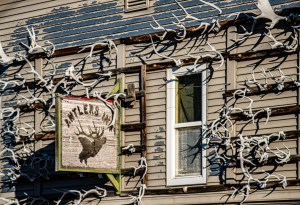
Ukiah, Oregon, population 159, and the two main features are a panoramic view of the surrounding hills, and the Antlers Inn, which from all appearances is an overnight haven for sportsmen. and aficionados of stuffed, dead animals. The front of the building, guilded with rows of antlers that were shed by local elk, is just a preview of what’s inside; a veritable herd of various dead animals, stuffed and mounted.
According to the gospel of Yelp, The Antlers is, to put it mildly, Spartan. One reviewer described the bed as being an old army cot. No phones, no television, no radio and no private bathroom. I’m reminded of Roger Miller’s old song, King of the Road; “No phone, no pool, no pets. I ain’t got no cigarettes.”
The countryside here is beautiful and the town has a rough hewn charm about it. I’m not a fan of hunting, especially trophy hunting, but I’m not at all averse to being off the grid or shared bathrooms, so as I leave Ukiah behind I’m a bit sorry that I didn’t decide to spend a night here and get a chance to explore and meet the locals. I wish that I’d at least taken some time to slowly cruise the side roads to get a better feel for the place. I feel like I’m in too much of a rush.
***
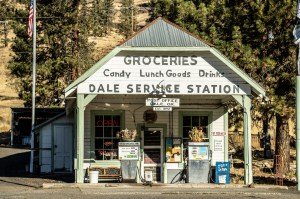
Twenty minutes down the road I arrive at Dale. The population of Dale is in the neighborhood of 270, but as I pass through, which only takes a matter of seconds, I can’t really spot anything that resembles a neighborhood. A general store, two pump gas station (one for diesel) and post office, all packed into one building, likely also serves as the informal (formal?) community center.
***
A Hamms Beer sign in the store’s window wrings out a pang of personal nostalgia. Hamms is an old, weak and watery, old school brew that was shilled on TV by a cartoon bear to a jingle that touted it as “the beer refreshing,” “from the land of sky blue waters.” Mom and dad sipped on Hamms while lounging on the backyard patio, Giants baseball on the radio, and me splashing around in our above ground pool. Memories of the last vestiges of what boomers fantasize as a sort of golden age of suburban life.
***
Many of my road trips through ranchland like this have been on two lane roads that roll and twist between fields divided into parcels defined by barbed wire fences.
Before barbed wire, most cattle grazed on the wide open range. In 1873, a fellow named Joseph Glidden put a coffee mill to use to make barbs that could be applied to wire fencing. He wound up in a patent dispute with another inventor, Lucien Smith, who invented the first such fencing seven years earlier. Glidden survived the dispute in a ruling by the U.S. Supreme Court and promptly marketed his invention. Glidden’s improved fence allowed ranchers to confine their stock, thus reducing the threat of cattle rustlers, and freeing them to more securely increase the size of their herds, all leading to an increase in the availability of beef.
Glidden’s invention, which enriched him to the tune of about a million dollars, altered the food economy, while changing the storied narrative of the American West. The “devil’s rope,” as it was called, removed much of the open land that nomadic Native American tribes called home. It also brought about the demise of an American icon – the open range cowboy.
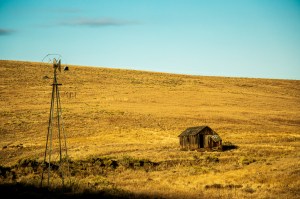
I’m driving through something of a throwback to the days before Glidden’s “devil’s rope.” Out here much of the ranchland is still open range. Moving south from Dale I’m seeing, more and more, signs warning motorists that this is open range country, where you’re as likely as not to run into a cow meandering along the road. Run into one, literally, and you’ll be left on a quiet road with a thousand or so pounds of raw steak and burgers, a hacked off rancher, and the promise of a hefty auto repair bill.
***
I’m the only one physically in the car but still, I carry two companions. Apprehension, the first of my riders, makes himself known on those occasions when I’m driving those stretches of Highway 395 that live up to its lonely billing. While I knew all of that lonely shit going in, there are times when the remoteness is disconcerting. I’m not one for traffic but I wouldn’t mind seeing more than a car or two an hour.
My wife keeps reminding me, “You’re not that young anymore,” and while that’s true I’m still not ready to assume the role of the geezer who’s content to go to the city park to feed the ducks and then toddle off to the senior center for bingo. It isn’t so much my age that makes me nervous, as the possibility that I’ll get hit with a bout of atrial fibrillation. It’s a condition that strikes me a couple times a year at most. In theory, and usually in practice, my meds will kick my wonky heart back into normal rhythm. When the meds don’t work, it’s off to a hospital to have my heart shocked back into sinus rhythm. I’m dogged by the realization that hospitals are in short supply out here in very, very rural Oregon.
***
My other companion is exhilaration. There’s nothing complicated about this fellow. He just keeps reminding me that life is short and I should do what I enjoy, while I can, before that time when bingo is the highlight of the day. He reminds me that if I run into a calamity, I’ll figure it out. And who knows, the bingo days may never come.
***
The road roller coasters from flat as a billiard table grassland, to ripples that turn into rolls. that steepen with an ascent into pine forests, all followed by the inevitable descent to the flats, where the sequence starts all over again.
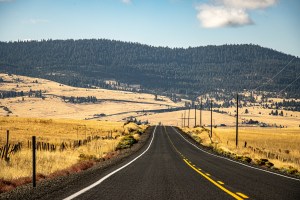
Road to Frenchglen
Plopped into the middle of the sea of green/gold grassland is Long Creek, population 173, give or take. As I drive into town, I pass an expansive red building, the Long Creek Mercantile. This combination feed store, general store and cafe advertises itself as the home of the “Worst Darn Breakfast.” Translated, that probably means it’s pretty fucking good. I’m tempted to stop for a break but knowing that there’s still 165 miles till I get to Frenchglen, and, being certain that uncertainty might be a certainty, I decide to push on.
A few minutes out of Long Creek is Fox, a few scattered buildings, a white church and some ranches scattered about the region. The closure of the town’s post office twenty years ago essentially marked the demise of Fox’s viability as a town.
Two minutes down the road from Fox, there’s even less of Beech Creek.
Mount Vernon is about thirty minutes down the road, and apprehension is screaming in my ear. I’m verbally asking myself what’s changed over the course of just one year, when I’d covered over 8000 miles, on a solo road trip through the Midwest. I keep talking to myself. “Fuck this, maybe I am getting too old for this sort of thing. Maybe Cora’s right. Hell, I’ll be 69 a week from now. Maybe I should take bus trips like a family friend likes to do.”
I answer myself, “Fuck it. I’m here. It’s not like I’m going to be able to take an off ramp for the Bay Area. Hell, the off ramps here are few and far between and whatever off ramps there are simply lead to a more desolate form of desolation.”
***
I’ve arrived in Mount Vernon and I can safely say that this isn’t the city in New York State, nor is it George Washington’s home in Virginia. This Mount Vernon is smack in the center of Oregon’s John Day Valley and was named after settler David W. Jenkins’ black stallion in 1877. The stallion’s stable, a stone building surrounded by a fence, is still standing just outside of town, a shrine of sorts. I wonder if, after sauntering to that stable in the sky, old Mount Vernon (the horse), was stuffed, and now stands ignominiously in some nearby podunk museum.
Mount Vernon is an all-American small town, all festooned with American flags; cloth ones, vinyl ones, new ones, tattered ones, flags painted on the sides of buildings and gigantic flags mounted on the beds of gigantic pickups. No doubt, I’m in the US of A.
***
Out here there’s no dearth of reminders that I’m in mega MAGA country. In an area where there’s an American flag on damn near every other building, I’m seeing an almost equal amount of MAGA signage and more than a sprinkling of fuck Biden signs.
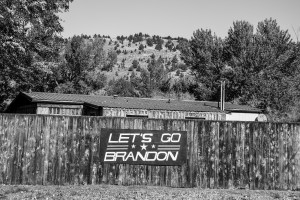
The prevailing politics of northeastern Oregon. Let’s Go Brandon is MAGA-speak for fuck Biden
I suppose it’s a good thing that my Black Lives Matter t-shirt is sitting in a drawer at home – libtard bastard that I am.
***
The highway heads due east towards John Day. There’s an interesting history to this junction town. People were drawn to the area when gold was discovered in 1867. Many of the early residents came from China, mostly bachelors (female immigrants were not allowed) who were seeking work and riches in the mines.
One of the town’s earliest buildings, a trading post and stage stop, was erected in 1864, and its primary customer base was from the Chinese community. By 1871, under Chinese ownership, the building was known as Kam Wah Chung & Co. John Day’s growing community was made up largely of Chinese residing in a section called Tiger Town. Kam Wah Chung & Co saw its boom times during the late 1880’s when it was bought by three Chinese immigrants, Lung On,Ye Nem, and an herbalist, Ing Hay, who went by the nickname “Doc”.
For years, Kam Wah Chung & Co served the community as a general store, an apothecary, a doctor’s office, a boarding house for migrant workers, and a community center. The mercantile part of the business died with the passing of Lung On in December 1940. “Doc” Hay continued the apothecary until 1948, when he was forced to retire and live out his years in a Portland nursing home.
Slated for demolition, the Chung Wah building was saved by the John Day Historical Society, which acquired the building in 1968, and later transformed it into a museum.
Once largely Chinese, the ensuing decades saw the community’s makeup change to one that is now 88.4% white. The Asian community makes up 1.84% of the population.
I follow the signs in town that lead to the Kam Wah Chung museum which is home to the largest intact collection of Chinese medicine and formulas. Tours are offered but the place is all booked up when I arrive. Fuck me.
***
Back on the road.
From John Day, the highway resumes its southerly course. Just outside of aptly named Canyon City, I’m driving through a canyon in the Malheur National Forest. The shoulders that loom over the winding road are denuded of a once lush forest. A wildfire turned a once abundant woodland into scarred slopes of blackened toothpicks. The road straightens out and I pass the charred corpse of a horse trailer.
Malheur isn’t a stranger to wildfires. It’s a devastating kinship that will last into the unforeseeable future.
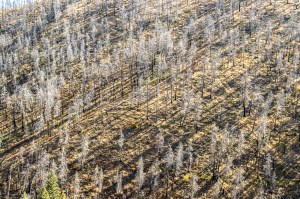
The sun casts eerie shadows on a scorched hill in Malheur NF
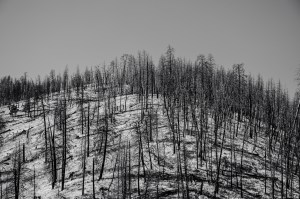
Malheur NF Oregon
Past the burned area, I’m back in ranchland. Farm and ranch equipment that appear to be on their last legs, yet still serviceable, litter the open fields. They aren’t burned out or rusted out. They’re just there. Do they belong to someone? Did they wear out their usefulness? Why? Do we toss out machinery just as we toss out old Hamms beer cans?
***
I take a short break just south of Seneca, where autumn is in its full green and orange glory, a palette against a background of dark hills. But for the occasional roar and swoosh of a passing big rig, the road here is quiet. My apprehensions have been pushed aside by the pleasant, peaceful hush.
Before the town of Burns, I wonder just how Poison Creek, which I just passed, got its name.
Burns is the last real outpost of civilization before I veer off 395 to Frenchglen. The car needs gas and I have to piss like a racehorse. Sam’s Service is a little white building, painted with blue trim. The place looks worn, but the gas is cheap and, damn me, I gotta pee. A couple pumps, a working service bay, a Coke machine, a minimal store and a stocky Paiute gas jockey behind the counter.
“Fill it?”
“Please.”
“Gotta bathroom?”
“Round back.” He hands me a key.
“Thanks.”
The bathroom? Not the Ritz and that’s for damned sure, but. I just need to take a leak. The door sticks. When I get in, lo and behold there’s a condom dispenser. Not that I’m in need of a rubber. I just thought those dispensers went out with rotary phones. Business done and I have a short panic attack when the stubborn door seems to have me locked in. A good yank – out. The gas jockey cashes me out, and I’m back on the road. The car is full and I’m comfortably drained.
Burns is my cutoff. Highway 395 heads west but I’m going south on Route 205 to Frenchglen, an hour away. During my research, Frenchglen looked intriguing.
There are basically two places to sleep in Frenchglen, the historic old hotel, or the backseat of your car. I opt for the former. When I made my reservation, the proprietor asked if I wanted to reserve a spot at the community dinner. Otherwise, she warned, it’s a long ass drive to a restaurant.
I reserved.
***
I intend to stop at the Sunset Valley Cemetery. I’m fascinated by old graveyards and Sunset Valley shows up, just barely, on the internet. Google Girl tells me I’m there but – nothing. I scan the horizon but all I see is a ranch off to the left. Fuck me. Continuing on the road, I take a quick glance in the side mirror and see that I’ve passed a little arch that looks to be graveyard-ish. I turn around and as I approach the arch, a closer look reveals a tiny, overgrown cemetery. A dirt road leads to the ranch I’d seen when I originally passed. and what looks to be a route to the graveyard. I stop at a turnout where a barbed wire gate leads to the cemetery and rangeland. From where I’m standing, I can see the cemetery but the gate is rickety. I give it a little tug and it feels as if the whole thing is going to fall at my feet. Fuck it. I’m not going to be the guy who let some rancher’s herd slip out onto the highway. Besides that, from a distance, this little cemetery has the look of a private family graveyard, possibly belonging to whoever lives in the ranch house down the road. Yeah, I’m not going to intrude.
***
The land here is stark, barren and uniquely, and hauntingly beautiful. Miles back, I couldn’t see anything but trees. Out here, the view stretches out forever. Every now and then I pass a dirt road that leads to… Who knows?
This is old land, a place once populated by the Paiute and Bannock tribes. It’s a land that saw the passage of pioneers and is now home to hardy folk who raise cattle and cherish solitude. I couldn’t live here. Too many empty miles between the things I want and need.
***
This is a land with a violent history. The year 1878 saw the last of the local Indian wars, when members of the Paiute and Bannock tribes banded at the foot of the nearby Steens Mountain. Battles ensued, further north at Murderers Creek, and later at the mouth of Cummings Creek, and again, in the Fox Valley. In the end, the indigenous tribes were vanquished and scattered to nearby reservations. Because that’s how it worked in America – from sea to shining sea.
***
The highway winds through more open range. I can sense that Frenchglen is close. Off to my left the land is flat as a board till it hits the high country that’s topped by Steens Mountain. Just to my right, the land rises to bluffs that loom over the road. I’m dog tired, and I’d like to haul ass and get to my destination, but the road is a series of turns and that flat land to the left is dotted with cattle, some just skirting the highway’s edge.
Rounding a corner I screech to a halt when I come up on a bull meandering down the road as if he owns it, and, given our current stand off, he does. The bull turns and looks at me with what seems like a “what the fuck are you looking at” expression.
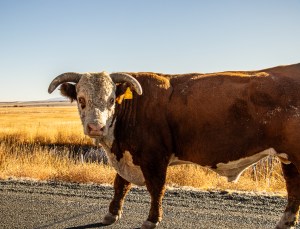
What are you lookin at?
Knowing he has the upper hand he continues to amble down the road while I follow, slowly and at a distance, all the while keeping my eye in the rearview mirror for a car that might round a blind curve and drive up my tailpipe. Finally the bull wanders onto the nearby field. A few more bends in the road and there it is – Frenchglen.
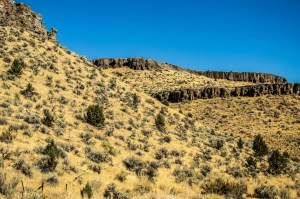
Road to Frenchglen. On my right, the road rises up to looming bluffs
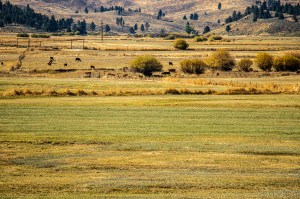
On my left is open range



 The Life in My Years