
“Good food is very often, even most often, simple food.”
~ Anthony Bourdain, Kitchen Confidential: Adventures in the Culinary Underbelly
Kraków. It’s old. Fourth century old.
Put in American perspective, because for Americans it’s always about America, Krakow was the capital of Poland five centuries before a European landed in what would later be the United States. Jagiellonian University was graduating students three centuries before the first Harvard student said to the first ever Harvard prof, “My dog ate my homework.”
Krakow has basked in the grandeur of royalty and been chastened by invaders; Mongols in 1241, Swedes in 1657, Nazi Germany in 1939 and the Soviet Union in 1945. As a part of the Eastern Bloc, Poland was under the yoke of the Soviet Union until 1993. In Krakow, one doesn’t have to look hard to see the remnants and scars left by the latter two.
Today Krakow is a historic treasure, with two of its districts, Stare Miasto (old town) and Kazimierz (the old Jewish Quarter), having been designated UNESCO World Heritage sites, along with other UNESCO Heritage sites within a short drive of the city.
Today, Krakow is also old world made young and vibrant by a large population of college students and a lively cultural and nightlife scene. One can plunge into jazz at the basement Jazz Club u Muniaka, just steps away from a 13th century church.
Arrival
The cabbie brought us to the city from John Paul II International Airport using mostly backroads. There’s a first for everything and this was the first time I’ve taken anything but a highway to or from a major city’s international airport. The ride took us past a few stands of woodland and modest homes until we arrived in the city.
Once in the city itself, the driver looped onto Plac Dominikański, drove one short block and dumped us out. It wasn’t quite that unceremonious. He turned, put his arm on the back of his seat and explained that cars are not allowed onto the old square, and so we would have to walk to our hotel.
Well, that sent a shiver. Whenever we pass tourists trudging along a clogged street, weaving through crowds of tourists, and dragging luggage clattering on cobblestones, I’ve always muttered to myself, “there but for the grace of God …” Now, here in Krakow, God’s grace had apparently run out. Full disclosure, whatever grace I ever had is long past its expired date. Being the heathen that I am, I’ve been on borrowed time. Maybe I’ve just been pulled along on the coattails of my devout wife and in Krakow, God was firing a warning shot across her bow.
The driver must’ve noticed my brief look of terror and said, in a kind voice, “It’s only about 200 meters.” He pointed to our right, “Go up that way to the square, and once you’re on the square, turn right.”
Like most Old World European cities, the first thing you see when you arrive at an old town’s main square is an imposing old church. Kraków is no different. We turned the corner onto Rynek Główny (Central Square) and the gothic spires of St. Mary’s Basilica loomed before us. A magnificent centuries old building unexpectedly presents itself and you’re compelled to pause, marvel and say something like, “Damn! Look at that.” It’s almost like a usual drill except the there’s nothing at all usual about the imposing sight that soars from the square.
The Venetian House is located right on Rynek Główny, in an old building with its own courtyard just inside the front entrance. We arrived well before check in and after leaving our luggage we headed straight for the nearest T-Mobile office. The often spotty coverage that we normally get in the old European cities was non-existent in Krakow. Just like the old days, we were internet blind.
Crossing the threshold of the 15th century Barbican, the old city gate, was like time travel, as just a few blocks outside of Old Town, Kraków turns to modern kitsch at the three story Galeria Krakowska.
Malls all over the world are all more or less the same; tawdry shrines to commercialism and materialism. Malls dot countries around the world but they all scream the same language of shameless consumerism. The same steel and glass and plastic plants, the same garish, blazing light, the same drone of zombie-like shoppers looking for something in particular and nothing at all really, the same food courts serving the same international versions of plastic food, and all of it to the sound of piped in elevator music and semi-hits from long forgotten almost pop stars. For those who aren’t looking to buy, the mall is the land of “I don’t have anything else to do.” To quote Frank Zappa, “Like, oh my god, fer sure, fer sure,”* at Galeria Krakowska we could just as well have been in Encino, California. It was, “like, so bitchin’.” * From “Valley Girl” Lyrics and music by, Frank Zappa and Moon Zappa
The nice man at the T-Mobile shop told us that T-Mobile in Poland is essentially a third cousin many times removed from T-Mobile USA, and all he could do for us, if we wanted internet, was to sell us sim cards for our phones. I got a sim card and Cora decided to just stay tied to me at the hip. “If we get separated, just ask someone for directions to our hotel and I’ll meet you there,” I suggested.
Eating Kraków
There was a Michelin starred restaurant just a few steps from our hotel. We briefly considered it and then reconsidered. Did I really want to pay a couple hundred U.S., for 13 courses of miniature Polish food? A kielbasa the size of my pinkie next to some fancy, foamy version of mustard. Two pierogi that could fit in the palm of my hand with room to spare. A Polish pretzel that I could slip on my finger next to my wedding band. Never mind.
Give me the food of the people, damn it!
Dining at the milk bar
One afternoon we decided to eat literally like the proletariat of the bad old days of Communist Poland. Well, it was my choice. Cora was along for the ride.
The Polish bar mleczny (literally translated as “milk bar”) is a holdover from the dreary era when Poland was under the thumb of the Soviet Union, when those lucky enough to own a car knew to disconnect the windshield wipers and bring them in for the night lest they end up as stolen merchandise on the black market, and if you wanted to buy necessities like eggs and milk you might have to stand in an hours long line (and we Americans think our milk and eggs problem is bad).
The milk bar was the bone that the state threw to the commoners so that they could enjoy an affordable opportunity to dine out.
A milk bar has nothing to do with the traditional understanding of either the juice of the cow or a place to have a few pops. There are no white table cloths and candles at a milk bar, no romantic booth, and no pretentious servers. What you get are plain tables and chairs, fluorescent lighting and its, serve yourself. A milk bar is a cafeteria where you can get cheap eats and cozy up with a new Polish acquaintance.
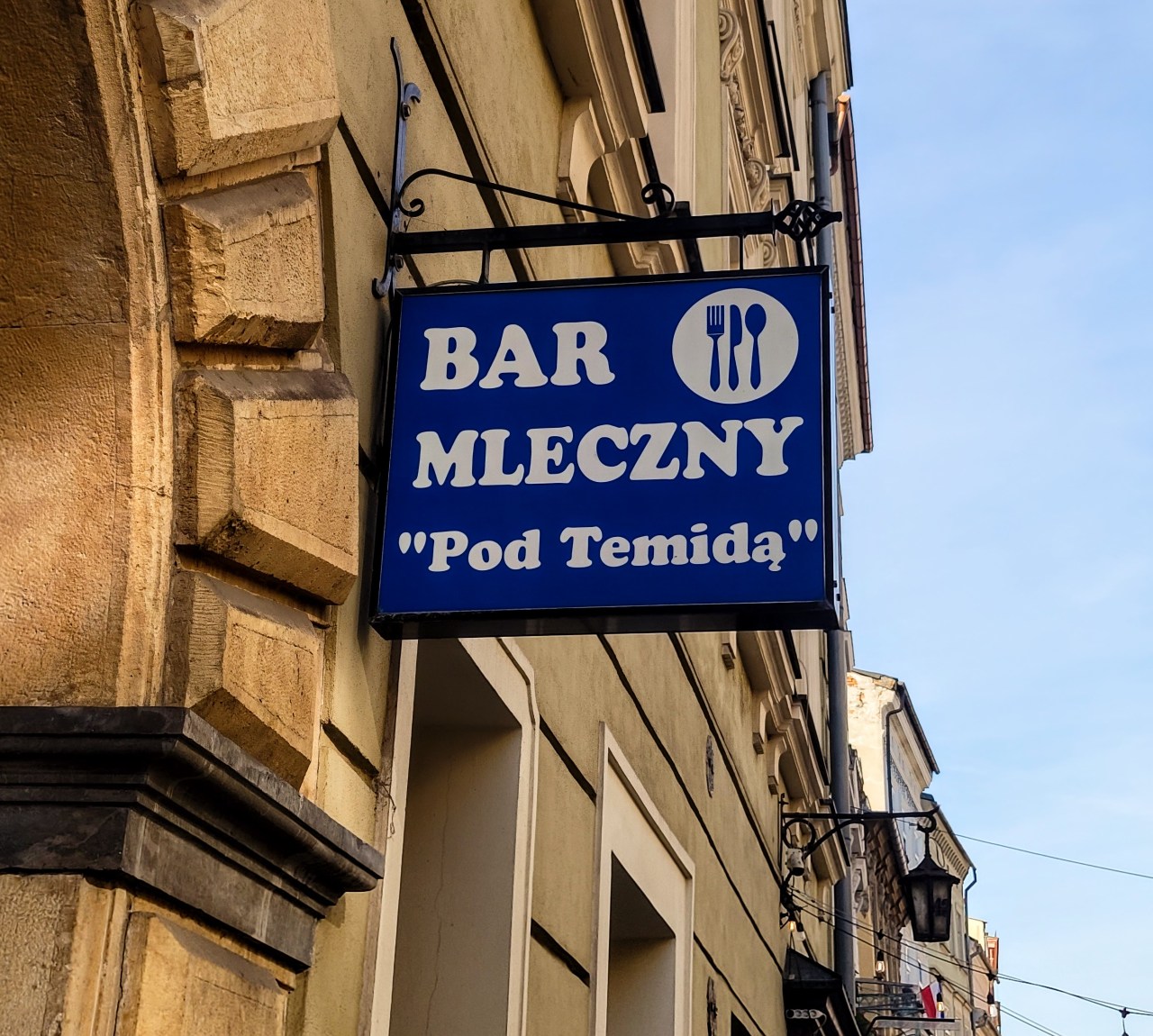
At bar mleczny. Pod Temidą we fell into a line that stretched from a counter in the back, to nearly the front door. It could’ve been my old high school cafeteria, only smaller and populated by adults speaking Polish. Two very busy women deftly worked the counter. One took orders and the other did your basic schlepping. Halfway between the door and the counter was a large menu board written in both English and Polish. It’s here that you had to get your shit together and figure out what to order.
There’s no steam table where you can point and ask, “What’s that?” (which at a restaurant, or hell, even your neighbor’s backyard cookout, comes off as a bit insulting. I guess it is better than, “What in the fuck IS that?”).
With our trays in hand we got to the front counter and placed our orders with the milk bar lady who knew just enough English. The orders were relayed to the back kitchen through a little window. By the time we paid what was probably about eight dollars U.S, our food was shoved back through the window and placed on our trays. Cora ordered a Fanta to drink and I pointed to a row of tumblers filled with a purple drink. “What’s that?,” I asked. (Yeah, I know).
“Juice,” said the woman.
“I’ll have that.” The drink of the proletariat!
The tables in the main room were all packed so we carried our trays to an adjacent dining room. We found a place next to two Polish women who looked like they’d just come from church (it was a Sunday). I nodded to the lady next to me and she nodded back.
Cora took a spoonful of soup and frowned. Yeah, it looked thin and something that might have come out of the official Politburo cookbook. On the other hand, my goulash and potatoes, with a side of two salads, was warm, rich and filling. The purple juice was – meh.

There’s food for the belly and there’s food that enriches your life experience. The former is transitory, the latter you take with you and enjoy over a lifetime.
The Blue Nyski

Maybe I should’ve had a few shots of vodka before visiting the blue Nysa van. Street food after booze is, after all, proper etiquette.
The blue Nysa represents a merging of old and new Poland, of the communist days of the Polish People’s Republic (Polska Rzeczpospolita Ludowa or PRL) and of post PRL freedom of enterprise. You know, good old capitalism.
We’d had an early dinner and while Cora was settled in our room, I was on a mission – a kielbasa mission. Long before America cursed the world’s dinner table with swill from the clown, the king and the chicken colonel, Poland blessed the culinary potluck with kielbasa, a smoky, spice laden sausage of beef, pork or both (there’s a turkey version but that whole notion is a criminal effrontery). My mission on a chilly evening was to locate, Krakow Kiełbaski z Niebieskiej Nyski or in more simple terms, the blue Nysa, which, as word on the street has it, is where one can get the best kielbasa in Krakow, hell, maybe all of Poland. And if it’s the best in Poland it must be the best in the whole damn world.
I didn’t feel a shred of remorse in leaving Cora behind. In fact I was doing her a favor by not dragging her along. She was tired and wanted to relax after a day of walking. More to the point, after two weeks in Austria and Germany she’d enjoyed about all the sausage she could stand. Point of fact, early in our trip she confessed, “I’m not a sausage person.” Had she told me that while we were dating it could’ve spelled the end of our relationship.
After cutting through Market Square, I left Stare Miasto (old town), took dark Wielopole Street, crossed busy Jozefa Dietla and headed towards Grzegórzecka Street where nirvana at the Nysa is located.
Would I have made this walk on dark streets in Oakland, near my home town? Oh, fuck no. There is no sausage worth risking my life for. It’s the same old thing in every European city. Cora and I walk a street at night and one asks the other, “Would we do this at home?” “Oh fuck no. Who wants to get shot?” comes the answer.
Passed under an overpass and there it was – the kingdom of kielbasa; sausage Shangri-la.
A small awning extends from the side of this particular van where two old boys run the operation. One wields a pair of long cook forks, each holding about 10 sausages. He roasts the sausages over an open flame, and there’s no precise, culinary Bobby Flay bullshit going on here. He keeps it simple and instinctive, testing for doneness by tapping the sausages with the blunt edge of a knife. The other man keeps the line moving, taking and filling orders, and cashing out customers. And if you left home with your American Express card, it won’t do you any good here, because at Krakow Kiełbaski z Niebieskiej Nyski, cash is king.

Krakow Kiełbaski z Niebieskiej Nyski isn’t a tourist trap, it’s a sausage shrine, the holy of holies, a mecca for devotees of perfectly charred mystery meat. Locals drive up, park in the adjacent lot and pick up bags of takeout orders.
This well oiled machine of pure unabashed capitalism has been feeding vodka sopped customers regularly from 8 in the evening until 3 in the morning, since 1991. Oh, the delicious irony. Once the reds were given the boot these entrepreneurs opened what might have been Poland’s first food truck, out of an old van that’s a throwback to the bad old days of commie austerity.
When I got to the front of the line I ordered my sausage with a roll and a bottle of Oranzada, a fruity Polish soda. Counter man served it up with a dollop of mustard on a flimsy paper plate which I carried to one of two small tables (no chairs, thank you) where I stood elbow to elbow with my fellow sausage pilgrims.
With a plastic knife I cut a groove into the roll that was only half the length of the sausage and is really useful only as a handle to grip the kielbasa.
The sausage was as legendary as advertised, and it was with more than a little sadness that I took my last bite, dumped my paper plate and handed my empty soda bottle to a boy who was the designated bottle jockey, placing bottles in plastic crates and replacing full crates with empties.
Getting the royal treatment
Kazimierz. A tale of two districts. The cafes, bars, galleries, street art and crowds of mostly young people belie the troubled history of this historic fourteenth century neighborhood. For centuries Kazimierz was Krakow’s Jewish district until the Second World War when the Nazi occupiers confiscated the property of the Jews and forced them into Podgorze on the other side of Vistula River. In the end, most of Krakow’s Jewish population perished in the death camps at Auschwitz and Bełżec. The neighborhood itself was laid waste by the Nazis and fared little better after the war, being largely left to rot, under the rule of the Communist regime.
It was only after Steven Spielberg used Kazimierz for location shooting of Schindler’s List, that the neighborhood gained the international attention that spurred a resurgence.
Maybe it’s just coincidence that the odd looking “Okraglak” or “ rotunda,” smack in the middle of a small plaza called Plac Nowy in Kazimierz is within staggering distance of a healthy (or unhealthy depending on your opinion of imbibing spirits) number of bars. Once a kosher slaughterhouse, Okraglak is now where you can score zapiekanka, Poland’s gift to the world of street food.
There’s something that’s oddly luxurious about the simplest of foods and to me that describes zapiekanka. Invented in the 1970s when the party pooping commies were in power it had to be simple in a nation that was often a food desert. In its most basic form, zapiekanka is a baguette, halved lengthwise, toasted and then topped with cheese and a mushroom sauce. After that, all bets are off as far as toppings go.
When we arrived, Plac Nowy was mostly empty. On two sides of the square, a small flea market was in operation, offering various crafts, jewelry, clothing, antiques, vinyl records and assorted stuff.
The rotunda itself is a collection of little windows, each one housing a purveyor of street food, mostly zapiekanka. It was a random choice, and we went to the little hatch under the name, Zapiekanki Królewskie. Being one of those, go big or go home sorts, I ordered the Royal; spinach, bacon, chicken, corn, tomato, chives and a sauce of your choice. Some of the sauces, ketchup or bbq, seemed a bit disgusting but dill seemed perfect.
Since there was no place but the curb to sit and eat, Cora wasn’t having it. She wasn’t going to eat standing up and she wanted proper seating. That said, she wasn’t above taking a bite of my zapiekanka and falling in love with it. She got a kebab from a purveyor at the corner of the plaza that had seating (customers only).
By the time we were done eating, Plac Nowy was packed with people taking bites of zapiekanka, and pigeons loitering at their feet.
If you’re looking for a scenic plaza with a romantic vibe, don’t bother with Plac Nowy. A plain concrete slab lacking any landmarks (unless you count the rotunda and its history) and its large population of pigeons looking for zapiekanka droppings, you couldn’t be faulted for calling the plaza an eyesore. And maybe that’s how it should be. Its plainess and simplicity, like the food it serves, represents a throwback to the best and the worst of what was an overall very forgettable period.
I had designs on a milk bar for our last day in Krakow, but Cora surprised me by asking if we could go back to Plac Nowy for zapiekanka. This time she didn’t stress over the lack of seating. We each got a Royal and a soda, all for the ridiculously reasonable price of about 12 dollars US, and then sat on a curb with the pigeons. It was as good as it gets – and hey, Michelin, you know what you can do with your stars.

It was mid-afternoon and the gigantic open faced sandwiches carried us through dinner. The next morning we would be up at 3:30 in the morning to catch a cab to the airport and then home.
As usual, Cora was ready to go home and I was despondent, and this time more so than usual.
We were going home to an election, one that I predicted, correctly as it turned out, would not end well.
 The Life in My Years
Thanks for taking me to Poland Paul. My grandparents came from Warsaw in 1913. My grandfather tried to get his family to follow, but they didn’t. After the war, there was no one left. So again thanks for this “taste” of where half my family came from.
LikeLiked by 1 person
Hello Anne, I’m gald that I was able to give you a small taste of Poland. Hopefully one day you will be able to visit if your heart desires. In the course of a year, I’ve visited Slovakia, Poland and Czechia, all countries that have suffered the scars of autocratic rule. They all have museums that describe in stark detail, the histories of those days, as well as monuments that celebrate their liberation.
Thank you for reading and commenting.
Paul
LikeLiked by 1 person
Hi Paul,
As always, your travel blogs are highly entertaining. Loved the story of the milk bar. It sounds like simplicity in both food and environment, and truly, the best food when I’ve travelled is the food of the country, which is usually not fancy but fresh and tasty. I think it’s a waste to have designer food when in a foreign country. I’d much rather eat what the locals eat.
I can’t say I’ve ever had a strong desire to go to Poland, but after reading your experience, I’d do it if just for the kielbasa and zapiekanka. Thanks for sharing your food adventure!
eden
LikeLiked by 1 person
Hello Eden, There was a time when I never expected to visit Poland (or Czechia for that matter) but after doing some brief research I found that they are very old countries with rich histories. And they are so different than Spain, Italy, France and Portugal.
If you go to Poland just be sure to have your kielbasa with a side of mustard.
Thank you for reading and commenting
Paul
LikeLiked by 1 person
Definitely kielbasa with mustard, no ketchup this time! 😀
LikeLiked by 1 person
A great write up of the the traditional foods of Poland, sourced at those traditional eateries. Except, you don’t mention my favourite, pierogi! Surely you tried those too? I have great memories of eating with Spanish friends at a simple pierogi restaurant not far from the old town.
Your comments about the mall remind me of my reaction when I saw the notorious golden arches while on a guided city walk. I commented that it was a shame that US fast food had invaded such a historic city with its own great food traditions. But our young guide pointed out that to the locals the arches were a sign of freedom. With Western capitalism banned under communist rule, the arrival of MacDonalds was the first indication that things were changing and eating there felt like a small act of defiance against the old regime.
LikeLiked by 1 person
Hello Sarah, I did have pierogi, twice, and I loved them both times. I had a number of other Polish dishes during our time in Krakow, including beet soup, cabbage rolls, potato pancakes, pączki (the polish donuts) and pretzels. There was a shop that sold pretzels that were filled with fruit and other filling which were wonderful. The pretzel that I had from one of the many stands was doughy and dry. I enjoyed everything else that I ate.
I focused on the the three experiences because they have some interesting history behind them.
Malls. They appear to be doing quite well in Europe, while here in the states they’ve fallen out of favor at the same time as they’ve been damaged by online shopping.
I guess I can understand your guide’s perspective. Many of the fast food restaurants that I saw in any of the European countries that we visited were populated mostly with younger people. What I do find galling is the golden arches or the giant KFC signs, glowing on otherwise noble centuries old buildings. Corporate grafitti.
Thank you for reading and commenting
Paul
LikeLiked by 1 person
I’m glad you enjoyed the pierogi and that filled pretzel sounds wonderful! I had a great plain salty one, not dry at all, but I’d have loved to have tried a fruity one 🙂
LikeLiked by 1 person
Walking around in ancient cities is the most amazing feeling. I haven’t been able to do it more than once, and only in Aberdeen, but your descriptions take me back and recollections immediately flash in specific word groups: rough stone, angle of the light, familiar/unfamiliar smells, crisp air, people’s faces.
Are you guys doing an around the world trip? It seems like you’ve been traveling for a while now…?
PS: “politburo cookbook” LOL !
LikeLiked by 1 person
Hello Stacey. World tour? No. We are making up for time lost when we were putting kids through school and college and we were still working. But a four year tour might starting on January 19th of 2025 sounds like a great idea.
So, I had to look up Politburo Cookbook just to make sure that it isn’t a real thing. While I didn’t find Politburo Cookbook I did find CCCP Cook Book. I imagine that if you want to eat cheap this cookbook is just the thing.
I hope that you’re employment situation has been resolved.
Thank you for reading and commenting
Paul
LikeLiked by 1 person
Thanks for remembering, Paul. (About the job stuff). Not resolved, per se, but getting along with freelance. It’s working out in a weird way. 🙂
LikeLiked by 1 person