
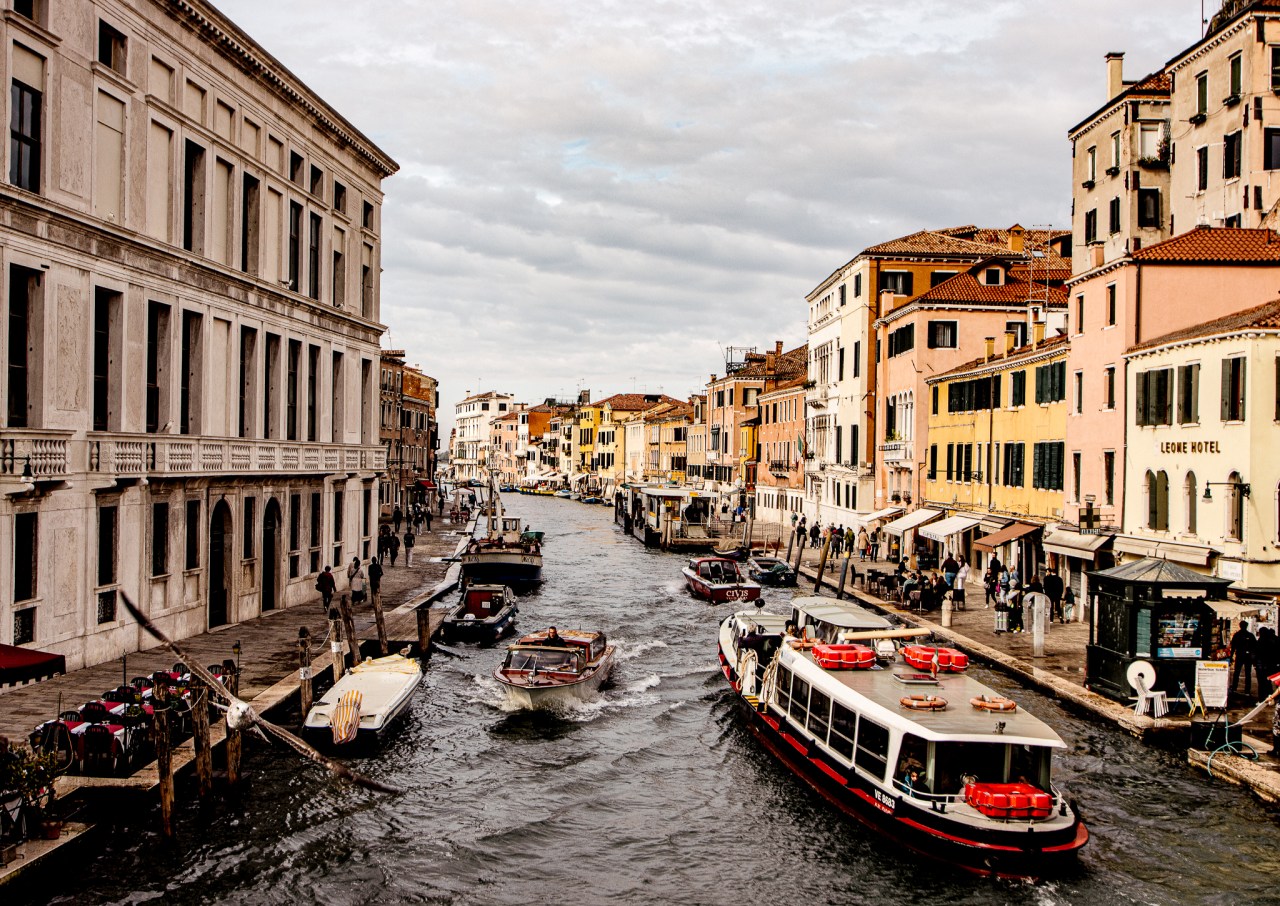
The aircraft is on approach, circling the regal city known as “La Dominante.” Forehead leaning against the window I look down and easily pick out the features. There’s the Grand Canal, busy with water traffic; vaporettos, working boats, and pleasure craft. I can even see the gondolas, little water bugs bobbing on canals big and small. Over there is Piazza San Marco and across the water the distinctive Basilica di Santa Maria della Salute.
Venetzia.
As the plane circles, my view becomes blurred by tears. My heart, the heart that has always rested in the warm Tuscan soil, is happy. The ancient voices of the Caesars speak to me. Il Tevere, (the Tiber River) courses through my veins. The delicious aromas of i mercati di Roma kiss the air I breathe. Looking down I realize that the pull I’ve always felt is stronger than I could’ve known; an irresistible connection. Even though I’ve never spent more than a month in Italy at one time, this feels like my homecoming.
I was nurtured in the Italian way by my mother, an Italian war bride, and her mother, my Nonna Maria. They molded our family culture and founded our traditions. My ties to Italy have tightened, as the country of my birth, the place where I’ve spent all of my life has turned into an angry place, a dis-United States that has pivoted from the place I’ve known, loved, and been proud of, into a burgeoning autocracy, ruined by a cheap carny turned president who, with the help of his acolytes, has ripped away the decency of the office, torn down national traditions, and disdained the Constitution. Now I turn to bella Italia for solace.
The plane completes its lethargic arc and straightens its approach. As we lose altitude I watch the highway of boats, the vaporettos and swift water taxis maneuvering between an aquatic highway delineated by strips of buoys. The water, even from high above, appears choppy and I worry about how Cora, a non-swimmer, suspicious of boats, will fare.
***
Close to touchdown, water looms. It isn’t unlike landing at SFO, where you get the unnerving feeling that the plane will splash down rather than touch down. Old timers like me know the drill at SFO. Just a moment after you see the strip of airport hotels on the San Mateo Peninsula to the west, you look down and there’s land.
Of course old locals like me can remember back to 1968, when a JAL DC-8 ditched into the fog bound bay near Coyote Point, two and a half miles short of the runway. There were no casualties except for the egos of the pilot and the copilot, and the jangled nerves of passengers, but had the plane landed a short distance further from the runway it would have exploded into a public park.
***
Suddenly the calming sight of the broad white threshold markings of the runway. Thud; the rear landing gear. Another lighter thud; front gear. The whooshing of the thrust reversers converting megajoules of kinetic energy as the hurtling plane slows down. Jolt of deceleration. The click of a hundred seat belt buckles being undone before the pilot has turned off the seat belt sign.
It’s a quick trip through the airport, thanks in large part to Schengen, that wonderful agreement between the EU nations which has largely abolished controls at mutual borders. We’d passed through customs at our European port of entry six days earlier at Amsterdam. The process was quicker and certainly less gruff than I’ve experienced at U.S. Customs. The agent asked us where we were bound and I told him Prague and then Italy.
“Why Prague?”
“I’ve heard it’s magnificent.” A much more satisfactory answer than, “That’s where my connection for unloading the ten kilos of cocaine in my suitcase is located.” It’s a policy of mine not to give snappy answers to people who wield sharp instruments, such as dentists and doctors, and those who can stash you away for years in the stony lonesome.
While Cora waits with our luggage I ask the woman at the information desk where I can catch a bus to get to Piazzale Roma. We’ve booked an apartment through VRBO and the landlady’s assistant, Lucia, has instructed us to get to Piazzale Roma and then catch a vaporetto, Venice’s aquatic bus.
The info lady skips over my question. “Where is it you want to go?”
“Rialto.”
“Why do you want to take the bus? Take the Alilaguna Orange Line directly to Rialto. It’s faster. The bus can take over an hour just to arrive and board.”
She gives me instructions to the Alilaguna pier and we take off on the forced march. A forced march is de rigueur at any major airport.
The pier is packed and busy. Water taxis and the big Alilaguna boats constantly coming and going, churning the waters near the pier. The ticket machines are straightforward and after getting our tickets we fall into the queue for the Orange Line.
***
The line moves quickly and just as we’re about to board, the gatekeeper, a guy named Tony, stops us. We’re first in line for the next one that arrives in fifteen minutes.
Tony (I imagine his full name is Antonio) is a chatty guy. He and I talk alternately in Italian and English about all kinds of things. His English is better than my Italian. At least he compliments me on my accent and asks me where it came from. I tell him the story of my mother. He asks me where we’re going after Venice and I tell him Bergamo and Rome. “Why Bergamo?” he asks.
“Why not?”
“Go to Milan.” I tell him that we have tickets to go watch Inter Milan play calcio (soccer).
Tony asks me why we went to Prague. People are asking why Prague and at this point, I’m wanting to ask back, “What in the fuck is wrong with Prague?” but I stick with “It’s a beautiful city with lots to see.”
He asks where we’re from. “San Francisco.”
“I’ve always wanted to go to San Francisco,” he says. He tells us he has a relative in San Francisco. Everybody tells us they have a relative in San Francisco. They must be under counting the population there.
We go back and forth in Italian a bit and then Tony asks me if I know “vaffanculo” and I tell him that everybody knows that. At least anybody who’s seen any one of a number of mob movies. Cora asks me what “vaffanculo” means and I tell her, “Go fuck yourself,” and she punches me in the shoulder and Tony laughs.
I can tell that Cora is nervous about getting on the boat. The water looks very choppy here. The boat arrives and we board, put our luggage in the luggage area and take seats under the overhang. Once we get underway, the water smooths out. Water taxis speed past our clunky boat. We could’ve taken one and arrived at the Rialto much sooner but they’re spendy and Cora wouldn’t be down with riding on the smaller, quicker boats.
It doesn’t take long for Cora to get over her anxiety, particularly when she can see a lifelong dream getting closer by the minute. I’ve been to Venice twice and seen much of what there is to be seen. This is her first time and my thrill will be to watch her own thrill.
I’ve phoned Lucia on What’s App and told her we’ve boarded the Orange Line boat. She apologizes to me for trying to send us on a bus trip instead of the Alilaguna and instructs me to call her when we’ve arrived at Rialto.
***
It’s mid-afternoon and the Rialto, one of Venice’s major tourist attractions, is packed. The confused passengers just dumped from the boat and trying to catch an elusive bearing or two, add to the frenzy. Riva del Ferro, the lane that fronts the Grand Canal is a riotous, boiling brew of activity. Men push heavy stacked carts through the ant farm throng of tourists, many of whom are looking at just about anywhere but where they’re walking. They’re focused on cell phones, tourist brochures, store windows, the panorama around them or just trying to figure out where in the hell they are. That latter can be something of a challenge in La Dominante.
Just up the lane at a gondola pier the cocky boatmen, heads thrust back, chins jutting out proudly, watch the serpentine mass passing by, waiting patiently for the next fare. Here at Rialto the gondoliers don’t have to make their appeals. Oftentimes, there’s a queue of out of towners waiting to have that singular Venetian experience.
Just a hundred meters or so up the lane is the famed 16th century Rialto Bridge. In the shadow of the bridge there is a dock for the working boats. In Venice deliveries are made by boat and then the cargo is loaded onto carts and hauled to their final destinations by hardy, muscular deliverymen.
***
Off the boat and we tuck ourselves into a little corner, out of the continuous tide of foot traffic, so I can call Lucia. She shows up in a few minutes and leads us over a bridge to Ramo dei Bombaseri where we turn right. That bridge is a major pain as we’re forced to haul our luggage up and over. This bridge, like many, is a steep climb. It’s an unnecessary bridge as a quick detour onto Sottoportego della Cerva would have us at the little piazza near our apartment without the need to pass over the bridge. It was – a bridge too far. I suppose that Lucia wanted us to be able to catch a close up view of the Rialto Bridge as Bombaseri runs right into the famous arch.
Once at our building, Lucia explains the three keys we need to get in; one for the heavy front gate, one to the second floor lobby and the third to our apartment. The apartment is a cozy little studio with windows that overlook a little canal called Rio della Fava. This is a view that will captivate me the entire time. Opening the window lets in the sounds of the little waterway; the movement of the water, the sloshing of a gondolier’s oar and the subdued happy chatter of enchanted tourists on a gondola ride. It all echoes quietly off the tight walls that border the tiny canal. My smug, ‘I’ve seen Venice before,’ disappears. It doesn’t matter how many times you’ve seen Venice, its allure never diminishes. Looking out that window, I’m enamored.
Once inside the apartment, Lucia launches into an explanation of all of the features of the apartment along with some of the restaurants and stores nearby. I only half listen because I’m certain that, like all VRBO properties we’ve stayed at, there will be a comprehensive manual. Turns out I’m wrong. There is no comprehensive manual. That will be a problem in the days to come. There’s also not much in the way of basic provisions. You know, like olive oil, basic condiments and, oh yeah, enough toilet paper to get past a couple days.
I want desperately to take Cora on a gondola ride. Now! Fuck unpacking and a little relaxation or going to the store. Her common sense prevails and after unpacking, we make a list and strike out for Supermercato Despar.
This is where I discover that one of the most common sounds in Venice, outside of the tourist clamor and the motors of working boats and water taxis, is the tone that Google Maps makes when it’s saying, ‘I don’t know where in the fuck I am, or where we’re going. Dude, you are on your own.’
A sight that’s as common as the ubiquitous souvenir Venetian carnival mask is the tourist looking down in bewilderment at an equally bewildered cell phone, and then looking up and around, head swiveling like a periscope, looking for some identifying sign or landmark.
I suppose it’s the fact that service can be spotty in a 2000 year old labyrinth of a city, a honeycomb of narrow lanes and waterways enveloped by ancient buildings. Damn those original architects for not anticipating GPS. Galileo didn’t figure that out? Guy was overrated.
It will take me a day of tracking and then backtracking multiple times like a tin duck at the carnival shooting gallery to give up on Google and GPS and turn to the old fashioned tourist map. I also quickly recall from previous trips, the arrowed signs painted on buildings at the intersections of lanes and piazzas. They’re the trusty little breadcrumbs that point towards major areas in the city; Per Rialto, Per S. Marco, All’ Academia.
But on this first afternoon we wander about like the undead, looking in vain for the damned supermarket. Just as we’re about to decide on restaurants for the duration, and rationing toilet paper, Cora looks up, “There it is.”
Supermercato Despar is not quite as super as the Safeway back home but what it lacks in size it makes up for in quality. We grab necessities and then head for wishes. Cora wants fruits and veggies and I want salamis, cheese and bread. There’s a wide selection of un-prepackaged breads and I choose a loaf and put it in one of the paper bags at the display. Meanwhile, Cora is grabbing her healthy foods.
At the checkout the woman scans our purchases until she gets to one of the fruits, “Deve pesarlo,” she tells us. Oops. I get ready to step out and go weigh the purchases but she puts up a hand to pause me and says kindly, “Va bene, lo faccio.” She grabs the greens, the fruit and the loaf of bread and leaves the checkout stand.
The protocol is to use the digital scale located near the product, weigh it and then tag it with the small receipt that the scale spits out. It’s an honor system. What stops someone from weighing three pears, taking the receipt and then adding another couple pears? Well, honesty.
The checker returns, smiles and rings up our purchase. Clearly this is an oft repeated routine for her. Supermercato Despar at Rialto is smack in the middle of tourist central and most of the clientele is from out of town, out of country, out of continent.
And that’s one of Venice’s tragedies. It’s a tragedy that Cora and I are partly, and unknowingly responsible for. Cora and I are two of the thousands upon thousands of tourists who are overwhelming the city.
An article published in The Guardian just around the time of our visit reports that for the first time ever the number of tourist beds, 49,693, has surpassed the number of residents, 49,304. Since the early 1950’s Venice has bled more than 150,000 residents. Twenty million tourists per year and as many as 120,000 on a single busy day can’t help but to strain the infrastructure.
Apart from the numbers issue, too many tourists are rude, treat the residents like lackeys, and disrespect the community, the historic buildings and monuments, and local traditions. They litter, they get drunk and obnoxious, they picnic on bridges, and they swing selfie sticks like fly swatters.
Jobs outside of those related to tourism are relatively few and continue to shrink. The character of the city itself has undergone changes as businesses such as bars, restaurants and shopping opportunities become geared more to tourist tastes than to the needs of the locals.
Tourism has also brought about gentrification and soaring housing costs. Much of the available housing has been converted to vacation rentals or hostels and B&Bs. Another Guardian article tells of Simonetta Boni, a lifelong resident of Venice who lost her home when her landlord raised her rent from €800 per month to €1,500.
It took years, but Venice finally banned mountainous cruise ships away from central Venice. No longer will the eyesore behemoths ply the Giudecca Canal, spoiling the beautiful views. There was a time when the giant ships would cruise past Piazza San Marco, annihilating the panorama, displacing tons of water that sloshed onto the shore and threatened to compromise the foundations.
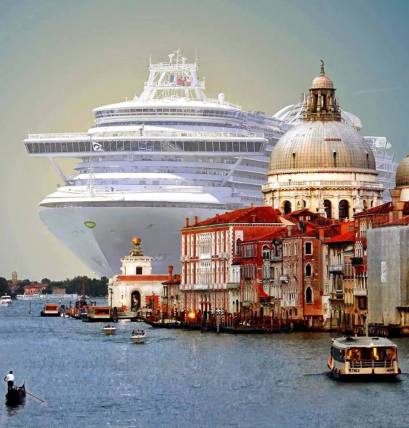
The bad old days. A cruise liner overwhelms Venice
(To my way of thinking, the world would be better if every cruise ship was docked and then dismantled for scrap. These ugly peaks spoil the views in ports of call, and are notorious polluters, creating as much as 210,000 US gallons of sewage and 130 US gallons of hazardous waste in a week.)
Does all of this mean that tourism to Venice should cease? Of course not. The nation, the city and local activists have been working to minimize the effects of over tourism.
Should tourists find other places to go? Of course not. Tourists might have to put up with what they might view as inconveniences. The cruisers will have to disembark farther from the center of the city. Day trippers will have to pay a tourist fee of €5. Most importantly, visitors to Venice can play a large part in keeping Venice livable by being respectful of the residents and the city and acting like decent human beings.
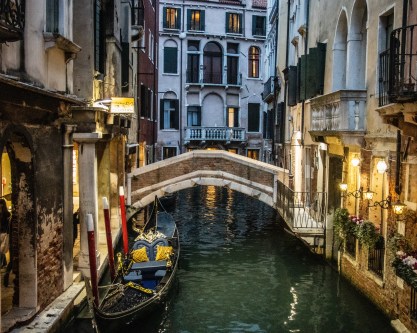
Evening serenity.

 The Life in My Years
I’m sure you work hard crafting your narratives, but I also think you must be a born story teller.
LikeLike
Hi David, Funny thing about this piece is that I struggled for the longest time and then one morning I got up and was able to knock it out. Not that it didn’t present challenges but one day it just seemed to get clarity.
Thank you for reading and commenting.
Paul
LikeLike
I know what you mean. In high school, and especially college, I had to write a lot of papers. One day it was word constipation and the next day it might be … well, the opposite.
LikeLike
❤️❤️❤️😊
LikeLike
Thank you Jane.
LikeLike
Another wonderful read.
Thanks for continuing to write.
LikeLike
Apologies for the late response. WP sent your comment to spam and I just found it. Thank you so much for the kind words.
Paul
LikeLike
No problem, Paul. WP works in mysterious ways…
LikeLike
Paul, you can write about hell, and I’d want to visit.
How gorgeous is your description? And written with humour as well.
As you know, I plan to go, and your article is both timely and informative.
Thank you!
e
LikeLike
Hello Eden, I hear the temperature in hell varies. If you’re from the warmer climes then hell is colder than a well diggers ass. If you’re from the colder climes the hell is hotter than, uh, hell. It’s probably full of MAGAts there too.
Thank you so much for reading and commenting. Remember to go straight to the tourist map when in Venice.
Paul
LikeLike
You capture the beauty and also the challenges of Venice so well. It was the first foreign trip I took with my now-husband, then-boyfriend, way back in 1979! He’d been before, I hadn’t, and we both loved it. We’ve talked often about going back but I’m nervous about spoiling those good memories, especially when I read about the crowds that descend on it now. Maybe an off-season visit will be the answer, especially once the new restrictions are in place. If we do I may ask for the details of that apartment – but take some toilet paper!
LikeLike
Hello Sarah, We were on the cusp of off season; end of October. I don’t think you can ever get away from the crowds there. If you go make reservations in advance for the main attractions. Our apartment was overall quite nice. It was about 3 minutes to Rialto but located at the end of a quiet sottoportegio. I you want a bit more solitude you might want to try looking for a place around the Jewish Ghetto in the Cannaregio District. We went there one afternoon and it was very peaceful.
LikeLike
Oh you lucky people! looking forward to more from you about Venice …
LikeLike
Hello Alison,
I do consider ourselves very fortunate to be able to travel. Thank you for reading and commenting.
Paul
LikeLike